
Classification of Population Theories
How Many Categories Can Population Theories Be Classified Into?
The study of population has a long and fascinating history. Since ancient times, scholars and philosophers have expressed valuable ideas regarding the size, growth, distribution, and characteristics of human populations. Among the early contributors were Confucius, Plato, Aristotle, Giovanni Botero, and Ibn Khaldun. In the modern period, important contributions were made by John Graunt and William Godwin.
A landmark contribution was made by John Graunt in 1662 through his work “Natural and Political Observations Made upon the Bills of Mortality,” in which he presented one of the earliest scientific analyses of population characteristics and demographic trends.
Although the history of population thought is very old, the development of modern population theory largely revolves around the ideas of Thomas Robert Malthus. Consequently, population theories are commonly classified into four broad categories with Malthus as the central reference point:
- Pre-Malthusian Population Thought
- Malthusian Population Theory
- Post-Malthusian Population Theory
- Modern Demographic or Neo-Malthusian Theory
What Were the Characteristics of Pre-Malthusian Population Thought?
Pre-Malthusian population thought dates back to ancient times and includes the demographic ideas of Chinese, Greek, Roman, and medieval scholars.
Ancient Chinese Population Thought
The Chinese philosopher Confucius believed that excessive population growth reduces per capita production and disrupts social stability. According to him, a balance between population size and available resources was necessary for maintaining social harmony and economic well-being.
Greek Population Thought
Among the Greek thinkers, Plato and Aristotle were the most influential contributors to demographic thought. They argued that a prosperous and orderly society required an optimum population size that could be supported by available resources.
Their discussions mainly focused on population control. To regulate population growth, they suggested measures such as restricting polygamy, regulating childbirth, establishing colonies, and encouraging migration. At the same time, they also proposed incentives for population growth when necessary, including rewards for larger families and social discouragement of celibacy.
Roman Population Thought
Roman thinkers placed considerable emphasis on population regulation. Pliny supported emigration until a stable and balanced population level could be achieved. Roman demographic thought generally emphasized maintaining equilibrium between population size and available resources.
Medieval Western Population Thought
Two important medieval scholars were Ibn Khaldun and Giovanni Botero. In his work “Universal History,” Ibn Khaldun explained the cyclical nature of population change and its relationship with the rise and decline of civilizations. Giovanni Botero emphasized the relationship between population size and high birth rates and examined how demographic growth influenced economic and political power.
Mercantilist and Classical Economic Views
Mercantilist thinkers generally viewed population growth positively. Guillaume Budé expressed this idea in the famous statement: “The King’s glory is in the multitude of the people.” A large population was considered a source of national strength and prosperity.
The classical economist Adam Smith further supported population growth in his famous 1776 work “An Inquiry into the Nature and Causes of the Wealth of Nations.” According to Smith, population growth expands markets for goods and services while also facilitating greater specialization and division of labour, thereby contributing to economic development.
These early ideas and debates laid the intellectual foundation for the emergence of modern population theories, culminating in the influential work of Thomas Robert Malthus at the end of the eighteenth century.
When Did Thomas Robert Malthus Present His Population Theory?
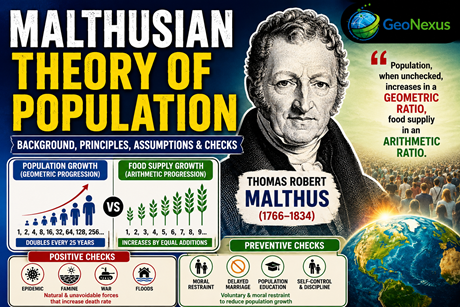
Thomas Robert Malthus was an English economist and clergyman who is widely regarded as one of the founders of modern population studies. In 1798, he published the first edition of his famous work “An Essay on the Principle of Population,” in which he examined the relationship between population growth and food production.
This work became known as the Malthusian Theory of Population. The theory is also referred to by several other names, including:
- Population Pessimism Theory
- Malthusian Law of Population
- Natural and Social Theory of Population
Following the popularity of the first edition, Malthus published a substantially revised second edition in 1803. The sixth and final edition published during his lifetime appeared in 1826. In 1830, he published a shorter version entitled “A Summary View of the Principle of Population,” which responded to criticisms of his earlier work.
Although later scholars revised and reinterpreted many of Malthus’s ideas, his theory remains one of the most influential and widely discussed theories in the history of population studies.
Background of the Malthusian Theory of Population
The Malthusian Theory of Population emerged from Thomas Robert Malthus’s observations of the prevailing social and economic conditions of his time. In 1793, William Godwin, in his famous work “An Enquiry Concerning Political Justice and Its Influence on Morals and Happiness,” welcomed the contemporary British government’s policy regarding population growth and argued that increasing population would not cause any harm and might even bring economic benefits. Malthus strongly disagreed with this optimistic view and developed his own theory of population as a response.
During the late eighteenth century, England became involved in a series of wars with other countries. As a result, food prices rose sharply, while poverty, famine, and unemployment increased throughout society. At the same time, the government encouraged population growth in order to strengthen military power and support the war effort. Little attention was given to population control, leading to increasing pressure on the economy and the production system. Society gradually became divided into two distinct classes—the rich and the poor. Malthus believed that government policies were indirectly encouraging excessive population growth. Contemporary writers also expressed concern regarding the rapid increase in population. Matthew Hale, in his work on the origin of humanity, warned that population was growing faster than mortality and that, unless controlled, the situation would become increasingly severe. It was against this background of social and economic distress that Malthus formulated his theory in 1798 by establishing a relationship between population growth and food production.
What Are the Assumptions and Main Propositions of Malthus’s Population Theory?
Malthus explained his theory on the basis of several fundamental assumptions. These assumptions are as follows:
- Food is essential for human survival.
- The attraction between men and women is natural, necessary, and permanent.
- The availability of food plays a crucial role in regulating population growth.
- The Law of Diminishing Returns operates in agriculture.
- The total amount of cultivable land and its productive capacity remain fixed.
- Agricultural production is subject to diminishing returns.
- Agriculture is the principal source of production.
- The level of production technology remains constant.
- Population growth is controlled through preventive checks and positive checks.
- There is a direct relationship between childbearing and standards of living.
Main Proposition of the Theory
Malthus based his theory on two fundamental principles:
- Population, if left unchecked, increases in a geometrical progression (Geometrical Progression).
- Food supply increases only in an arithmetical progression (Arithmetical Progression).
According to Malthus, population has a natural tendency to grow at a geometric rate, such as:
1, 2, 4, 8, 16, 32, 64, 128, 256 …
In contrast, food production can increase only at an arithmetic rate, such as:
1, 2, 3, 4, 5, 6, 7, 8, 9 …
As time passes, the gap between population growth and food supply becomes increasingly wider, leading to an imbalance between the number of people and the available means of subsistence.
Malthus estimated that after two centuries the ratio between population and food supply would become 256 : 9, and after three centuries it would increase to 4096 : 13. Such a situation would inevitably lead to food shortages, poverty, famine, and other social problems.
According to Malthus, the population of his time doubled approximately every 25 years. Using a 25-year interval as the unit of measurement, he illustrated the relationship between population growth and food production as follows:
| Years | 0 | 25 | 50 | 75 | 100 | 125 | 150 | 175 | 200 |
|---|---|---|---|---|---|---|---|---|---|
| Population Growth | 1 | 2 | 4 | 8 | 16 | 32 | 64 | 128 | 256 |
| Food Supply Growth | 1 | 2 | 3 | 4 | 5 | 6 | 7 | 8 | 9 |
This table demonstrates Malthus’s central argument that population tends to grow much more rapidly than food production. Consequently, unless population growth is checked, society will eventually face severe shortages of food and resources.
Explanation of Malthus’s Population Theory
Malthus developed his population theory by establishing a relationship between population growth and food production. According to him, the tendency of population to increase is much stronger than the capacity of the Earth to produce food. The major components of his theory are discussed below.
i) Geometrical Progression of Population Growth
Malthus believed that the natural attraction between men and women and the biological urge for reproduction lead to a continuous increase in population. According to him, if population growth remains unchecked, the population of a country will increase in a geometrical progression or geometric ratio.
He estimated that under normal conditions, population would double every 25 years. Thus, population would increase in the sequence:
1 : 2 : 4 : 8 : 16 : 32 : 64 : 128 : 256 …
If this trend continues without any restraint, the population would increase 256 times within 200 years and 4,096 times within 300 years. Therefore, Malthus argued that population possesses an inherent tendency to grow very rapidly.
ii) Arithmetic Progression of Food Supply
According to Malthus, the supply of food does not increase at the same rate as population. Since agricultural production is constrained by the availability of land and the operation of the Law of Diminishing Returns, food production can only increase in an arithmetical progression.
The growth of food supply follows the sequence:
1 : 2 : 3 : 4 : 5 : 6 : 7 : 8 : 9 …
Thus, while population multiplies rapidly, food production increases only by equal additions over time.
iii) Imbalance Between Population and Food Supply
Malthus argued that because population increases geometrically while food production increases arithmetically, a situation eventually arises in which population growth outstrips the available food supply. As a result, an imbalance develops between the number of people and the means of subsistence.
This imbalance gives rise to various social and economic problems such as poverty, unemployment, hunger, food shortages, malnutrition, and famine. According to Malthus, these problems are the inevitable consequences of unchecked population growth.
What Are Malthus’s Checks on Population Growth?
Malthus recognized that if population continued to grow unchecked, society would eventually face severe shortages of food and resources. Therefore, he suggested that certain mechanisms, known as checks, operate to restore the balance between population and food supply. These checks are broadly classified into two categories.
i) Positive Checks
Positive checks are natural and unavoidable forces that increase the death rate and thereby reduce population growth. According to Malthus, whenever population exceeds the available food supply, nature intervenes through various calamities to restore equilibrium.
Examples of positive checks include:
- Famine
- Epidemics and pandemics
- Wars
- Floods
- Droughts
- Earthquakes
- Volcanic eruptions
- Other natural disasters
These events reduce population by increasing mortality. However, Malthus acknowledged that their effects are often temporary because population may begin to grow rapidly again once conditions improve.
ii) Preventive Checks
In the later and revised editions of his theory, Malthus placed greater emphasis on preventive checks, which are voluntary measures adopted by individuals to limit population growth.
He regarded excessive population growth as a social problem and argued that moral restraint was the most effective means of population control. According to Malthus, individuals could reduce population growth through:
- Self-discipline and self-control
- Celibacy
- Delayed marriage
- Avoidance of irresponsible sexual behaviour
- Family planning and population education
Malthus believed that people should exercise moral responsibility before marriage and childbearing. It is important to note that Malthus was not entirely opposed to population control; rather, he objected to what he considered unnatural or artificial methods of birth control. His primary emphasis was on moral restraint as the most desirable preventive measure.
Thus, through the operation of positive and preventive checks, Malthus argued that a balance could be maintained between population growth and food supply.
