
Introduction
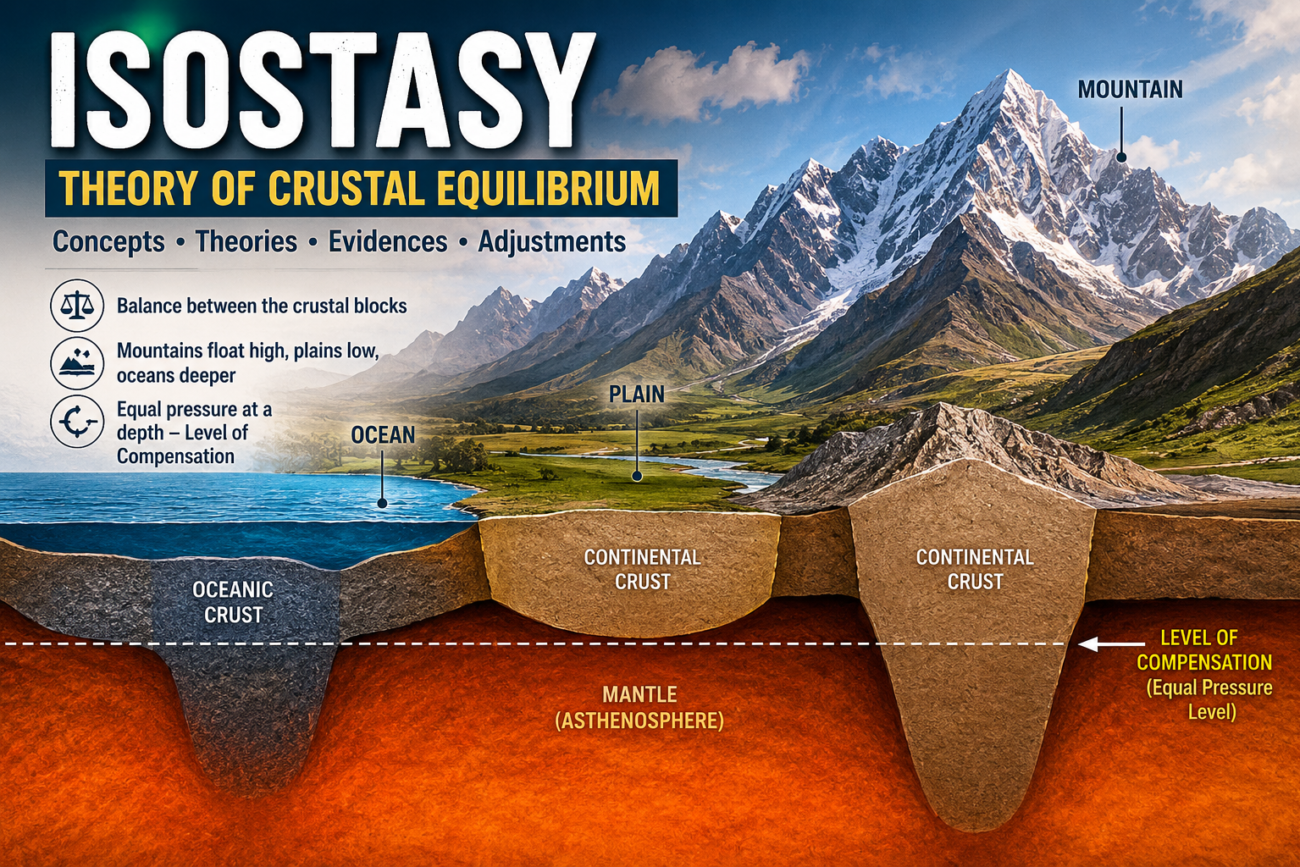
Isostasy is one of the fundamental concepts of Geomorphology and Geophysics. The Earth’s surface is highly uneven and consists of mountains, plateaus, plains, valleys, and ocean basins. Despite such variations in elevation, these landforms remain balanced upon the Earth’s interior. This balanced condition of the Earth’s crust is known as Isostasy.
The term “Isostasy” was first used by the American geologist Clarence Edward Dutton in 1889. The word is derived from two Greek words:
- Isos meaning equal
- Statis meaning standing or state
Therefore, Isostasy means a “state of equal balance” or “state of equilibrium”.
Dutton explained the concept in detail during a lecture delivered before the Philosophical Society of Washington on 27 April 1889. Later, the concept was formally published in his famous work “On Some of the Greater Problems of Physical Geology”. Since then, Isostasy has become one of the most important theories explaining crustal equilibrium.
In simple terms, Isostasy refers to the balanced arrangement of the Earth’s crust where mountains, plateaus, plains, and ocean basins remain in equilibrium upon the denser mantle beneath them.
Characteristics of Isostasy
The main characteristics of Isostasy are closely related to the structure and equilibrium of the Earth’s crust. The lighter continental crust or SIAL floats over the denser SIMA layer of the mantle. Different landforms such as mountains, plateaus, and plains maintain equilibrium despite differences in elevation. Regions with greater height generally extend deeper into the Earth’s interior, while lower regions possess shallower roots. This equilibrium is maintained along a certain depth known as the Level of Compensation. Isostasy also controls crustal upliftment, subsidence, and adjustment processes over geological time.
Historical Development of Isostatic Concepts
The concept of Isostasy gradually developed through the contributions of several scientists and geologists. Different scientists proposed different theories to explain how crustal blocks maintain balance.
The major contributors include:
- Airy (1855)
- Pratt (1859)
- Heiskanen
- Hayford and Bowie (1917)
- John Jolly (1925)
- Daly (1927)
- Holmes
Among them, Airy and Pratt provided the two most influential classical theories of Isostasy.
Airy’s Theory of Isostasy
British mathematician and astronomer Sir George Biddell Airy proposed his theory of Isostasy in 1855 in his famous paper:
“On the Computations of the Effect of the Attraction of the Mountain Masses as Disturbing the Apparent Astronomical Latitude of Stations in Geodetic Surveys.”
Airy based his theory mainly on:
- Pascal’s Law,
- Archimedes’ Principle of Buoyancy,
- and the Law of Floatation.
According to Pascal’s Law, hydrostatic pressure remains equal at the same depth within a liquid. Archimedes’ Principle states that a body immersed in a fluid experiences an upward buoyant force equal to the weight of the displaced fluid. Airy applied these principles to explain the balance of the Earth’s crust.
Airy’s theory is based on the principle of:
“Uniform Density with Varying Thickness”
According to him, all crustal landforms possess nearly equal density, but differ in thickness. Mountains are thicker and extend deeper downward into the mantle, whereas plains possess comparatively shallow roots.
He explained this concept through the example of an iceberg. Just as a small portion of an iceberg remains above water while a much larger portion remains submerged, mountains also possess deep underground roots beneath the Earth’s surface. According to the floating ratio proposed by Airy, approximately one part remains above the surface while nine parts remain submerged.
Thus:
- higher mountains possess deeper roots,
- and lower plains possess shallow roots.
Because of this idea, Airy’s theory is also called the:
“Root Hypothesis”
Airy further stated that the continental crust or SIAL is composed of lighter rocks with an average density of about 2.7 gm/cm³, while the oceanic crust or SIMA is denser with an average density of about 3.0 gm/cm³.
Airy’s Experimental Explanation
Airy attempted to explain Isostasy through a simple experimental model. He placed several iron rods of equal density but different lengths into a container filled with mercury.
He observed that:
- the longer rods submerged deeper,
- while shorter rods remained submerged at shallower depths.
From this experiment, he concluded that:
- the greater the height of a landform,
- the deeper it extends into the Earth’s interior in order to maintain equilibrium.
Therefore, mountains, plateaus, and plains remain balanced according to the law of floatation.
Criticism of Airy’s Theory
Although Airy’s theory became highly influential, several criticisms were raised against it.
Firstly, Airy assumed that all crustal blocks possess equal density. However, in reality, rock density varies according to mineral composition and geological structure.
Secondly, he ignored the increase of temperature and pressure with depth. Normally, temperature increases by approximately 1°C for every 32 meters of depth. Therefore, extremely deep mountain roots may not remain solid because rocks could partially melt at such depths.
Thirdly, according to Airy’s floating ratio, the Himalayas would require extremely deep roots extending tens of kilometers downward, which appears unrealistic.
Another criticism is that lighter continental crust cannot penetrate too deeply into denser mantle material.
Finally, Airy’s theory cannot adequately explain all geological structures and crustal variations across the Earth.
Despite these criticisms, Airy’s theory remains one of the most important explanations of crustal equilibrium.
Pratt’s Theory of Isostasy
British scientist Archdeacon John Henry Pratt proposed another important theory of Isostasy in 1859. He rejected Airy’s idea of varying crustal thickness and instead proposed the concept of density variation.
Pratt explained his ideas in the paper:
“On the Deflection of the Plumb-line in India, Caused by the Attraction of the Himalaya Mountains and of the Elevated Regions Beyond, and its Modification by the Compensating Effect of a Deficiency of Matter Below the Mountain Mass.”
His theory was based largely on geodetic surveys conducted in India, especially between Kaliana in the Shiwalik Himalayas and Kalianpur in the Malwa region.
Pratt’s theory is based on the principle of:
“Varying Density with Uniform Depth”
According to Pratt:
- crustal blocks possess equal depth,
- but differ in density.
He believed that:
- mountains possess lower density,
- plateaus possess moderate density,
- plains possess greater density,
- and ocean basins possess the highest density.
Thus, there exists an inverse relationship between:
- height,
- and density.
According to Pratt:
- lower density regions stand higher,
- while denser regions remain at lower elevations.
Pratt also introduced the concept of the:
“Line of Compensation”
According to him, above this line density varies among crustal blocks, but below it density remains uniform. All crustal blocks exert nearly equal pressure on this compensation level despite differences in elevation.
Pratt further showed that the average density of mountains is approximately 2.75 gm/cm³ and density gradually increases toward plains and ocean basins.
Heiskanen’s Concept of Isostasy
Finnish geodesist W. A. Heiskanen modified Airy’s theory and presented his concept in 1933.
According to Heiskanen, the simple iceberg analogy used by Airy could not completely explain Isostasy. He introduced the concept of:
“Local Compensation Level”
According to him, hydrostatic equilibrium is maintained along this compensation level.
Heiskanen explained that the pressure exerted on the compensation level depends upon:
- the height of the landform,
- and the density of materials above it.
Unlike Airy, Heiskanen emphasized that density changes both horizontally and vertically within the Earth’s crust. He explained that rock density gradually increases downward with depth. For example:
- upper crustal density may be about 2.70 gm/cm³,
- while density near sea level may increase to about 2.76 gm/cm³.
According to Heiskanen:
- landforms with lower density stand at greater heights,
- while denser landforms remain at lower elevations.
Thus, Heiskanen’s theory combines both:
- density variation,
- and thickness variation
in explaining Isostasy.
John Jolly’s Theory
Irish geophysicist John Jolly criticized the theories of Hayford and Bowie and supported Airy’s ideas in his book “The Surface History of the Earth” published in 1925.
Jolly argued that the compensation level cannot exist at very great depths because of extremely high temperatures within the Earth.
According to him, beneath the Earth’s outer shell there exists a layer about 10 miles or 16 km thick within which density variation occurs.
Therefore, he rejected the concept of a narrow compensation line and proposed the idea of a:
“Zone of Compensation”
According to Jolly:
- compensation is regional,
- not confined to a single line.
This compensation zone is approximately 16 km thick.
Although Jolly did not directly mention the Law of Floatation, his theory indirectly supports Airy’s concept that lighter crustal blocks float over denser underlying materials.
Daly’s Anti-Root Hypothesis
Canadian geologist Reginald Aldworth Daly proposed the famous:
“Anti-Root Hypothesis”
in his book “Our Mobile Earth” published in 1927.
Daly opposed Airy’s concept of deep mountain roots.
According to Daly:
- the compensation level exists at approximately 77 km depth,
- and mountains are uplifted by buoyant forces from the mantle below.
He argued that because mountain rocks possess lower density, upward buoyant forces from the mantle push mountains upward. In contrast, denser oceanic crust sinks deeper into the mantle.
Therefore:
- mountains do not possess deep roots,
- rather, mantle materials rise upward beneath them.
However, Daly’s theory did not gain much acceptance because it contradicts the normal principles of buoyancy and floatation.
Holmes’ Theory of Isostasy
British geologist Arthur Holmes strongly supported Airy’s ideas.
According to Holmes:
- elevated landforms are composed of lighter materials,
- while denser materials occur beneath them,
- and hydrostatic equilibrium is maintained through floatation.
Holmes identified three major layers:
- Continental SIAL (density 2.7 gm/cm³)
- Oceanic SIMA (density 3.0 gm/cm³)
- Mantle SIMA (density 3.3 gm/cm³)
He also acknowledged the presence of water, sediments, and other surface materials.
Later, in 1978, A. Holmes and D. L. Holmes explained Isostasy through diagrams of crustal columns extending to equal depths beneath the Earth.
They proposed the concept of:
“Level of Equal Pressure”
According to them:
- although crustal columns differ in height,
- each column exerts nearly equal pressure at a specific depth.
Holmes explained Isostasy using four crustal columns:
- a 4 km plateau,
- a 1 km plateau,
- a plain at sea level,
- and a 5 km deep ocean basin.
Although these columns differ in elevation and density, their total mass remains nearly equal.
Evidences of Isostasy
Several natural phenomena support the concept of Isostasy.
In Greenland, the Baltic region, and the Canadian Shield, crustal uplift occurred after the melting of continental glaciers during interglacial periods. Removal of heavy ice load caused the crust to rise upward.
Similarly, sediment deposition in regions such as:
- the Po River Delta of Italy,
- and the Ganga Delta of India
caused crustal subsidence because of increased load.
Evidence from the Ganga Delta includes:
- terrestrial animal bones,
- and wooden fragments
found beneath marine deposits.
Geomorphologist King also provided evidence of land uplift in northeastern Canada caused by isostatic adjustment.
Level of Compensation
The concept of the:
“Level of Compensation”
was first explained by Pratt.
It refers to a depth within the asthenosphere where all crustal blocks exert nearly equal pressure.
According to Dutton, it is the:
“Level of Uniform Pressure”
Jolly later modified this idea into a:
“Zone of Compensation”
Airy believed that mountains and plains possess different compensation levels, whereas Pratt believed all landforms stand upon the same compensation level.
Isostatic Adjustment
When equilibrium of the Earth’s crust is disturbed, natural processes gradually restore balance. This process is known as:
“Isostatic Adjustment”
For example:
- tectonic uplift increases mountain height,
- weathering and erosion remove materials,
- reducing crustal load.
This reduction of load causes crustal uplift.
At the same time:
- eroded sediments accumulate in river valleys and ocean basins,
- increasing load there,
- and causing subsidence.
Thus, equilibrium is gradually restored.
The overall process of isostatic balancing is called:
“Cymotogene”
Isostatic Rebound
Isostatic rebound refers to crustal uplift caused by:
- erosion,
- or melting of glaciers.
During the Pleistocene Ice Age:
- thick ice sheets depressed the crust under enormous weight.
When glaciers melted:
- crustal load decreased,
- causing gradual upliftment.
This phenomenon is clearly observed in:
- Greenland,
- Scandinavia,
- and Canada.
Role of Erosion and Deposition
Erosion and deposition play major roles in Isostatic balance.
Erosion reduces:
- rock thickness,
- and crustal load.
As a result:
- upliftment occurs due to Isostatic adjustment.
On the other hand:
- deposition increases crustal load,
- causing subsidence.
Because of continuous Isostatic uplift, ancient mountain ranges such as:
- the Aravalli,
- the Appalachians,
- and the Urals
still preserve significant elevation despite prolonged erosion.
Gravity Anomaly
The difference between:
- theoretical gravity,
- and observed gravity
is called:
“Gravity Anomaly”
Gravity anomalies may be:
- positive,
- or negative.
Young fold mountains generally show negative gravity anomalies because they are composed of lighter rocks. Ancient shield regions and ocean basins usually show positive anomalies because they are denser.
Pierre Bouguer first demonstrated that gravity anomalies over land are generally negative.
Gravity anomalies occur mainly because:
- crustal equilibrium becomes disturbed,
- or rock density varies.
Free Air Gravity Anomaly
When gravity measurements are corrected only for elevation effects, the result is called:
“Free Air Gravity Anomaly”
Here, density variation is not considered.
Bouguer Gravity Anomaly
When gravity measurements are corrected for:
- elevation,
- instrument height,
- and rock mass,
the result is called:
“Bouguer Gravity Anomaly”
Mountains generally show negative Bouguer anomalies, while ocean basins show positive anomalies.
Isostatic Anomaly
When gravity anomalies are corrected considering rock density differences, the result is called:
“Isostatic Anomaly”
Young fold mountains usually show negative Isostatic anomalies, while shield plateaus and ocean basins show positive anomalies.
Dynamic Explanation of Gravity Anomaly
Scientists later realized that gravity anomalies cannot always be explained by statistical methods alone.
Thus, the concept of:
“Dynamic Explanation of Gravity Anomaly”
was developed.
This explanation allows scientific interpretations to change according to new geological evidence.
For example, negative gravity anomalies in African Rift Valleys were initially explained by crustal subsidence. Later, thick low-density sedimentary deposits were identified as the main cause.
Cymatogeny
Geomorphologist Lester King proposed the concept of:
“Cymatogeny”
It refers to simultaneous:
- mountain uplift,
- and erosion.
As mountains are eroded:
- sediments accumulate in nearby seas,
- causing marine subsidence,
- while mountains become lighter and rise upward due to Isostatic adjustment.
Isostatic Movement
Continuous upliftment and subsidence of crustal blocks caused by equilibrium adjustment is known as:
“Isostatic Movement”
The elevation of landforms depends largely on rock density:
- lower density → greater elevation,
- higher density → lower elevation.
For example:
- the Himalayas possess great elevation because of lower density,
- while the Siberian Plain remains lower because of greater density.
Hypsographic Curve
A:
“Hypsographic Curve”
represents the distribution of Earth’s surface elevations and ocean depths.
It is prepared by plotting:
- area proportion,
- elevation,
- and depth
above and below sea level.
The curve helps explain the major physiographic divisions of the Earth and the relationship between continental and oceanic surfaces.
Conclusion
Isostasy is one of the most important concepts explaining the equilibrium of the Earth’s crust. Mountains, plateaus, plains, and ocean basins maintain balance through differences in density, thickness, upliftment, and subsidence.
The theories proposed by:
- Airy,
- Pratt,
- Heiskanen,
- Jolly,
- Daly,
- and Holmes
collectively improved our understanding of crustal equilibrium and geological adjustment.
Modern geological studies show that Isostasy plays an important role in:
- mountain building,
- glacial rebound,
- crustal uplift,
- gravity anomalies,
- erosion and deposition,
- and long-term landscape evolution.
Thus, Isostasy remains one of the fundamental concepts of Geomorphology, Geophysics, and Earth System Science.
