
Population Theories: Sadler, Doubleday, and Dumont
Introduction
The Malthusian Theory of Population generated widespread debate among economists, sociologists, and demographers during the nineteenth century. Several scholars criticized Malthus’s pessimistic view that population growth inevitably outpaces food production. Among the most notable critics were Michael Thomas Sadler, Thomas Doubleday, and Arsène Dumont, who proposed alternative explanations of population growth based on social, economic, cultural, and biological factors. Their theories collectively provide important insights into the relationship between population growth, living standards, food supply, and social development.
Michael Thomas Sadler’s Population Theory (Population Density and Fecundity Principle)
Background
As a direct response to Malthus’s population theory, the British social reformer and economist Michael Thomas Sadler proposed the Population Density and Fecundity Principle in his 1830 book “The Law of Population.” Sadler emphasized social welfare and argued that population growth is naturally regulated rather than controlled by food shortages or famine.
Main Propositions
According to Sadler, there is an inverse relationship between population density and reproductive capacity. The principal arguments of his theory are:
- As population density increases, the fertility and reproductive capacity of the population decrease.
- Population growth declines as the standard of living improves.
- Population is regulated by natural laws, and fertility tends to decline automatically as population becomes denser.
- Improvements in education, culture, social awareness, comfort, and living standards contribute to lower birth rates and a more controlled rate of population growth.
Sadler therefore rejected Malthus’s claim that food scarcity is the primary regulator of population growth and instead emphasized the role of social development and living conditions.
Thomas Doubleday’s Diet Theory
Background
The British economist Thomas Doubleday criticized Malthus’s population theory and presented his Diet Theory in his famous 1842 work “The True Law of Population.” He argued that there is an inverse relationship between food supply and reproductive capacity.
Main Proposition
According to Doubleday, fertility varies according to the nutritional status and living conditions of different social groups. He classified society into three categories based on food availability.
i) First Category: Wealthy and Well-Fed Population
This group consists of affluent individuals who enjoy a high standard of living and abundant food supplies. According to Doubleday, fertility tends to be relatively low among such populations, and population growth gradually declines. He observed that despite improved living conditions, reproductive rates often remain moderate or low.
ii) Second Category: Poor Population with Limited Food Supply
This category includes poorer sections of society where food availability is limited. Doubleday argued that fertility is highest among these groups and that population growth tends to be more rapid. According to him, populations experiencing food scarcity often exhibit higher birth rates.
iii) Third Category: Moderate-Income Population
This group consists of people with moderate incomes who have access to adequate food supplies and maintain balanced lifestyles. Neither excessively rich nor extremely poor, these populations tend to maintain a relatively stable population size with balanced fertility levels.
Support from Josué de Castro
The Brazilian scholar Josué de Castro supported Doubleday’s views and suggested that populations consuming protein-rich diets generally exhibit lower fertility rates and slower population growth. He cited many European countries as examples. In contrast, populations whose diets are dominated by carbohydrate-rich foods tend to have higher fertility rates and faster population growth, as observed in many parts of Asia and Africa.
Arsène Dumont’s Theory of Social Capillarity
Background
The French sociologist and demographer Arsène Dumont proposed the Theory of Social Capillarity in 1890. It is considered one of the most important cultural theories of population growth.
Main Proposition
Dumont studied demographic trends in France during the late nineteenth century and observed that fertility rates were declining despite economic progress. He concluded that lower fertility was associated with increasing intellectual, cultural, and social aspirations.
According to Dumont:
“The direct cause of declining birth rates is the desire of individuals to rise from a lower social position to a higher one.”
He compared social mobility to the physical phenomenon of capillary action, where a liquid rises through a narrow tube. Similarly, individuals seek upward social mobility by improving their education, occupation, income, and social status. As people strive to climb the social ladder, they tend to limit family size in order to maintain or improve their standard of living.
Dumont famously stated:
“The development of number in a nation is in inverse ratio to the development of the individual.”
This means that as individuals become more educated, prosperous, and socially advanced, fertility tends to decline.
Harvey Leibenstein’s Support
The economist Harvey Leibenstein further developed ideas similar to Dumont’s theory. He argued that as per capita income increases, children are no longer viewed primarily as productive economic assets. Consequently, the desire for larger families declines, leading to lower fertility rates.
Alternative Population Theories: Leibenstein, Spencer, and Gini
Introduction
The nineteenth and twentieth centuries witnessed the emergence of several alternative population theories that challenged the assumptions of Malthusian population theory. These theories emphasized the influence of economic development, social advancement, education, individual aspirations, and biological factors on population growth. Among the most important contributors were Harvey Leibenstein, Herbert Spencer, and Corrado Gini. Their theories provide valuable insights into the relationship between population growth and socio-economic development.
Harvey Leibenstein’s Motivational Theory of Population Growth
Background
The Motivational Theory of Population Growth was proposed by the Ukrainian-born American economist Harvey Leibenstein in 1974 in his research paper “An Interpretation of the Economic Theory of Fertility: Promising Path or Blind Alley?” The theory is regarded as one of the important economic theories of population growth.
Leibenstein’s ideas were closely associated with his broader concept of the Critical Minimum Effort Theory of economic development. Based on empirical evidence, he argued that population growth rates are closely related to per capita income and the stage of economic development of a country.
His approach was heavily influenced by Arsène Dumont’s Theory of Social Capillarity, which suggested that as individuals move upward in the social hierarchy, their desire for large families decreases.
Main Propositions
According to Leibenstein, there is an inverse relationship between per capita income and fertility.
As economic development progresses and per capita income rises, parents become less interested in having large numbers of children as productive economic assets. Instead, greater emphasis is placed on education, health, and quality of life.
Leibenstein also observed that mortality rates decline with improvements in public health, sanitation, and medical facilities. However, during the early stages of development, mortality often declines more rapidly than fertility. This creates a temporary fertility gap, resulting in rapid population growth before fertility rates eventually begin to decline.
Thus, according to Leibenstein, population growth is largely influenced by economic incentives and changing motivations associated with rising incomes and development.
Herbert Spencer’s Fertility Function Theory of Population
Background
The famous English philosopher and sociologist Herbert Spencer presented his biological theory of population in his 1864 book “The Principles of Biology.” His theory is commonly known as the Fertility Function Theory of Population.
Spencer argued that population growth is regulated by natural biological processes. Similar to Sadler and Doubleday, he believed that fertility tends to decline naturally as societies become more advanced and complex.
Main Propositions
Spencer believed that there exists an antagonistic relationship between individualization and reproduction.
According to him, as individuals devote more energy and effort to personal development, education, professional advancement, and social achievement, less energy remains available for reproduction. Consequently, fertility declines.
He argued that:
“As the complexity of life increases, fertility decreases.”
In traditional rural societies where life is relatively simple and economic activities are primarily agricultural, fertility tends to be high. Examples include many developing countries with agrarian economies.
In contrast, modern industrial societies are characterized by greater educational demands, occupational specialization, and complex lifestyles. As a result, fertility rates are generally lower in countries such as Germany, Sweden, and France.
Spencer further suggested that educated and economically prosperous individuals, particularly women, tend to marry later and have fewer children.
Spencer’s Classification of Society
Spencer classified society into three broad categories:
i) Rich Society
In affluent societies, individualization is high and fertility is low. These societies generally represent advanced stages of development.
ii) Poor Society
In poor societies, individualization is limited and fertility is high. These societies are generally less developed.
iii) Middle-Income Society
In developing societies, individualization and fertility remain relatively balanced. Consequently, population growth tends to remain moderate.
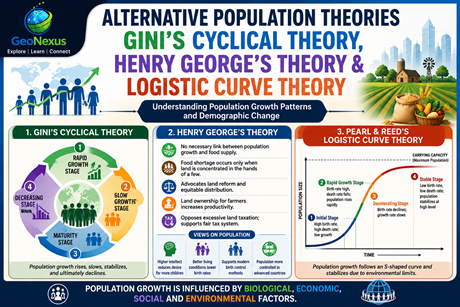
Corrado Gini’s Cyclical Theory of Population Growth
Background
The Italian statistician and sociologist Corrado Gini proposed the Cyclical Theory of Population Growth, which explains the relationship between population growth, social development, and national progress.
Unlike economic explanations, Gini emphasized biological factors and considered population growth to be governed primarily by natural processes. For this reason, his theory is often classified as a Natural Law Theory of Population.
Main Propositions
The central idea of Gini’s theory is that population growth follows a cyclical pattern over time.
According to Gini, societies pass through different stages of demographic development. During the early stages, particularly in agricultural societies, fertility rates and population growth are very high.
As societies industrialize and become economically and socially advanced, fertility rates gradually decline and population growth slows down.
Eventually, population growth may fall to extremely low levels or even become negative. At this stage, demographic decline may contribute to economic stagnation and social deterioration.
Gini argued that excessive population growth can create serious social and economic problems. However, he also believed that prolonged population decline could weaken national vitality and reduce economic dynamism.
Thus, population growth is neither continuously increasing nor continuously decreasing; rather, it moves through recurring cycles influenced by social and biological factors.
Four Stages of Gini’s Cyclical Theory of Population Growth
Gini believed that population growth follows a cyclical pattern similar to the life cycle of an individual. Therefore, he identified four stages of population growth:
i) Rapid Growth Stage
At this stage, population increases very rapidly. High fertility rates and expanding economic opportunities contribute to accelerated population growth.
ii) Slow Growth Stage
In this stage, population continues to grow, but the rate of increase becomes comparatively slower than in the previous stage.
iii) Maturity Stage
This stage is characterized by stable and slow population growth. Birth rates and death rates gradually approach equilibrium, resulting in a mature and balanced demographic structure.
iv) Decreasing Stage
During the final stage, population begins to decline. According to Gini, this decline may be accompanied by social and economic deterioration, leading to a reduction in the overall vitality of society.
Henry George’s Theory of Population and Food Production
Background
Henry George (September 2, 1839 – October 29, 1897) was an American political economist and journalist. In his famous book “Progress and Poverty” (1879), he presented several important ideas concerning population growth, land ownership, and food production.
Main Propositions
Henry George strongly criticized Malthus’s theory and proposed several alternative viewpoints:
- There is no direct relationship between excessive population growth and food shortages; an adequate food supply can be maintained alongside population growth.
- Food production becomes constrained only when agricultural land is concentrated in the hands of a few individuals.
- He emphasized the importance of land reforms and equitable distribution of land resources.
- According to George, granting land ownership rights to farmers would increase agricultural productivity.
- He opposed excessive taxation on land and argued that reducing or abolishing such taxes would help keep land ownership in the hands of cultivators.
Henry George’s Views on Population
Henry George further argued that:
- As intellectual development increases, the desire for large families tends to decline.
- Improvements in living standards and social progress lead to lower birth rates.
- Modern methods of birth control can help regulate population growth.
- Population growth has already become more controlled in many advanced Western countries.
Thus, George emphasized social progress, land reforms, and economic justice rather than population control as solutions to demographic problems.
Raymond Pearl and Lowell Reed’s Logistic Curve Theory
Background
The foundations of the Logistic Curve Theory were first established by Adolphe Quetelet in 1835. He observed that population growth slows as population density increases. Later, in 1838, P. F. Verhulst developed the mathematical concept of logistic growth. However, his ideas did not gain immediate acceptance.
The theory became widely recognized through the work of Raymond Pearl and Lowell Reed in the 1920s. They rejected the Malthusian assumption that population grows indefinitely in geometric progression and argued that such an assumption was unrealistic. The theory gained further popularity after the publication of Pearl’s book “The Biology of Population Growth” in 1926.
Assumptions of the Theory
The Logistic Curve Theory is based on the following assumptions:
- Population grows within a limited geographical area.
- The rate of population growth cannot be infinite.
- Population size cannot fall below zero.
- There exists a point of maximum growth rate on the population growth curve. Beyond this point, growth gradually slows until the curve eventually becomes nearly horizontal.
The Logistic or S-Shaped Curve
The theory represents population growth through a Logistic Curve, which has the shape of the English letter “S.” Therefore, it is also known as the S-Shaped Theory of Population Growth.
The curve illustrates both accelerating and decelerating phases of population growth and suggests that population eventually stabilizes due to environmental and resource constraints.
Four Stages of the S-Shaped Curve
i) First Stage
At this stage, both birth rates and death rates are high. Since the country remains underdeveloped, population growth remains low and relatively stable.
ii) Second Stage
Birth rates remain high while death rates begin to decline due to improvements in healthcare, sanitation, and living conditions. Consequently, population increases rapidly.
iii) Third Stage
As development progresses, birth rates also begin to decline while death rates remain low. Population continues to grow, but the rate of growth gradually decreases.
iv) Fourth Stage
Both birth rates and death rates become low and nearly equal. Population growth approaches zero and stabilizes at a high level.
Pearl and Reed summarized their theory with the statement:
“Population wanes and waxes, rises and falls, and increases rapidly and slowly, but on the whole it is ever increasing.”
