
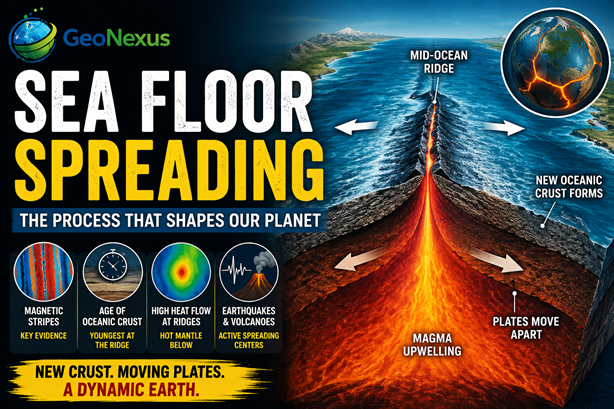
1. Introduction
The Earth’s surface is constantly changing through a variety of geological processes operating over millions of years. One of the most significant discoveries in modern geology is the concept of Sea Floor Spreading, a process that explains how new oceanic crust is formed and how ocean basins gradually expand over time. This theory revolutionized our understanding of the dynamic nature of the Earth’s crust and later became one of the key foundations of the Plate Tectonics Theory.
Why Sea Floor Spreading Matters
Before the development of the Sea Floor Spreading concept, scientists struggled to explain how continents could move across the Earth’s surface. Although Alfred Wegener’s Continental Drift Theory suggested that continents were once joined together and later drifted apart, it lacked a convincing mechanism to explain how such movement occurred.
Sea Floor Spreading provided that missing link. It demonstrated that the ocean floor is not static but continuously renewed through the addition of molten material from the Earth’s mantle. As new crust forms along mid-ocean ridges, older oceanic crust is pushed away on both sides, causing the ocean basin to widen gradually. This process not only explains the movement of continents but also helps scientists understand the formation of ocean basins, volcanic activity, earthquakes, and the long-term evolution of the Earth’s surface.
The theory also established a strong connection between mantle convection currents and crustal movement, providing crucial evidence for the modern Plate Tectonic framework.
Overview of the Theory
Sea Floor Spreading is a geological process that occurs mainly along mid-ocean ridges, where fractures in the oceanic crust allow molten basaltic magma from the mantle to rise toward the surface. As this magma cools and solidifies, it forms new oceanic crust. The newly formed crust gradually pushes the older crust away from the ridge in opposite directions, leading to the expansion of the ocean floor.
The concept was first clearly explained by the American geologist Harry Hammond Hess in 1960 during his studies of the Mid-Atlantic Ridge. Later, in 1961, the American marine geologist R. S. Dietz introduced the term “Sea Floor Spreading” to describe this process. Further support came from the studies of Frederick Vine and Drummond Matthews in 1963, whose research on magnetic anomalies provided strong evidence for the theory.
Sea Floor Spreading is an extremely slow geological process. Depending on the ocean basin, the rate of spreading may range from a few centimeters to nearly 18 centimeters per year. Despite its slow pace, this process has played a major role in shaping the modern configuration of continents and oceans over geological time.
Today, Sea Floor Spreading is recognized as one of the most important concepts in Earth science because it explains how new oceanic crust is created, how ocean basins evolve, and how the Earth’s lithospheric plates move across the planet’s surface.
2. What Is Sea Floor Spreading?
Definition
Sea Floor Spreading is a geological process in which new oceanic crust is continuously formed along mid-ocean ridges as molten basaltic magma rises from the Earth’s mantle through fractures in the ocean floor. As the newly formed crust solidifies, it pushes the older oceanic crust away from the ridge on both sides, causing the ocean basin to expand gradually over time.
This process was first clearly explained by the American geologist Harry Hammond Hess in 1960 and later termed “Sea Floor Spreading” by marine geologist R. S. Dietz in 1961. It is considered one of the most important geological processes responsible for the growth and evolution of ocean basins.
Although the movement is extremely slow—typically ranging from a few centimeters to several centimeters per year—it has significantly reshaped the Earth’s surface over millions of years.
Simple Explanation
Imagine a long crack running through the middle of the ocean floor. Deep beneath this crack, hot molten material from the mantle rises upward and reaches the surface. When this molten material cools, it forms new oceanic crust.
As more magma continues to rise and solidify, the newly formed crust pushes the older crust away from the center in opposite directions. This continuous addition of new material causes the ocean floor to spread outward, much like a conveyor belt moving away from its center.
In simple terms, Sea Floor Spreading is the process by which new ocean floor is created at mid-ocean ridges and older ocean floor is pushed away, gradually increasing the size of the ocean basin.
This mechanism explains how oceanic crust is renewed, why continents move apart, and how the Earth’s surface continues to evolve over geological time.
3. History of the Sea Floor Spreading Theory
The development of the Sea Floor Spreading Theory marked a major turning point in Earth science. Before this concept emerged, scientists knew that continents had moved over geological time, but the mechanism responsible for that movement remained unclear. The theory of Sea Floor Spreading provided a scientific explanation for the formation of new oceanic crust and the expansion of ocean basins, laying the foundation for the modern understanding of Plate Tectonics.
Harry Hess and the Origin of the Idea
The concept of Sea Floor Spreading was first clearly proposed by the American geologist Harry Hammond Hess in 1960 during his investigations of the Mid-Atlantic Ridge. Building upon Arthur Holmes’ idea of mantle convection currents, Hess suggested that hot material rising from the Earth’s mantle reaches the ocean floor through fractures along mid-ocean ridges.
According to Hess, molten magma emerging from beneath the Earth’s crust cools and solidifies to form new oceanic crust. As new crust is continuously added, the older crust is gradually pushed away from the ridge on both sides. This process results in the expansion of the ocean floor and the gradual movement of continents.
Hess further argued that the Atlantic Ocean was widening because the continents on either side were slowly moving apart. He estimated that the ocean floor was spreading at a rate of only a few centimeters per year. His ideas were later published in 1962 in a landmark work titled “History of Ocean Basins,” where he presented a comprehensive explanation of the process.
The theory successfully connected mantle convection, ocean-floor formation, and continental movement into a single geological framework, making it one of the most influential ideas in modern geology.
Contribution of R. S. Dietz
While Hess was developing his ideas, American marine geologist Robert Sinclair Dietz independently supported the concept through his own research. In 1961, even before Hess’s detailed publication appeared, Dietz published his work titled “Continent and Ocean Basin Evolution by Spreading of the Sea Floor.”
Dietz strongly supported the idea that new oceanic crust forms along mid-ocean ridges and spreads outward, causing the expansion of ocean basins. He was also the first scientist to formally use the term “Sea Floor Spreading,” which later became the accepted name for the theory.
His contribution played an important role in bringing wider scientific attention to the concept and helped establish Sea Floor Spreading as a credible explanation for ocean-basin evolution and continental movement.
The theory received further support in 1963 when British geologists Frederick Vine and Drummond Matthews provided evidence from magnetic anomalies on the ocean floor. Their findings strengthened the scientific acceptance of Sea Floor Spreading and contributed significantly to the development of the Plate Tectonics Theory.
Together, the contributions of Hess, Dietz, Vine, and Matthews transformed our understanding of the Earth’s dynamic crust and revolutionized the field of geology.
4. How Does Sea Floor Spreading Work?
Sea Floor Spreading is a continuous geological process through which new oceanic crust is formed and older crust is gradually pushed away from the center of the ocean basin. This process primarily occurs along mid-ocean ridges, where tectonic plates move apart and molten material from the Earth’s interior rises to the surface. The interaction between mantle convection, magma movement, and crustal displacement drives the expansion of the ocean floor.
Mid-Ocean Ridges
The process of Sea Floor Spreading begins at mid-ocean ridges, which are long underwater mountain chains extending through the world’s oceans. According to Harry Hess, these ridges develop above the upward-moving limbs of mantle convection currents.
As tectonic plates move away from each other, fractures and rift zones form along the ridge axis. These fractures provide pathways through which molten material from the mantle can reach the ocean floor. Mid-ocean ridges therefore act as the primary sites of new oceanic crust formation and are regarded as the centers of sea-floor expansion.
The Mid-Atlantic Ridge is one of the best-known examples of a mid-ocean ridge and played a crucial role in the development of the Sea Floor Spreading Theory.
Magma Upwelling and New Crust Formation
Beneath the mid-ocean ridge, hot basaltic magma rises from the mantle toward the Earth’s surface. As the tectonic plates diverge, gaps are created in the oceanic crust, allowing this magma to move upward through the fractures.
When the magma reaches the ocean floor, it cools and solidifies, forming new oceanic crust. Continuous volcanic activity along the ridge ensures a steady supply of fresh crustal material.
This newly formed crust is youngest near the ridge and becomes progressively older as it moves farther away. The repeated addition of magma and formation of new crust gradually increases the size of the ocean floor and contributes to the growth of ocean basins over geological time.
Movement of Oceanic Crust
As new crust forms along the ridge, it exerts pressure on the previously formed oceanic crust, forcing it to move away from the ridge on both sides. This movement occurs very slowly, usually at a rate of a few centimeters per year, but over millions of years it results in significant displacement.
Harry Hess proposed that this outward movement is driven by mantle convection currents operating beneath the Earth’s crust. The newly created crust near the ridge continuously replaces older crust, while the older crust is transported farther from the spreading center.
In the Atlantic Ocean, for example, the movement of oceanic crust causes the continents on opposite sides of the ocean to gradually move apart. The same process occurs in other ocean basins, although spreading rates vary from one ocean to another.
Thus, Sea Floor Spreading functions as a natural conveyor-belt system in which new oceanic crust is created at mid-ocean ridges and older crust is pushed outward, resulting in the continuous expansion and evolution of the ocean floor.
5. Evidence Supporting Sea Floor Spreading
When Harry Hess proposed the concept of Sea Floor Spreading, it was initially a hypothesis based on geological reasoning. Over time, however, several geological, geophysical, and oceanographic investigations provided strong evidence supporting the theory. Studies of ocean-floor sediments, magnetic patterns, heat flow, and earthquake distribution have all confirmed that the ocean floor is continuously expanding and being renewed.
Magnetic Stripes on the Ocean Floor
One of the strongest pieces of evidence for Sea Floor Spreading comes from the discovery of magnetic stripes on the ocean floor. In 1963, British geologists Frederick Vine and Drummond Matthews demonstrated that rocks on either side of a mid-ocean ridge contain symmetrical patterns of magnetic anomalies.
As molten basaltic lava erupts along a mid-ocean ridge and cools, magnetic minerals within the rock align themselves with the Earth’s magnetic field. Because the Earth’s magnetic polarity has reversed many times throughout geological history, newly formed oceanic crust preserves a record of these changes.
As a result, alternating bands of normal and reversed magnetic polarity appear on both sides of the ridge in a nearly symmetrical pattern. This symmetry indicates that new crust is continuously being created at the ridge and pushed outward in opposite directions. The magnetic stripes therefore provide direct evidence that the ocean floor is spreading over time.
Age of Oceanic Crust
Another important line of evidence comes from the age of oceanic sediments and crustal rocks. Oceanographic drilling projects revealed that ocean-floor sediments are not the same age everywhere.
Researchers found that the youngest rocks and sediments occur near mid-ocean ridges, while progressively older rocks are found farther away from the ridge. This age pattern indicates that new oceanic crust is constantly forming at the spreading center and gradually moving outward.
Investigations carried out through the JOIDES (Joint Oceanographic Institutions for Deep Earth Sampling) program provided significant support for this idea. Using the drilling vessel Glomar Challenger, scientists collected sediment samples from different parts of the ocean floor and found that sediment age increased with distance from mid-ocean ridges.
The absence of extremely old oceanic crust and the systematic increase in age away from the ridge strongly support the concept of continuous sea-floor expansion.
Read More: Karl Marx’s Theory of Population
Heat Flow Patterns
Heat-flow measurements from the ocean floor also provide convincing evidence for Sea Floor Spreading. Scientists observed that heat flow is not evenly distributed across the ocean basins.
Although oceanic rocks generally contain fewer radioactive materials than continental rocks, measurements revealed that heat flow in many oceanic regions is surprisingly high. More importantly, heat flow near mid-ocean ridges is often three to four times greater than in surrounding oceanic areas.
This unusually high heat flow indicates the presence of hot mantle material beneath the ridges. According to Hess’s theory, magma rising from the mantle accumulates beneath these ridges and periodically erupts onto the ocean floor, creating new crust.
The concentration of heat near spreading centers therefore provides strong evidence that active crust formation is occurring beneath mid-ocean ridges.
Earthquake and Volcanic Activity
The distribution of earthquakes and volcanic activity offers additional support for Sea Floor Spreading. Studies show that mid-ocean ridges are characterized by frequent shallow-focus earthquakes and active volcanic processes.
These earthquakes occur because the oceanic crust is continuously being fractured and pulled apart as tectonic plates move away from each other. The resulting cracks allow mantle-derived magma to rise toward the surface and form new crust.
Scientists have found that earthquake activity is significantly higher beneath mid-ocean ridges than in many other parts of the ocean floor. The combination of frequent seismic activity, crustal fractures, and volcanic eruptions indicates that these regions are actively generating new oceanic crust.
Together, the occurrence of shallow earthquakes and volcanic activity provides further confirmation that Sea Floor Spreading is an ongoing geological process.
6. Sea Floor Spreading and Plate Tectonics
The concept of Sea Floor Spreading played a crucial role in the development of the modern Plate Tectonics Theory. Before the discovery of sea-floor spreading, scientists had evidence that continents had moved over geological time, but they lacked a convincing mechanism to explain how such movement occurred. The discovery that new oceanic crust forms at mid-ocean ridges and gradually moves away from them provided the missing link between continental movement and Earth’s internal dynamics.
Today, Sea Floor Spreading is recognized as one of the fundamental processes responsible for the movement of tectonic plates and the continuous reshaping of the Earth’s surface.
Connection with Continental Drift
In 1912, Alfred Wegener proposed the Continental Drift Theory, suggesting that all continents were once joined together and later drifted apart to their present positions. Although Wegener presented several lines of evidence in support of continental movement, he could not explain the force responsible for moving the continents.
The solution began to emerge through the work of Arthur Holmes, who proposed that convection currents within the Earth’s mantle could drive crustal movement. Building upon this idea, Harry Hess suggested that new oceanic crust is continuously created along mid-ocean ridges and pushed outward by mantle-derived magma.
Sea Floor Spreading provided a practical mechanism for continental movement. As the ocean floor expands, continents resting on tectonic plates are carried along with the moving crust. This explained how continents could gradually drift apart over millions of years and provided strong support for Wegener’s earlier hypothesis.
Thus, Sea Floor Spreading transformed Continental Drift from a controversial idea into a scientifically accepted process linked to plate motion.
Divergent Plate Boundaries
Sea Floor Spreading occurs primarily at divergent plate boundaries, where two tectonic plates move away from each other.
As the plates separate, fractures develop in the oceanic crust, creating pathways for hot magma from the mantle to rise toward the surface. The magma cools and solidifies to form new oceanic crust, filling the gap created by plate separation.
This process results in:
- Formation of new oceanic crust.
- Expansion of ocean basins.
- Development of mid-ocean ridges.
- Frequent volcanic activity.
- Shallow-focus earthquakes.
The Mid-Atlantic Ridge is one of the most well-known examples of a divergent plate boundary where active sea-floor spreading continues today.
Because new crust is constantly being added at these boundaries, divergent margins are often referred to as spreading centers.
Global Tectonic Processes
Sea Floor Spreading is not an isolated geological phenomenon but part of a much larger global tectonic system. The Earth’s lithosphere is divided into several large and small tectonic plates that continuously move due to processes operating within the mantle.
As new crust forms at divergent boundaries, older crust is gradually displaced away from the spreading center. This movement contributes to the overall motion of tectonic plates across the Earth’s surface.
The process influences numerous geological activities worldwide, including:
- Movement of continents.
- Formation of ocean basins.
- Development of mountain systems.
- Volcanic activity.
- Earthquake occurrence.
- Recycling of oceanic crust.
Harry Hess also suggested that while ocean floors expand in some regions, crust must be consumed elsewhere to maintain balance within the Earth’s crustal system. This concept later became an important component of Plate Tectonic Theory and helped explain the dynamic nature of the Earth’s surface.
In essence, Sea Floor Spreading acts as the driving mechanism that links mantle convection, plate movement, and continental displacement into a single global tectonic framework. Without Sea Floor Spreading, the modern theory of Plate Tectonics would not be able to explain how the Earth’s crust continuously evolves over geological time.
7. Importance of Sea Floor Spreading
The theory of Sea Floor Spreading is one of the most significant contributions to modern Earth science. It not only explains how new oceanic crust is formed but also provides a scientific basis for understanding continental movement, ocean-basin evolution, and the dynamic nature of the Earth’s surface. The concept transformed geology by demonstrating that the ocean floor is continuously renewed and reshaped over geological time.
Formation of New Oceanic Crust
One of the most important contributions of Sea Floor Spreading is its explanation of how new oceanic crust is created. According to the theory, molten basaltic magma rises from the mantle through fractures along mid-ocean ridges. As this magma cools and solidifies, it forms new oceanic crust.
The continuous addition of new crust along spreading centers causes the ocean floor to expand gradually. At the same time, older crust is pushed away from the ridge, resulting in the constant renewal of the oceanic surface. This process explains why the youngest oceanic rocks are found near mid-ocean ridges and why the age of oceanic crust increases with distance from the spreading center.
Thus, Sea Floor Spreading provides a clear explanation for the origin and growth of ocean basins.
Understanding Earth’s Evolution
Sea Floor Spreading has greatly improved our understanding of how the Earth has evolved over millions of years. Before the acceptance of this theory, many geological features of the ocean floor remained unexplained.
The theory revealed that the Earth’s crust is not static but continuously changing through processes operating deep within the mantle. The formation of new crust, movement of tectonic plates, and gradual reorganization of continents and oceans are all linked to sea-floor expansion.
By explaining the relationship between mantle convection, crust formation, and plate movement, Sea Floor Spreading helped scientists understand the long-term development of the Earth’s surface and the evolution of major geological features such as ocean basins and mid-ocean ridges.
Explaining Continental Movement
Perhaps the greatest significance of Sea Floor Spreading is that it provided a mechanism for continental movement. Although Alfred Wegener’s Continental Drift Theory proposed that continents had once been united and later drifted apart, it could not explain how this movement occurred.
Sea Floor Spreading solved this problem by showing that continents are carried by moving tectonic plates. As new oceanic crust forms and spreads outward from mid-ocean ridges, the plates—and the continents resting upon them—are gradually transported across the Earth’s surface.
This explanation provided strong support for the idea of continental drift and later became one of the foundations of the Plate Tectonics Theory. It demonstrated that continental movement is a natural consequence of the continuous creation and expansion of oceanic crust.
8. Limitations and Challenges
Although the Sea Floor Spreading Theory eventually became one of the cornerstones of modern geology, it was not immediately accepted by the scientific community. Like many revolutionary scientific ideas, the theory faced criticism, skepticism, and extensive debate before sufficient evidence emerged to support it. Over time, advances in marine geology, geophysics, and ocean-floor exploration helped resolve many of these concerns and strengthened the theory’s scientific foundation.
Early Criticism
When Harry Hess first proposed the concept of Sea Floor Spreading in 1960, many geologists were cautious about accepting the idea. At that time, detailed information about the ocean floor was limited, and direct evidence for the continuous formation of new oceanic crust was not yet available.
One of the main concerns was the lack of observational data demonstrating that ocean floors were actually expanding. Scientists also questioned whether mantle convection currents were strong enough to drive large-scale crustal movement. Since much of the ocean floor remained unexplored, several aspects of the theory were considered speculative.
Furthermore, although Hess proposed that new crust was being created along mid-ocean ridges, the precise mechanism responsible for the movement of oceanic crust required additional verification.
Scientific Debates
The development of the Sea Floor Spreading Theory led to important scientific debates regarding the evolution of ocean basins and continental movement. Some researchers initially favored alternative explanations for geological phenomena observed on the ocean floor.
A major debate centered on whether continents moved independently or whether the entire oceanic crust was involved in large-scale movement. The theory also raised questions about the origin of magnetic anomalies, the age distribution of oceanic crust, and the relationship between mantle processes and crustal dynamics.
The situation changed significantly in the early 1960s when Frederick Vine and Drummond Matthews demonstrated that symmetrical magnetic patterns existed on both sides of mid-ocean ridges. Their findings provided strong evidence that new oceanic crust was continuously forming and moving outward from spreading centers.
Additional support came from ocean-drilling programs such as the JOIDES and Glomar Challenger expeditions, which revealed that oceanic sediments become progressively older with increasing distance from mid-ocean ridges. These discoveries helped resolve many of the debates surrounding the theory.
Modern Understanding
Today, Sea Floor Spreading is widely accepted as a fundamental geological process and forms an essential part of the Plate Tectonics Theory. Modern research has confirmed that new oceanic crust is continuously generated at divergent plate boundaries and that ocean basins evolve through the movement of tectonic plates.
Advanced technologies, including deep-sea drilling, seismic surveys, satellite observations, and magnetic mapping, have provided overwhelming evidence supporting the theory. Scientists can now measure spreading rates, map magnetic stripes, and monitor tectonic activity with remarkable accuracy.
Modern understanding also recognizes that Sea Floor Spreading does not occur at the same rate everywhere. Different ocean basins exhibit different spreading rates, ranging from relatively slow expansion in parts of the Atlantic Ocean to much faster spreading in portions of the Pacific Ocean.
Although the fundamental principles of the theory are now well established, research continues to improve our understanding of mantle convection, crustal formation processes, and the complex interactions between tectonic plates. As a result, Sea Floor Spreading remains an active area of scientific investigation and a vital component of Earth system science.
9. Interesting Facts About Sea Floor Spreading
Sea Floor Spreading is one of the most fascinating geological processes occurring on Earth. Although it operates extremely slowly, it has played a major role in shaping the modern arrangement of continents and oceans. Here are some interesting facts that highlight the significance of this remarkable phenomenon.
1. The Ocean Floor Is Constantly Growing
New oceanic crust is continuously being formed along mid-ocean ridges as magma rises from the Earth’s mantle and solidifies. This means that parts of the ocean floor are constantly expanding, even though the movement is too slow to be noticed in everyday life.
2. The Mid-Atlantic Ridge Was Key to the Discovery
The concept of Sea Floor Spreading was developed largely from studies of the Mid-Atlantic Ridge, one of the longest underwater mountain systems on Earth. Harry Hess used observations from this region to formulate his theory.
3. Oceanic Crust Is Much Younger Than the Earth
The Earth is approximately 4.5 billion years old, yet oceanic crust is comparatively young. Ocean-floor drilling studies found that most oceanic crust is far younger because new crust is continuously created while older crust is displaced away from spreading centers.
4. Sea Floor Spreading Helped Prove Continental Drift
Alfred Wegener’s Continental Drift Theory initially lacked a convincing mechanism. Sea Floor Spreading provided the missing explanation by showing how continents can move as tectonic plates are carried by the expanding ocean floor.
5. The Process Is Extremely Slow
Sea Floor Spreading occurs at a rate of only a few centimeters per year. Depending on the ocean basin, spreading rates may range from about 1–2 centimeters annually to more than 10 centimeters per year in some regions.
6. Different Oceans Spread at Different Rates
Not all oceans expand at the same speed. The Atlantic Ocean generally spreads more slowly, while parts of the Pacific Ocean experience much faster rates of expansion.
7. Magnetic Stripes Record Earth’s Magnetic History
As lava cools on the ocean floor, it preserves the direction of the Earth’s magnetic field at that time. These magnetic patterns form symmetrical stripes on both sides of mid-ocean ridges and provide some of the strongest evidence for Sea Floor Spreading.
8. Mid-Ocean Ridges Are Zones of High Heat Flow
Scientists discovered that heat flow near mid-ocean ridges is significantly higher than in surrounding oceanic regions. This occurs because hot mantle material lies closer to the surface beneath spreading centers.
9. Earthquakes Frequently Occur Along Spreading Centers
Mid-ocean ridges are not only sites of crust formation but also regions of frequent shallow-focus earthquakes. These earthquakes occur as tectonic plates move apart and new crust forms.
10. Sea Floor Spreading Is a Foundation of Plate Tectonics
Modern Plate Tectonics Theory would not be possible without the concept of Sea Floor Spreading. It provides the mechanism that explains how tectonic plates move, how continents drift, and how ocean basins evolve through time.
Did You Know?
- Harry Hess first presented the idea of Sea Floor Spreading in 1960.
- The term “Sea Floor Spreading” was introduced by R. S. Dietz in 1961.
- Frederick Vine and Drummond Matthews provided crucial magnetic evidence supporting the theory in 1963.
- New oceanic crust forms mainly along mid-ocean ridges, the longest mountain chains on Earth.
- Sea Floor Spreading remains one of the most important discoveries in modern geology.
These fascinating facts demonstrate why Sea Floor Spreading is considered a revolutionary concept that transformed our understanding of the Earth’s dynamic surface.
10. Sea Floor Spreading Rate and Related Concepts
Understanding how fast the ocean floor expands is essential for studying plate movements, ocean-basin evolution, and global tectonic processes. Scientists have developed several methods to measure spreading rates and analyze the geological features associated with sea-floor expansion.
Sea Floor Spreading Rate
The rate of sea-floor spreading can be determined by examining the age and distribution of magnetic stripes on the ocean floor. One commonly used approach involves measuring the distance between magnetic bands of known age and calculating how far the oceanic crust has moved over time.
Studies have shown that spreading rates vary significantly among different ocean basins. In general, sea-floor spreading occurs at rates ranging from a few centimeters to about 10 centimeters per year on one side of a mid-ocean ridge.
The Atlantic and Indian Oceans typically experience relatively slow spreading, often around 1–1.5 centimeters per year. In contrast, the Pacific Ocean spreads much more rapidly, with rates commonly reaching 6 centimeters per year or more.
More recent investigations suggest that some regions of the Pacific Ocean may expand at rates of 6–9 centimeters per year on each side of the ridge, resulting in a total expansion of 12–18 centimeters annually. In comparison, spreading rates in the South Atlantic and Indian Oceans are generally lower.
These differences demonstrate that sea-floor spreading is not uniform across the globe and depends on regional tectonic conditions.
What Is Half Spreading Rate?
Sea Floor Spreading occurs simultaneously on both sides of a mid-ocean ridge. However, geologists often report the rate of expansion for only one side of the ridge. This measurement is known as the Half Spreading Rate.
For example, if the spreading rate in the Pacific Ocean is reported as 6 centimeters per year, this usually refers to the movement of crust on one side of the ridge. Since the opposite side is also moving away at approximately the same rate, the total widening of the ocean basin would be about 12 centimeters per year.
The concept of half spreading rate is widely used in marine geology because it simplifies comparisons between different spreading centers.
What Is an Isochron?
An Isochron is a line connecting magnetic stripes of the same age on the ocean floor. These lines are identified from maps of paleomagnetic patterns preserved within oceanic crust.
Because newly formed oceanic crust records the Earth’s magnetic field at the time of its formation, magnetic stripes provide a timeline of sea-floor development. By connecting crust of the same age, scientists can reconstruct past plate movements and calculate spreading rates.
Isochrons have become important tools in marine geophysics and plate reconstruction studies, helping researchers understand how ocean basins evolved through time.
What Is a Spreading Zone?
A Spreading Zone is the active region on either side of a mid-ocean ridge where sea-floor expansion is occurring. Within this zone, new oceanic crust is continuously created and older crust is gradually pushed away from the ridge.
These regions represent some of the most dynamic geological environments on Earth. The Mid-Atlantic Ridge provides a classic example of a spreading zone, where the North American and Eurasian plates continue to move apart as new oceanic crust forms between them.
Spreading zones are characterized by active volcanism, frequent shallow earthquakes, high heat flow, and continuous crustal formation.
What Is a Thermistor?
A Thermistor is an electrical resistance device used to measure temperature changes and calculate heat flow within rocks and geological formations.
In marine geological studies, thermistors help scientists determine geothermal gradients and heat-flow patterns beneath the ocean floor. These measurements have played an important role in confirming that heat flow near mid-ocean ridges is significantly higher than in surrounding oceanic regions.
The term “Thermistor” is derived from the words Thermal and Resistor. Depending on their operating characteristics, thermistors are generally classified into:
- Negative Temperature Coefficient (NTC) Thermistors
- Positive Temperature Coefficient (PTC) Thermistors
Heat-flow measurements obtained using thermistors have provided important evidence supporting the Sea Floor Spreading Theory by demonstrating the presence of hot mantle material beneath spreading centers.
Why These Concepts Matter
Spreading rates, isochrons, thermistors, and spreading zones are more than just technical terms. Together, they provide the scientific tools needed to measure, monitor, and verify the process of Sea Floor Spreading. These concepts help geologists determine how fast tectonic plates move, how ocean basins evolve, and how the Earth’s crust is continuously renewed over geological time.
11. Conclusion
Sea Floor Spreading is one of the most important geological processes responsible for shaping the Earth’s surface. It explains how new oceanic crust is continuously formed along mid-ocean ridges through the upwelling of magma from the mantle and how older crust is gradually pushed away from these spreading centers. Although the process occurs at a rate of only a few centimeters per year, it has profoundly influenced the evolution of oceans and continents over millions of years.
The theory, first clearly proposed by Harry Hammond Hess and later strengthened by the contributions of R. S. Dietz, Frederick Vine, and Drummond Matthews, provided a scientific explanation for the expansion of ocean basins and the movement of continents. Evidence from magnetic stripes, ocean-floor sediments, heat-flow measurements, and earthquake activity strongly supports the concept and confirms that the ocean floor is far more dynamic than previously believed.
Sea Floor Spreading also played a crucial role in the development of the Plate Tectonics Theory, offering the mechanism needed to explain continental drift and global crustal movement. By linking mantle convection, crust formation, and plate motion, the theory transformed our understanding of Earth’s geological processes.
Today, Sea Floor Spreading remains a fundamental concept in geology, geophysics, and oceanography. It not only helps scientists reconstruct the Earth’s geological history but also provides valuable insights into earthquakes, volcanic activity, mountain building, and the long-term evolution of the planet. As research and technology continue to advance, our understanding of this remarkable process will further improve, reinforcing its significance in modern Earth science.
Key Takeaways
- Sea Floor Spreading is the process through which new oceanic crust forms at mid-ocean ridges.
- The concept was first proposed by Harry Hammond Hess in 1960.
- R. S. Dietz introduced the term “Sea Floor Spreading” in 1961.
- New crust forms when basaltic magma rises from the mantle and solidifies.
- Older oceanic crust is pushed away from the ridge as new crust forms.
- Magnetic stripes provide some of the strongest evidence for sea-floor expansion.
- Oceanic crust becomes progressively older with increasing distance from mid-ocean ridges.
- High heat flow and frequent earthquakes characterize active spreading centers.
- Sea Floor Spreading provides the mechanism that supports Continental Drift and Plate Tectonics.
- The process continues today and plays a vital role in shaping the Earth’s surface.
Sea Floor Spreading transformed geology from a science focused on static landforms into one that recognizes the Earth as a constantly evolving and dynamic planet.
Frequently Asked Questions (FAQ)
What Is Sea Floor Spreading?
Sea Floor Spreading is a geological process in which new oceanic crust is formed at mid-ocean ridges through the eruption and solidification of basaltic magma. As new crust is created, older oceanic crust is pushed away from the ridge, causing the ocean floor to expand gradually over time.
Who Proposed the Sea Floor Spreading Theory?
The concept of Sea Floor Spreading was first clearly explained by the American geologist Harry Hammond Hess in 1960 based on his studies of the Mid-Atlantic Ridge. Later, in 1961, American marine geologist R. S. Dietz introduced the term “Sea Floor Spreading” and helped popularize the theory.
Where Does Sea Floor Spreading Occur?
Sea Floor Spreading occurs mainly along mid-ocean ridges, which are underwater mountain chains formed at divergent plate boundaries. These ridges contain fractures through which magma rises from the mantle to create new oceanic crust.
Examples include:
Mid-Atlantic Ridge
East Pacific Rise
Indian Ocean Ridge System
How Fast Does Sea Floor Spreading Happen?
Sea Floor Spreading is a very slow geological process. The rate varies among different ocean basins:
Atlantic Ocean: approximately 1–1.5 cm per year
Indian Ocean: approximately 1.5–3.5 cm per year
Pacific Ocean: approximately 6–9 cm per year (on one side of the ridge)
In some regions, the total spreading rate on both sides of a ridge may reach 12–18 cm per year.
How Does Sea Floor Spreading Support Plate Tectonics?
Sea Floor Spreading provides the mechanism that explains how tectonic plates move. As new oceanic crust forms at mid-ocean ridges, older crust is pushed outward, carrying tectonic plates and continents along with it. This process supports the Plate Tectonics Theory by demonstrating that the Earth’s lithosphere is continuously moving and being reshaped.
What Is the Main Evidence for Sea Floor Spreading?
Several lines of evidence support Sea Floor Spreading, including:
Symmetrical magnetic stripes on the ocean floor
Increasing age of oceanic crust away from mid-ocean ridges
High heat flow near spreading centers
Frequent shallow-focus earthquakes along mid-ocean ridges
Ocean-floor drilling results from scientific expeditions
Together, these observations confirm that new oceanic crust is continuously being formed and moved away from spreading centers.
What Is a Mid-Ocean Ridge?
A mid-ocean ridge is a long underwater mountain chain formed where two tectonic plates move apart. These ridges serve as the primary locations where magma rises from the mantle and creates new oceanic crust through Sea Floor Spreading.
What Is a Half Spreading Rate?
A half spreading rate refers to the rate at which the ocean floor moves away from a mid-ocean ridge on one side only. Since spreading occurs in both directions, the total spreading rate is usually twice the half spreading rate.
For example, if the Pacific Ocean has a half spreading rate of 6 cm per year, the total expansion of the ocean basin is about 12 cm per year.
Why Are Oceanic Rocks Younger Than Continental Rocks?
New oceanic crust is continuously created through Sea Floor Spreading, while older crust is gradually displaced away from spreading centers. As a result, oceanic rocks are generally much younger than continental rocks, which can survive for billions of years.

One thought on “What Is Sea Floor Spreading? Theory, Process, Evidence, and Importance Explained”