
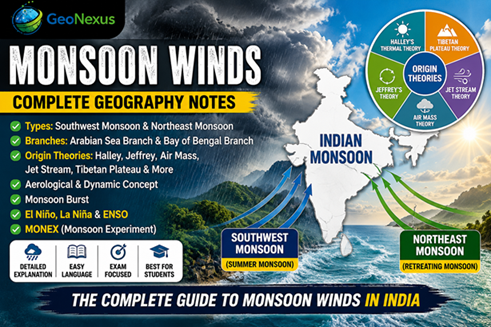
1. What is Monsoon?
Concept
The monsoon is the large-scale version of sea breeze and land breeze. It refers to a seasonal wind system that blows regularly from a particular direction during a specific season of the year due to differences in air pressure and temperature.
From the Indian perspective, monsoon can be defined as a temporary wind system generated by the seasonal reversal of high-pressure and low-pressure conditions over the landmass and the surrounding water bodies. During summer, these winds blow from the southwest, while during winter they blow from the northeast.
Definitions
According to A. A. Rama Shastry, “Monsoon is a large-scale seasonal wind system that extends over vast regions of the Earth and reverses its direction with the change of seasons.”
Meteorologists such as Koppen (1923), Hann (1932), and Angot (1943) described monsoons as the large-scale counterpart of land and sea breezes.
According to Conrad, “In the case of thermal monsoons, the wind system reverses its direction, and during extreme seasons the flow becomes nearly 180° opposite to its original direction.”
Meaning and Origin of the Term
The English word “Monsoon” is an ancient term meaning “season.” The origin of the word is uncertain and remains a subject of debate. It may have been derived from:
- The Malay word “Monsin”
- The Arabic word “Maswin”
- The Portuguese word “Moncao”
- The Dutch word “Moesson”
Although its exact origin is unclear, all these terms convey the idea of seasonal changes in wind patterns and rainfall.
Key Point
Monsoon is a seasonal wind system characterized by a reversal of wind direction between summer and winter, primarily caused by differential heating and pressure variations between land and water surfaces.
2. In Which Parts of the World Does the Monsoon Occur?
Ans: Although the countries of East and South Asia, particularly the Indian subcontinent, are considered the principal region of monsoon activity, this wind system is also observed in various other parts of the world, such as West Africa, Ethiopia, northwestern Australia, and the northwestern part of Southern Africa.
According to the direction and timing of the wind flow, the monsoon over the Indian subcontinent is divided into two types: the Normal or Summer Monsoon and the Retreating or Winter Monsoon.
3. Into How Many Types Can Monsoons Be Classified?
Ans: From a global perspective, monsoons can be regionally classified into three major categories, namely: (i) Asian Monsoon, (ii) African Monsoon, and (iii) American Monsoon.
The Asian monsoon can further be divided into two types: (a) South Asian Monsoon and (b) East Asian Monsoon, the latter being particularly prominent in China, Japan, Korea, and Taiwan.
Again, based on their intrinsic characteristics, monsoons may be classified into two categories: (i) Traditional Monsoon and (ii) Pseudo Monsoon.
4. What is Meant by Traditional Monsoon or True Monsoon (The Principal Monsoon Region)?
Ans: The term Traditional Monsoon refers to the monsoon system of those regions where a large mass of maritime air regularly penetrates inland during a particular season of the year and retreats during another specific season. Such monsoon circulation is characterized by a distinct seasonal reversal of wind direction.
The monsoon system of Asia is regarded as a True Monsoon because it exhibits all the essential characteristics of a monsoon circulation.
The regions of the world that experience traditional monsoon conditions include India, Pakistan, Bangladesh, Myanmar, Thailand, Laos, Cambodia, Vietnam, Southern China, the Philippines, and the northern coastal parts of Australia.
5. What is Meant by Pseudo Monsoon or the Secondary Monsoon Region?
Ans: A Pseudo Monsoon refers to the monsoon system of those regions where only some of the characteristics of a true monsoon are observed. For this reason, it is often described as exhibiting “Monsoonal Tendencies.”
This type of monsoon is found along the southwestern coast of Africa, the Gulf of Guinea coast, Sierra Leone, Liberia, Ivory Coast, East Africa, and western Madagascar. In addition, seasonal reversals of wind direction are also observed in parts of North and South America, Europe, and Australia.
Such conditions develop primarily due to the unequal heating of land and water surfaces, which creates seasonal pressure differences and results in monsoon-like wind circulation.
6. How Many Types of Monsoon Winds Blow Over India?
Ans: With the change of seasons, two types of monsoon winds prevail over India, namely: (a) the Southwest Monsoon or Summer Monsoon, and (b) the Northeast Monsoon or Retreating Monsoon. Due to the triangular shape of the Indian peninsula, the Southwest Monsoon enters India through two distinct branches. These are: (i) the Arabian Sea Branch and (ii) the Bay of Bengal Branch. Together, these two branches transport approximately 7,700 billion cubic metres and 3,400 billion cubic metres of water vapour, respectively, between June and September, resulting in about 2,400 billion cubic metres of rainfall over India.
7. What is the Arabian Sea Branch of the Summer Monsoon?
Ans: The branch of the monsoon that originates over the Arabian Sea portion of the Indian Ocean and enters the Indian mainland through the western coast from the southwest direction is known as the Arabian Sea Branch of the Southwest Monsoon.
As soon as this branch enters India, it is obstructed by the Western Ghats and the Cardamom Hills, causing heavy rainfall on the windward slopes of the western coastal region. Due to orographic rainfall, the area receives approximately 200–300 cm of annual rainfall.
As the air current crosses the Western Ghats and moves further eastward, its moisture content gradually decreases, leading to a decline in rainfall. Consequently, a vast portion of the interior Deccan Plateau becomes a rain-shadow region.
Another branch of the Arabian Sea Monsoon flows northward across Gujarat and Rajasthan, almost parallel to the Aravalli Range, and eventually reaches the Himalayas, where it is forced to rise and produces moderate to heavy rainfall. A part of this branch is also obstructed by the Vindhya and Satpura Ranges, resulting in approximately 100–125 cm of rainfall.
8. What is the Bay of Bengal Branch of the Summer Monsoon?
Ans: The branch of the monsoon that originates over the Bay of Bengal portion of the Indian Ocean and enters the Indian mainland through the eastern coast from the southwest direction is known as the Bay of Bengal Branch of the Southwest Monsoon.
This branch enters the Indian region in two separate streams. One stream moves towards the Myanmar coast, while the other advances northwestward along the Gangetic Plain. Under the influence of these two streams, heavy rainfall occurs along the eastern coast and in northeastern India where the moist winds are obstructed by the Arakan Yoma, Garo Hills, Khasi Hills, Jaintia Hills, and the Himalayas.
The amount of rainfall gradually decreases from eastern India towards western India. For example, while Kolkata receives about 150 cm of rainfall, Patna receives around 112 cm, and Delhi receives nearly 70 cm annually.
Owing to the influence of this branch, Mawsynram in Meghalaya receives the highest annual rainfall in the world, approximately 1,250 cm, while the neighbouring Cherrapunji receives around 1,087 cm of rainfall.
9. What is Meant by Monsoon Burst?
Ans: During the period from May to July, the apparent northward movement of the Sun causes intense heating of the landmass of India, which lies within the tropical region. As a result, a low-pressure belt develops over the Indian subcontinent. This leads to the convergence of air masses near the Inter-Tropical Convergence Zone (ITCZ), and cool, moisture-laden winds from the Indian Ocean rush inland as the Southwest Monsoon.
The sudden onset of these monsoon winds over a vast area, accompanied by thunderstorms, lightning, and widespread heavy rainfall, is known as a Monsoon Burst.
As a result of this phenomenon, the monsoon normally sets in over different parts of India on the following dates: Andaman and Nicobar Islands around 20 May, Kerala around 29 May, the Konkan Coast around 3 June, Kolkata around 15 June, Delhi around 1 July, and Rajasthan around 15 July.
10. What are the Different Theories Regarding the Origin of Monsoon Winds?
Ans: The monsoon is regarded as the large-scale counterpart of land and sea breezes. Several theories have been proposed to explain its origin. These theories can broadly be classified into two groups: Classical Theories and Modern Theories.
The Classical Theories include:
(i) Halley’s Thermal Concept, (ii) Jeffrey’s Theory, (iii) Radon Concentration Theory, and (iv) Tibetan High-Pressure Theory or Tibetan Plateau Theory.
The Modern Theories include:
(i) Air Mass Theory and (ii) Jet Stream Theory.
In addition to these theories, the origin and development of the monsoon can also be explained through the Aerological Concept and the Dynamic Concept, both of which provide further insights into the mechanism of monsoon circulation.
11. Explain Halley’s Thermal Concept Regarding the Origin of Monsoon Winds.
Ans: One of the earliest theories explaining the origin of monsoon winds is Halley’s Thermal Concept. This theory was proposed in 1686 by the British astronomer and meteorologist Sir Edmund Halley. According to this concept, monsoon winds are essentially the large-scale counterparts of land and sea breezes that operate seasonally over the Gangetic basin and the surrounding regions.
According to Halley, during the winter season in the Northern Hemisphere, when the Sun is vertically overhead at the Tropic of Capricorn, the extensive landmass of Asia becomes progressively colder, while the surrounding oceans retain relatively higher temperatures. As a result, strong high-pressure centres develop over the Asian continent, particularly near Lake Baikal and Peshawar, whereas a low-pressure centre forms over the southern Indian Ocean.
Due to the temperature and pressure differences between the land and the ocean, air flows from the high-pressure region towards the low-pressure region. Under the influence of Ferrel’s Law, these winds blow from the northeast towards the southwest, giving rise to the Northeast Monsoon, also known as the Retreating Monsoon.
On the other hand, during the summer season in the Northern Hemisphere, when the Sun shines vertically over the Tropic of Cancer, intense heating of the Asian landmass results in the development of deep low-pressure centres over the Lake Baikal region and northwestern India, while relatively high pressure prevails over the adjacent Indian Ocean. Consequently, the trade winds cross the Inter-Tropical Convergence Zone (ITCZ) and enter the continent from the southwest towards the northeast. These winds move towards the continental low-pressure centres and form the Southwest Monsoon.
12. How Has Halley’s Thermal Concept Been Criticized?
Ans: Although Halley’s Thermal Concept was supported by meteorologists such as Angot, Hann, V. Köppen, Horace Robert Byers, and D. H. Miller, modern meteorologists have identified several shortcomings in this theory.
Firstly, the theory fails to explain the phenomenon of the sudden onset or burst of the monsoon over the Indian subcontinent. Secondly, it is unable to account for the occurrence of breaks in the monsoon, when rainfall temporarily ceases during the rainy season. Thirdly, the theory does not adequately explain instances of weak monsoon conditions or monsoon failure.
Furthermore, while the concept provides a general explanation for rainfall associated with monsoon circulation, it does not satisfactorily explain the occurrence of orographic rainfall and cyclonic rainfall that are closely linked with monsoon activity. Another major limitation is that although low-pressure conditions begin to develop over northwestern India as early as April, the theory does not explain why the monsoon consistently arrives only around June.
Finally, if monsoon circulation is solely a result of thermal contrasts in the lower atmosphere, the theory cannot explain why a corresponding opposite airflow develops in the upper atmosphere. Thus, Halley’s concept provides only a partial explanation of the monsoon mechanism and is considered inadequate in the light of modern meteorological knowledge.
13. Explain Jeffrey’s Theory Regarding the Origin of Monsoon Winds.
Ans: The British geophysicist and astrophysicist Sir Harold Jeffreys presented his theory on the origin of the Indian monsoon in his 1926 work entitled “On the Dynamics of Geostrophic Winds.” However, his contribution is often regarded more as a supportive extension of Halley’s theory rather than an entirely independent theory.
Jeffreys supported Halley’s thermal concept and demonstrated, through mathematical modelling, that the air currents above the monsoon layer flow in a direction opposite to that of the surface monsoon winds. According to his model, the air at an altitude of approximately 2.1 km above the Earth’s surface moves in the reverse direction of the winds blowing near the ground.
He argued that due to the normal lapse rate of temperature in the troposphere, atmospheric pressure decreases with increasing altitude. As a result, the direction of airflow in the lower atmosphere differs from that in the upper atmosphere. According to Jeffreys, while winds in the lower troposphere may flow in one direction, winds at an altitude of approximately 3–6 km tend to flow in the opposite direction.
He maintained that this principle is equally applicable to monsoon circulation, where the surface monsoon winds are accompanied by a reverse flow in the upper levels of the atmosphere. Thus, Jeffrey’s theory provided an important theoretical basis for understanding the vertical structure of monsoon circulation.
14. Mention the Limitations of Jeffrey’s Theory Regarding the Origin of Monsoon Winds.
Ans: Although Jeffrey’s theory succeeded in explaining the existence of air currents flowing in the opposite direction above the monsoon layer—a feature that was absent in Halley’s concept—it also suffers from certain limitations.
Firstly, monsoon winds develop mainly in the low latitudes, where the conditions required for geostrophic balance are generally weak or absent. However, Jeffrey’s theory is largely based on geostrophic principles, and therefore its applicability to monsoon regions is questionable.
Secondly, acceptance of Jeffrey’s theory implies that the differential heating of land and water surfaces is the sole cause of monsoon formation. Modern meteorological studies, however, have shown that the origin and development of the monsoon involve a much more complex interaction of atmospheric processes, and cannot be explained solely by land–sea thermal contrasts.
Thus, despite contributing to the understanding of the vertical circulation of monsoon winds, Jeffrey’s theory does not provide a complete explanation of the monsoon mechanism.
15. Explain the Radon Concentration Theory Regarding the Origin of Monsoon Winds.
Ans: According to the Radon Concentration Theory, monsoon winds originate as a result of the heat generated by the radiation emitted from radioactive substances. Radon refers to a radioactive gas produced from radioactive elements such as uranium and thorium.
This theory was proposed in July 1960 by a group of Russian oceanographers who conducted several surveys and investigations in the Red Sea and adjacent regions aboard the research vessel Yu. M. Shokalsky. Their studies revealed that the concentration of radon over land surfaces is nearly twice that over water bodies. Consequently, land surfaces become warmer than nearby water bodies due to the additional heat produced by radioactive emissions.
Based on these observations, Dr. A. A. Rama Shastry attempted to explain the origin of monsoon winds over the Arabian Sea and parts of the Middle East. However, it was later recognized that the amount of heat produced through radioactive radiation is far too small to generate and sustain the large-scale moisture-laden monsoon circulation. Therefore, this theory was largely rejected.
In recent years, a modified version of the Radon Theory has been proposed with the aid of satellite observations, known as the Monsoon Cloud Trajectory Theory, which attempts to explain monsoon behaviour through the movement and development of monsoon cloud systems.
16. Explain the Tibetan High-Pressure Theory or Tibetan Plateau Theory Regarding the Origin of Monsoon Winds.
Ans: The Tibetan Plateau Theory, also known as the Tibetan High-Pressure Theory, was proposed by the Indian meteorologist and former Director General of the India Meteorological Department, Dr. Pancheti Koteswaram, during the international symposium entitled “Monsoons of the World” held in New Delhi from 19–21 February 1958.
According to Koteswaram, the intense summer heating of the Tibetan Plateau plays a crucial role in controlling the circulation of monsoon winds. The Tibetan Plateau is a vast highland region surrounded by the Himalayas and the Kunlun Mountains, with an average elevation of about 4,000 metres above sea level. It extends approximately 1,000 km from north to south and 2,500 km from east to west, covering an area of nearly 2.5 million square kilometres.
Being enclosed by high mountain ranges, the plateau possesses a unique climatic environment. Koteswaram argued that its great elevation enables it to receive intense solar radiation, while the enclosed nature of the region helps retain heat. As a result, during summer the Tibetan Plateau becomes nearly 3°C warmer than the surrounding Indian subcontinent.
The intense heating of the plateau leads to the formation of a strong low-pressure centre. Warm air rises from this region and ascends into the upper atmosphere, accumulating near the tropopause at an altitude of about 10–12 km. This process gives rise to an active upper-air anticyclone. The anticyclonic circulation subsequently extends southward, where the air cools and subsides. One branch of this descending air is directed towards the Gangetic Plain, while another branch extends over the Indian Ocean.
These air masses later move towards the low-pressure region that develops over northern India during summer, thereby contributing to the formation and strengthening of the monsoon circulation.
The validity of Koteswaram’s observations received considerable support from the Monsoon Experiment (MONEX) conducted jointly by India and the Soviet Union in 1973. Based on the findings of this research programme, Koteswaram and the German meteorologist Professor Hermann Flohn concluded that the Tibetan Plateau acts as a major source of heat for the upper atmosphere, and that this upper-atmospheric heating plays a significant role in controlling monsoon circulation.
According to them, because of its exceptional height and vast area, the Tibetan Plateau becomes approximately 2–3°C warmer than neighbouring regions during summer. Owing to its emphasis on the heating effect of the plateau, Koteswaram’s theory is also known as the Thermal Engine Theory.
17. Explain the Air Mass Theory Regarding the Origin of Monsoon Winds.
Ans: The Air Mass Theory is one of the modern explanations for the origin of monsoon winds. This theory is based on the convergence of the trade winds of both hemispheres within the Inter-Tropical Convergence Zone (ITCZ).
According to this theory, the ITCZ is an unstable low-pressure belt that migrates northward and southward in accordance with the apparent movement of the Sun. During the summer season, as the Sun moves northward, the ITCZ also shifts northward. While this low-pressure belt is located near the Equator in March, it moves to approximately 8°N in April, 16°N in May, and around 24°N in June.
As a result of this northward shift, the trade winds from both hemispheres converge towards the ITCZ. After crossing the Equator, these winds are deflected by Ferrel’s Law and flow towards the low-pressure region near 24°N latitude, thereby giving rise to the Southwest Monsoon.
Conversely, during the southward movement of the Sun, the ITCZ shifts southward, leading to a reversal of wind circulation and the development of the Northeast Monsoon.
The large air mass formed by the convergence of the trade winds of both hemispheres is known as the Monsoon Air Mass, and this forms the basis of the Air Mass Theory.
18. Explain the Jet Stream Theory Regarding the Origin of Monsoon Winds.
Ans: The Jet Stream Theory is one of the most important modern theories explaining the origin and development of monsoon winds. Jet streams are narrow bands of high-speed winds that flow in the upper atmosphere at an altitude of approximately 6–12 km above the Earth’s surface, generally between 30° and 40° latitudes. These winds encircle the globe and travel at speeds ranging from 322 to 483 km per hour. In the Northern Hemisphere, they flow in an anticlockwise pattern, whereas in the Southern Hemisphere they flow in a clockwise pattern.
According to this theory, two major types of jet streams influence the Indian monsoon: the Subtropical Westerly Jet Stream (STWJ) and the Tropical Easterly Jet Stream (TEJ).
During the winter season, or when the Sun is in its southward apparent movement, the Subtropical Westerly Jet Stream remains positioned over the tropical regions of Asia at an altitude of about 12 km. Due to cooling, this jet stream descends to a lower altitude and, under the influence of the Himalayas and the Tibetan Plateau, splits into two branches. The northern branch flows in an arcuate pattern to the north of the Himalayas and Tibetan Plateau from west to east, while the southern branch extends south of these mountain barriers towards Afghanistan. This southern branch creates an upper-air anticyclonic circulation and gives rise to a high-pressure belt.
As a consequence, cold and dry air flows outward from this high-pressure region from the northeast towards the southwest, producing the Northeast or Retreating Monsoon over the Indian subcontinent.
On the other hand, during the summer season, when the Sun shines vertically over the Tropic of Cancer, the subtropical high-pressure belt weakens and shifts northward beyond the Himalayas and the Tibetan Plateau. At the same time, the Tibetan Plateau becomes intensely heated and develops into a strong thermal low-pressure centre.
The heated air rises vigorously and accumulates near the tropopause at an altitude of approximately 10–12 km, creating a strong upper-level anticyclone. Air from this anticyclone then flows southward, cools, and subsides. One branch extends towards the Gangetic Plain, while another spreads over the Indian Ocean. These air currents subsequently move towards the low-pressure region that develops over northern India and contribute to the formation and strengthening of the Southwest Monsoon.
Thus, according to the Jet Stream Theory, seasonal changes in the position and intensity of upper-atmospheric jet streams play a crucial role in the origin and behaviour of the Indian monsoon.
19. Name the Proponents and Supporters of the Jet Stream Theory of Monsoon Origin.
Ans: After Dr. Pancheti Koteswaram proposed the Tibetan Plateau Theory in 1958, he, along with P. R. Krishna Rao, emphasized the important role of the Tropical Easterly Jet Stream in the origin of monsoon winds in 1959.
Subsequently, several meteorologists supported and expanded the Jet Stream Theory. Among them were Hermann Flohn (1960), Pierre Pédelaborde (1963), and Stephenson (1965).
Further and stronger evidence in support of the theory was obtained through the Indo-Soviet Monsoon Experiment (ISMEX) and the Monsoon Experiment (MONEX) conducted in 1973. The findings of these large-scale international research programmes significantly strengthened the scientific acceptance of the Jet Stream Theory as an explanation for the origin and dynamics of the Indian monsoon.
20. Explain the Aerological Concept Regarding the Origin of Monsoon Winds.
Ans: The Aerological Concept of monsoon origin was proposed by the German meteorologist Richard Scherhag in his 1948 book “New Methods of Weather Analysis and Weather Forecasting” (original German title: Neue Methoden der Wetteranalyse und Wetterprognose).
According to this concept, the direction and behaviour of air circulation at all levels of the atmosphere are primarily controlled by temperature differences. However, while monsoon winds near the Earth’s surface are largely governed by the annual fluctuations of temperature and atmospheric pressure, the same relationship is not observed in the upper atmosphere. This characteristic is evident in monsoon systems throughout the world.
Scherhag pointed out that the monsoonal circulation observed in the upper part of the troposphere produces conditions that are often completely opposite to those prevailing near the Earth’s surface. The circulation of monsoon winds in the free troposphere exerts a strong influence on the thermal monsoon systems generated by surface low-pressure and anticyclonic conditions over the Indian subcontinent during different seasons.
According to this concept, the monsoonal circulation of the free atmosphere is much stronger and fundamentally different in nature from the circulation occurring near the Earth’s surface. Consequently, upper-atmospheric circulation plays a dominant role in influencing and controlling the behaviour of surface monsoon systems.
21. Explain the Dynamic Concept Regarding the Origin of Monsoon Winds.
Ans: The Dynamic Concept of monsoon origin was proposed by the German meteorologist Hermann Flohn in 1951 in his article “Grundzüge der atmosphärischen Zirkulation und Klimagürtel” published in Verhandlungen des Deutschen Geographentages, Frankfurt.
According to this concept, the origin of the Asian monsoon is not primarily the result of differential heating between land and sea surfaces. Rather, it is associated with the seasonal migration of global wind systems and pressure belts that occurs due to the changing position of the Sun and the resulting redistribution of heat.
Flohn argued that during the northward movement of the Sun, when the Sun shines vertically over the Tropic of Cancer, all major pressure belts and planetary wind systems shift northward. As a consequence, the Inter-Tropical Convergence Zone (ITCZ) also migrates northward, and its northern limit extends to nearly 30°N latitude over South and Southeast Asia.
As a result of this northward displacement, the Indian subcontinent comes under the influence of the equatorial westerlies, leading to the development of the Southwest Monsoon.
Similarly, during the southward movement of the Sun, all pressure belts and wind systems shift southward. Consequently, the ITCZ also migrates towards the south. Under these conditions, winds over South and Southeast Asia begin to flow from the northeast towards the southwest, resulting in the formation of the Northeast or Retreating Monsoon.
According to the Indian meteorologist D. S. Lal, one limitation of Flohn’s Dynamic Concept is that it largely ignores the role of upper-atmospheric circulation, which significantly contributes to the complexity and behaviour of the Asian monsoon system.
22. What is MONEX?
Ans: MONEX (Monsoon Experiment) was a special international research programme conducted under the Global Atmospheric Research Program (GARP) to investigate the origin, structure, and behaviour of monsoon systems. The programme was carried out in two phases between 1978 and 1979 and is collectively known as the Monsoon Experiment (MONEX).
The programme consisted of observations during two seasonal phases: the Winter Monsoon Experiment and the Summer Monsoon Experiment.
The Winter Monsoon Experiment was conducted in two stages. The first stage took place from 1–31 December 1978, while the second stage was carried out from 5 January to 5 March 1979.
Similarly, the Summer Monsoon Experiment was also conducted in two stages. The first phase was undertaken over the Arabian Sea from 1 May to 30 June 1979, while the second phase was conducted over the Bay of Bengal from 1–27 July 1979.
To achieve the objectives of the programme, the American meteorological satellite GEOS was positioned over the equatorial Indian Ocean near 60°E longitude to continuously monitor atmospheric conditions in the region. Inspired by the success of GEOS, the European Space Agency (ESA) subsequently launched the Meteosat satellite for similar meteorological observations.
MONEX greatly improved scientific understanding of monsoon dynamics and provided valuable information on the interaction between the atmosphere and oceans in the monsoon region.
23. Discuss the Impact of El Niño on Monsoon Winds.
Ans: El Niño is an abnormal, irregular, and periodic warming of ocean waters that develops in the equatorial region of the Pacific Ocean. This phenomenon significantly influences global atmospheric circulation and monsoon systems.
The effects of El Niño on the monsoon are as follows:
Firstly, it causes heavy rainfall over Peru and the coastal desert regions of South America, which are normally dry.
Secondly, over the northern part of Australia, East Asia, and the Indian Ocean region, areas that usually experience high-pressure conditions tend to develop relatively low-pressure conditions. As a result, the direction and intensity of monsoon winds are altered. Consequently, the monsoon becomes weaker over India and Southeast Asia, often leading to drought conditions.
Thirdly, El Niño contributes to the development of the Southern Oscillation along the continental margins of the Southern Hemisphere.
Finally, the disturbance created in the equatorial Pacific Ocean often initiates various climatic anomalies and natural hazards across different parts of the world.
24. Discuss the Impact of La Niña on Monsoon Winds.
Ans: La Niña represents the opposite phase of El Niño. During La Niña conditions, the average sea surface temperature of the Pacific Ocean decreases by approximately 3–5°C below normal. This phenomenon generally exerts a positive influence on monsoon circulation.
As a result of La Niña, rainfall decreases over the eastern equatorial Pacific Ocean and adjacent land areas such as Peru, often leading to drought conditions in those regions.
In contrast, monsoon circulation returns to its normal pattern over Southeast Asia, Indonesia, Australia, and the southwestern United States, resulting in increased rainfall and wetter-than-normal conditions.
La Niña also contributes to a decline in temperature over western Canada.
Furthermore, rainfall tends to decrease over the Gulf of Mexico region.
Overall, La Niña generally strengthens monsoon activity over South and Southeast Asia and is often associated with above-normal monsoon rainfall in India.
25. Discuss the Impact of ENSO on Monsoon Winds.
Ans: The relationship between ENSO (El Niño–Southern Oscillation) and the Indian monsoon was first recognized through the work of Sir Gilbert Walker, the first Director General of the India Meteorological Service, in 1924.
ENSO refers to a large-scale atmospheric and oceanic circulation system involving the Pacific Ocean and the Indian Ocean. Under El Niño conditions, winds in the upper atmosphere generally flow from west to east, while in the lower atmosphere they flow from east to west. This circulation creates a vast pressure oscillation known as the El Niño–Southern Oscillation (ENSO).
As a result of ENSO, air continuously moves towards the low-pressure region over the eastern Pacific Ocean, causing significant changes in the normal path and intensity of monsoon winds. Consequently, regions that normally receive monsoon rainfall in the Northern Hemisphere may experience severe drought conditions. On the other hand, parts of the Southern Hemisphere, including the Caribbean region of Central America and Australia, often receive excessive rainfall.
In the case of the Indian monsoon, ENSO may exert two different types of influence. If, during winter, atmospheric pressure over the Indian Ocean remains relatively low under the influence of ENSO, the normal monsoon circulation is maintained. This condition is known as Positive Southern Oscillation.
Conversely, if atmospheric pressure over the Indian Ocean remains relatively high during winter due to ENSO, the normal monsoon circulation is disrupted, leading to a weaker monsoon. This condition is known as Negative Southern Oscillation.
The complete cycle of the Southern Oscillation generally occurs over a period of approximately 2 to 7 years and plays a crucial role in determining the strength and variability of monsoon rainfall across South Asia.
