
1. Introduction
CMIP7 climate modeling represents the next major evolution in global climate science, providing researchers with advanced tools to understand Earth’s past, present, and future climate. Climate models are fundamental tools for simulating interactions among the atmosphere, oceans, land surface, cryosphere, and biosphere, enabling scientists to investigate how natural variability and human activities influence the climate system. By integrating physical, chemical, and biological processes, these models provide critical insights into future changes in temperature, precipitation, sea level, extreme weather events, and ecosystem dynamics.
Because Earth’s climate system operates across a wide range of spatial and temporal scales, many processes cannot be explicitly represented within global models. Instead, climate models rely on parameterization schemes to simulate sub-grid-scale processes such as cloud formation, convection, and land–atmosphere interactions. As a result, models developed by different research groups often produce varying projections, particularly for climate sensitivity, cloud feedbacks, and regional precipitation patterns. Systematic evaluation and comparison of climate models are therefore essential for identifying robust scientific conclusions, quantifying uncertainties, and improving future model development.
The primary framework for conducting such evaluations is the Coupled Model Intercomparison Project (CMIP), an international initiative coordinated by the World Climate Research Programme (WCRP). Since its establishment in 1995, CMIP has become the foundation of modern climate assessment, supporting successive Intergovernmental Panel on Climate Change (IPCC) reports and thousands of climate-impact studies worldwide. Today, CMIP7 climate modeling builds on this legacy by introducing emissions-driven simulations, enhanced Earth System Models, climate-risk assessment frameworks, and new opportunities for integrating artificial intelligence into climate research.
Why Model Intercomparison Is Necessary
No single climate model can perfectly represent the complexity of the Earth system. Differences in model structure, parameterizations, spatial resolution, and process representation can lead to varying climate projections. Model intercomparison provides a scientific framework for evaluating these differences under standardized experimental conditions.
By comparing simulations from multiple models using identical forcing scenarios and experimental protocols, researchers can distinguish between robust climate responses and model-dependent uncertainties. This approach improves confidence in climate projections, supports model development, and provides the scientific foundation for major international climate assessments. Over the past three decades, model intercomparison has become one of the most important pillars of modern climate science, enabling researchers to assess climate risks and inform evidence-based climate policy.
The Coupled Model Intercomparison Project (CMIP)
The Coupled Model Intercomparison Project (CMIP) was established in 1995 under the World Climate Research Programme (WCRP) to provide a coordinated framework for comparing climate model simulations produced by research institutions worldwide. Since its inception, CMIP has evolved into the world’s largest collaborative climate-modeling initiative, serving as the primary source of climate projections used in Intergovernmental Panel on Climate Change (IPCC) assessment reports.
Each successive CMIP phase has introduced important advances in climate modeling, including improved physical realism, expanded Earth system components, higher spatial resolution, enhanced forcing datasets, and more sophisticated future climate scenarios. Through coordinated experiments and open-access data sharing, CMIP has transformed climate science by enabling thousands of researchers to evaluate model performance, investigate climate processes, and assess future climate risks.
Today, CMIP datasets underpin a vast range of scientific and societal applications, including climate change detection and attribution, drought and flood assessment, agricultural impact studies, water-resource planning, biodiversity conservation, renewable energy assessment, and climate adaptation strategies.
Enter CMIP7 Climate Modeling: The Next Generation of Climate Modeling
The Coupled Model Intercomparison Project Phase 7 (CMIP7) or CMIP7 Climate Modeling represents the next major evolution in climate modeling. Developed in response to lessons learned from CMIP6 and emerging scientific challenges, CMIP7 aims to improve understanding of Earth system processes, climate extremes, carbon-cycle feedbacks, climate risks, and adaptation-relevant climate information.
Unlike previous phases that primarily focused on climate projection, CMIP7 Climate Modeling places greater emphasis on emissions-driven simulations, Earth system interactions, climate services, and policy-relevant applications. The new framework introduces enhanced forcing datasets, improved Earth System Models, higher-resolution simulations, expanded observational benchmarking, and a dedicated Assessment Fast Track designed to support the IPCC Seventh Assessment Report (AR7) and other climate assessment activities.
CMIP7 also reflects a broader transformation in climate science. Increasing attention is being directed toward climate tipping points, compound extremes, carbon dioxide removal pathways, air-quality interactions, wildfire-climate feedbacks, and long-term Earth system risks. At the same time, advances in artificial intelligence, machine learning, high-performance computing, and Earth observation systems are creating new opportunities for next-generation climate modeling.
As the climate research community prepares for the next decade of climate assessments and adaptation planning, CMIP7 is expected to become the scientific foundation for understanding future climate change and supporting climate-resilient development worldwide.
Scope of This Article
This article provides a comprehensive overview of CMIP7 Climate Modeling based on recent scientific literature. It examines the evolution of the CMIP framework, the motivations behind CMIP7, major scientific innovations, experimental design, emerging research themes, interdisciplinary applications, opportunities for researchers, current challenges, and future directions. By synthesizing the latest developments, this review aims to help researchers, students, and climate practitioners understand why CMIP7 is widely regarded as one of the most important advances in climate modeling since the introduction of Earth System Models.
2. Evolution of the Coupled Model Intercomparison Project (CMIP)
The Coupled Model Intercomparison Project (CMIP) has evolved over three decades into the world’s most influential climate-modeling initiative. Established under the World Climate Research Programme (WCRP), CMIP provides a standardized framework through which climate modeling centers conduct coordinated experiments using common forcing datasets, experimental protocols, and output formats. Each successive CMIP phase has expanded scientific understanding, improved model realism, and provided increasingly sophisticated climate information for international climate assessments. The evolution from CMIP1 to CMIP7 reflects both advances in computational capability and growing scientific demands for more accurate, policy-relevant climate projections.
2.1 CMIP1 (1995–1997): Establishing the Foundation
The first phase of CMIP was launched in 1995 with the primary objective of comparing simulations produced by coupled atmosphere–ocean general circulation models (AOGCMs). Prior to CMIP1, climate models were typically evaluated independently, making it difficult to understand differences among model projections and identify common climate responses.
CMIP1 introduced a standardized set of control and idealized climate-change experiments that enabled researchers to systematically compare model behavior. Although the participating models were relatively simple by modern standards and included only a limited number of climate system components, the project established the principles of coordinated model intercomparison that continue to underpin climate science today.
Key achievements of CMIP1 included:
- Standardized climate-model experiments.
- Improved understanding of model similarities and differences.
- Establishment of a collaborative international modeling framework.
- Foundation for future IPCC climate assessments.
CMIP1 demonstrated the value of coordinated climate-model evaluation and laid the groundwork for subsequent phases.
2.2 CMIP2 (Late 1990s): Expanding Climate Change Experiments
Building upon the success of CMIP1, CMIP2 expanded the scope of climate-model intercomparison by introducing additional transient climate-change simulations and greenhouse-gas forcing experiments. These experiments allowed researchers to investigate climate responses under increasing atmospheric carbon dioxide concentrations and provided a more systematic framework for studying climate sensitivity and long-term climate change.
CMIP2 also contributed to improvements in model physics, ocean representation, and coupled climate-system dynamics. The project helped strengthen confidence in model projections and supported climate research leading into the IPCC Third Assessment Report.
Major contributions included:
- Expanded transient climate simulations.
- Improved greenhouse-gas forcing experiments.
- Better understanding of climate sensitivity.
- Enhanced atmosphere–ocean coupling representation.
Although relatively modest in scale compared with later CMIP phases, CMIP2 played an important role in establishing climate-model intercomparison as a central component of climate science.
2.3 CMIP3 (2005–2006): Supporting the IPCC Fourth Assessment Report
CMIP3 represented a major milestone in climate-modeling history. It provided the climate projections that formed the scientific basis of the IPCC Fourth Assessment Report (AR4), which played a pivotal role in advancing global understanding of climate change.
For the first time, a large ensemble of coordinated climate simulations became available to the broader scientific community. Researchers worldwide used CMIP3 data to investigate climate variability, future warming patterns, precipitation changes, sea-level rise, and climate impacts across multiple sectors.
Several landmark findings emerged from CMIP3:
- Strong evidence of anthropogenic climate change.
- Improved estimates of future warming.
- Enhanced understanding of regional climate variability.
- Expansion of climate-impact and vulnerability studies.
CMIP3 significantly increased the visibility and influence of climate-model intercomparison and established CMIP as the primary source of climate projections for scientific assessments and policy discussions.
2.4 CMIP5 (2010–2014): The Era of Earth System Modeling
CMIP5 marked a substantial advance in climate-model complexity and scientific scope. In addition to traditional atmosphere–ocean interactions, many models began incorporating Earth system components such as dynamic vegetation, carbon cycles, aerosols, atmospheric chemistry, and biogeochemical processes.
A defining feature of CMIP5 was the introduction of the Representative Concentration Pathways (RCPs), which provided standardized future greenhouse-gas concentration trajectories for climate projections. These scenarios enabled systematic assessment of climate risks under alternative emissions futures and became widely used in climate-impact research.
Key innovations included:
- Introduction of Representative Concentration Pathways (RCPs).
- Expanded Earth System Models (ESMs).
- Improved carbon-cycle representation.
- Greater emphasis on climate impacts and adaptation.
- Enhanced regional climate analyses.
CMIP5 provided the scientific foundation for the IPCC Fifth Assessment Report (AR5) and supported thousands of studies related to climate change mitigation, adaptation, water resources, agriculture, biodiversity, and disaster risk.
2.5 CMIP6 (2014–2022): Increasing Complexity and Societal Relevance
CMIP6 represented the most comprehensive climate-modeling effort ever undertaken. The project introduced a substantially expanded experimental design, improved Earth system representation, higher-resolution simulations, and a large collection of specialized Model Intercomparison Projects (MIPs).
One of the most important developments was the adoption of the Shared Socioeconomic Pathways (SSPs), which integrated socioeconomic development trajectories with climate forcing scenarios. This framework enabled researchers to examine interactions among climate change, economic development, population growth, technological change, and adaptation capacity.
CMIP6 also expanded investigations into:
- Climate extremes.
- Carbon-cycle feedbacks.
- Aerosol forcing.
- Detection and attribution.
- Land-use change.
- Regional climate impacts.
Despite its success, CMIP6 also revealed several important challenges. Researchers identified issues related to high climate sensitivity in some models, structural uncertainty, computational demands, data-management complexity, and limitations in representing compound extremes and Earth system feedbacks. These lessons became major drivers for the development of CMIP7.
Major achievements included:
- Introduction of SSP scenarios.
- Improved Earth System Models.
- Expanded specialized MIPs.
- Enhanced climate-risk assessment.
- Greater support for adaptation and climate services.
At the same time, CMIP6 highlighted the need for more realistic carbon-cycle representation, improved climate-risk information, stronger observational benchmarking, and more efficient data infrastructures.
2.6 CMIP7 (2025–Present): Toward Earth System Risk Assessment
CMIP7 represents the next major evolution of climate modeling and is designed to address many of the scientific and operational challenges identified during CMIP6. Unlike earlier phases that primarily focused on climate projections, CMIP7 places greater emphasis on Earth system interactions, climate risks, adaptation planning, and decision-relevant climate information (Dunne et al., 2025).
Several transformative innovations distinguish CMIP7 from previous phases.
Emissions-Driven Simulations
One of the most significant developments is the shift from concentration-driven to emissions-driven climate simulations. This approach enables Earth System Models to explicitly simulate carbon-cycle feedbacks, carbon dioxide removal pathways, net-zero transitions, and climate reversibility (Sanderson et al., 2024; Hajima et al., 2025).
Enhanced Earth System Representation
CMIP7 expands the representation of:
- Carbon-cycle processes.
- Atmospheric chemistry.
- Wildfire dynamics.
- Freshwater systems.
- Marine biogeochemistry.
- Cryosphere interactions.
- Ecosystem feedbacks.
These improvements aim to provide a more comprehensive understanding of Earth system responses to climate change (McPartland et al., 2026).
High-Resolution Climate Modeling
Through initiatives such as HighResMIP2, CMIP7 promotes higher-resolution simulations capable of improving projections of heatwaves, droughts, floods, tropical cyclones, and other climate extremes (Roberts et al., 2025).
Climate Services and Adaptation
A dedicated Impacts and Adaptation Data Request highlights the growing importance of climate services and user-oriented climate information. CMIP7 seeks to provide datasets directly relevant to agriculture, water resources, disaster management, ecosystems, public health, and climate adaptation planning (Ruane et al., 2025).
Emerging Technologies
CMIP7 is also the first CMIP phase to explicitly recognize the growing role of artificial intelligence, machine learning, digital twins, and advanced computational technologies in climate modeling and climate services (Roberts et al., 2025).
As CMIP7 continues to evolve, it is expected to provide the scientific foundation for the IPCC Seventh Assessment Report (AR7) and future climate assessments. More importantly, it marks a broader transition from climate projection toward integrated Earth system risk assessment, supporting society’s efforts to understand and respond to the challenges of a rapidly changing climate.
Key Evolution Across CMIP Phases
| Phase | Major Advancement |
|---|---|
| CMIP1 | Standardized climate-model intercomparison |
| CMIP2 | Expanded greenhouse-gas and transient simulations |
| CMIP3 | Foundation for IPCC AR4 climate projections |
| CMIP5 | Introduction of Earth System Models and RCPs |
| CMIP6 | SSP framework, expanded MIPs, climate-risk focus |
| CMIP7 | Emissions-driven modeling, Earth system risk assessment, climate services, AI integration |
The progression from CMIP1 to CMIP7 illustrates how climate modeling has evolved from basic atmosphere–ocean simulations to sophisticated Earth system frameworks capable of addressing complex interactions among climate, ecosystems, human activities, and societal risks. This evolution provides the foundation for understanding why CMIP7 is widely regarded as one of the most important developments in contemporary climate science.
2A. What is CMIP7?
The Coupled Model Intercomparison Project Phase 7 (CMIP7) or CMIP7 Climate Modeling is the latest generation of the international climate-modeling framework coordinated by the World Climate Research Programme (WCRP). It brings together climate modeling centers worldwide to conduct standardized experiments using coupled atmosphere–ocean–land–ice Earth System Models (ESMs), enabling systematic comparison of climate simulations and providing the scientific foundation for future climate assessments.
CMIP7 builds upon the successes of CMIP6 while introducing significant innovations aimed at improving climate projections, Earth system understanding, and climate-risk assessment. Unlike previous phases that primarily relied on concentration-prescribed greenhouse-gas pathways, CMIP7 Climate Modeling places greater emphasis on emissions-driven simulations, allowing models to explicitly represent carbon-cycle feedbacks, carbon dioxide removal strategies, and net-zero transitions.
The project is organized around four major scientific questions:
- How will sea surface temperature patterns evolve under climate change?
- How will weather and climate extremes change in a warming world?
- How are water, carbon, and climate systems interconnected?
- What are the risks of climate tipping points and irreversible Earth system changes?
A key innovation is the introduction of the Assessment Fast Track (AFT), a curated set of priority experiments designed to provide timely climate information for the IPCC Seventh Assessment Report (AR7), climate services, impact assessments, and adaptation planning. CMIP7 also adopts a more flexible and continuous operational framework, allowing periodic updates of forcing datasets, diagnostics, and community experiments rather than relying solely on fixed multi-year phases.
Ultimately, CMIP7 represents a transition from traditional climate projection toward integrated Earth system risk assessment, combining improved Earth System Models, emissions-driven simulations, climate services, and emerging technologies such as artificial intelligence and high-performance computing to support climate science and decision-making in the coming decades.
3. Why Was CMIP7 Needed?
The Coupled Model Intercomparison Project has served as the backbone of global climate assessments for nearly three decades, providing the scientific foundation for successive Intergovernmental Panel on Climate Change (IPCC) reports and countless climate impact studies. While CMIP6 represented a major advancement in Earth system modeling through improved physical process representation, expanded scenario frameworks, and enhanced Earth system complexity, the scientific community identified several limitations that constrained its ability to address emerging climate challenges. Consequently, CMIP7 Climate Modeling was conceived not merely as the next phase of model intercomparison but as a strategic evolution designed to improve scientific realism, reduce uncertainties, enhance policy relevance, and support adaptation-oriented climate services (Dunne et al., 2025). The transition from CMIP6 to CMIP7 reflects lessons learned from previous modeling efforts and the growing demand for climate information capable of supporting decision-making in an era of accelerating climate change.
3.1 Lessons Learned from CMIP6
One of the most debated outcomes of CMIP6 was the emergence of unexpectedly high Equilibrium Climate Sensitivity (ECS) values in several Earth System Models. While multi-model mean ECS estimates remained broadly consistent with previous assessments, some models produced substantially higher climate sensitivities, raising concerns regarding model intercomparison, uncertainty quantification, and the interpretation of future warming projections. Zehrung et al. (2025) demonstrated that ECS estimates derived using the widely applied Gregory method can vary considerably depending on data-processing choices, including global averaging methods, radiative flux variables, anomaly calculations, and regression techniques. Their findings highlighted the need for standardized methodologies to ensure reproducibility and comparability of climate sensitivity estimates in CMIP7.
Model biases also remained a persistent challenge throughout CMIP6. Despite improvements in physical process representation, biases continued to affect precipitation, cloud dynamics, atmospheric circulation, ocean processes, and cryosphere simulations. Regional studies revealed substantial limitations in reproducing climate conditions over complex terrain and data-sparse regions. For example, evaluations of CMIP6 models in the Upper Blue Nile Basin showed systematic underestimation of rainfall intensity and drought duration, alongside elevation-dependent temperature biases, emphasizing the need for improved representation of orographic processes and regional climate dynamics in future model generations (Shenkut et al., 2025). Similarly, uncertainty associated with sea surface temperature and sea ice boundary conditions was shown to significantly influence simulated radiation budgets, further demonstrating the sensitivity of climate projections to forcing datasets and boundary assumptions (Fan et al., 2025).
Another major lesson from CMIP6 was the growing computational burden associated with increasingly sophisticated Earth System Models. The inclusion of interactive carbon cycles, atmospheric chemistry, dynamic vegetation, biogeochemical processes, and higher spatial resolution substantially increased computational requirements. As climate models evolve toward eddy-permitting oceans, kilometer-scale atmospheric grids, and fully coupled Earth system simulations, computational demands continue to escalate. HighResMIP assessments indicate that higher-resolution simulations significantly improve the representation of climate variability, extremes, and regional processes, but these improvements come at considerable computational cost, limiting ensemble size and experiment diversity (Roberts et al., 2025; Zapponini et al., 2026).
The unprecedented growth of CMIP6 archives also exposed significant data volume and management challenges. Climate archives now contain petabytes of information distributed across thousands of variables and experiments, creating difficulties in data storage, transfer, accessibility, and analysis. To address these issues, CMIP7 has introduced initiatives such as the Baseline Climate Variables (ESM-BCVs), which prioritize the most scientifically valuable variables while reducing unnecessary data redundancy (Juckes et al., 2025). Similarly, multiple CMIP7 Data Request papers emphasize streamlined variable management, standardized metadata, and improved communication between model developers and end users to maximize the scientific value of future archives (Li et al., 2026; Dingley et al., 2026; McPartland et al., 2026).
Reproducibility and transparency also emerged as important concerns during the CMIP6 era. Differences in model evaluation methods, climate sensitivity calculations, observational datasets, and benchmarking approaches often complicated inter-model comparisons. Studies reviewing terrestrial biogeochemical validation methods found substantial inconsistencies in evaluation frameworks across modeling groups, limiting objective performance assessment (Spafford and MacDougall, 2021). Likewise, challenges associated with evolving datasets, data citation, and Earth System Grid Federation (ESGF) infrastructure highlighted the need for improved standards for documenting, archiving, and citing climate model outputs (Stockhause and Lautenschlager, 2017). Consequently, CMIP7 places strong emphasis on standardized diagnostics, benchmarking tools such as ESMValTool, observational best practices, and reproducible workflows to ensure greater consistency across future climate assessments (Lauer et al., 2025; Beadling et al., 2026).
3.2 Emerging Scientific Challenges
Beyond addressing the limitations of CMIP6, CMIP7 Climate Modeling has been designed to tackle a new generation of scientific questions that have become increasingly important for climate science and policy. Among these is the growing concern surrounding compound climate extremes, where multiple hazards interact to produce impacts greater than those associated with individual events. The increasing frequency of concurrent droughts, heatwaves, wildfire outbreaks, extreme precipitation events, and cascading climate hazards demands improved representation of coupled Earth system processes and high-resolution climate dynamics. CMIP7 therefore prioritizes enhanced simulation of extremes through improved atmospheric physics, higher spatial resolution, and expanded Earth system diagnostics (Ruane et al., 2025; Dingley et al., 2026; Roberts et al., 2025).
Another major scientific driver is the need to better understand climate tipping points and nonlinear Earth system responses. Recent research has highlighted the potential vulnerability of critical components of the Earth system, including ice sheets, permafrost regions, tropical forests, ocean circulation systems, and carbon sinks. The CMIP7 framework explicitly identifies tipping points as one of its four overarching scientific questions and includes expanded Earth system variables, emissions-driven experiments, and long-term scenario extensions to investigate abrupt and potentially irreversible changes (Dunne et al., 2025; McPartland et al., 2026). The inclusion of new land, land-ice, cryosphere, and Earth system data requests further reflects the growing importance of understanding tipping element dynamics and associated climate risks.
Climate risk assessment has also become a central objective of CMIP7. While earlier CMIP phases primarily focused on physical climate projections, increasing demand from policymakers, adaptation planners, and climate service providers requires information directly relevant to societal decision-making. The Impacts and Adaptation Data Request emphasizes variables necessary for assessing vulnerability, adaptation options, infrastructure resilience, food security, water resources, and ecosystem responses under future climate conditions (Ruane et al., 2025). This shift reflects the broader evolution of climate modeling from scientific experimentation toward operational climate risk assessment and decision support.
Regional climate prediction represents another critical challenge. Many adaptation decisions are made at local and regional scales, yet substantial uncertainties remain in regional climate projections due to limitations in model resolution and process representation. Multiple CMIP7 Climate Modeling initiatives, including HighResMIP2, emphasize the need for higher-resolution simulations capable of resolving mesoscale atmospheric processes, ocean eddies, tropical cyclones, and regional extremes (Roberts et al., 2025). Furthermore, process-oriented model selection frameworks have been proposed to improve regional downscaling efforts and ensure that climate information is fit for specific applications and stakeholder needs (Goldenson et al., 2023).
Carbon cycle uncertainty has emerged as one of the most important scientific motivations behind CMIP7. Previous CMIP phases primarily relied on concentration-driven simulations, which limited the ability of Earth System Models to explicitly represent carbon-cycle feedbacks, carbon dioxide removal strategies, and emissions pathways. Several studies have argued that concentration-driven approaches fail to capture critical uncertainties associated with land-use change, carbon sequestration, ecosystem responses, and net-zero transitions (Sanderson et al., 2024; Hajima et al., 2025). Consequently, CMIP7 introduces a major shift toward emissions-driven simulations, enabling direct representation of carbon emissions, carbon removal technologies, and coupled carbon-climate feedbacks. Experiments such as flat10MIP and ScenarioMIP-CMIP7 are specifically designed to improve understanding of climate reversibility, net-zero pathways, and long-term carbon budget dynamics (Sanderson et al., 2025; Van Vuuren et al., 2026).
Finally, CMIP7 emerges at a time when artificial intelligence (AI) and machine learning are rapidly transforming climate science. Although AI-based climate models are not intended to replace process-based Earth System Models, they offer new opportunities for emulation, bias correction, uncertainty quantification, downscaling, and data assimilation. HighResMIP2 explicitly identifies opportunities for machine learning applications using high-resolution climate simulations as training and validation datasets, while next-generation climate modeling frameworks increasingly recognize the complementary roles of AI and traditional Earth System Models (Roberts et al., 2025; Sanderson et al., 2024). The integration of AI-driven tools with physically based climate models is therefore expected to become an important component of future climate research beyond CMIP7.
Collectively, these scientific challenges demonstrate why CMIP7 represents a transformative step in climate modeling. Rather than simply increasing model complexity, CMIP7 seeks to provide more policy-relevant, physically realistic, emissions-driven, and decision-oriented climate information capable of addressing the interconnected risks and uncertainties of the twenty-first century.
4. Major Innovations Expected in CMIP7
The seventh phase of the Coupled Model Intercomparison Project (CMIP7) represents one of the most significant transformations in the history of climate modeling. While previous CMIP phases primarily focused on improving physical realism and expanding Earth system complexity, CMIP7 aims to fundamentally reshape how climate models represent interactions among natural systems, human activities, and future climate risks. Emerging literature indicates that CMIP7 Climate Modeling will emphasize emissions-driven simulations, enhanced Earth system representation, higher spatial resolution, improved treatment of climate extremes, stronger integration of adaptation-relevant information, and the incorporation of advanced computational approaches, including artificial intelligence (AI) and machine learning (ML). Together, these innovations seek to improve scientific understanding while producing climate information that is more relevant to policymakers, stakeholders, and climate service providers (Dunne et al., 2025; McPartland et al., 2026; Van Vuuren et al., 2026).
4.1 Improved Earth System Models
One of the defining characteristics of CMIP7 is the advancement of Earth System Models (ESMs) beyond the traditional representation of atmosphere–ocean interactions toward a more comprehensive simulation of interconnected physical, biological, and biogeochemical processes. The CMIP7 Earth System Data Request explicitly emphasizes tracking energy, carbon, water, nutrient, and ecosystem fluxes across Earth system components, enabling a more holistic understanding of climate feedbacks and risks (McPartland et al., 2026).
Atmosphere
Atmospheric science remains a core component of CMIP7, but future models will provide substantially enhanced representations of atmospheric processes and feedbacks. The CMIP7 Climate Modeling Atmosphere Data Request identifies clouds, aerosols, atmospheric chemistry, atmospheric circulation, radiative forcing, temperature variability, and climate extremes as major research priorities (Dingley et al., 2026). Improved aerosol forcing datasets, updated anthropogenic emission inventories, enhanced volcanic forcing reconstructions, and revised solar forcing datasets are expected to reduce long-standing uncertainties in radiative forcing estimates and climate sensitivity calculations (Funke et al., 2024; Fiedler et al., 2025; Aubry et al., 2026).
Furthermore, AerChemMIP2 expands atmospheric chemistry research by investigating the climate impacts of reactive gases, aerosols, volatile organic compounds, hydrogen emissions, desert dust, and wildfire smoke, thereby linking climate change and air-quality assessments more closely than ever before (Fiedler et al., 2026).
Ocean
Ocean processes play a central role in regulating Earth’s climate through heat uptake, carbon sequestration, and large-scale circulation. CMIP7 aims to improve ocean process representation through higher-resolution ocean models capable of resolving mesoscale and sub-mesoscale dynamics that are poorly represented in current-generation ESMs. Simulations using AWI-CM3 demonstrate that increased ocean resolution substantially improves representations of sea-ice variability, ocean circulation, and ocean–atmosphere interactions, particularly in polar regions (Zapponini et al., 2026).
HighResMIP2 further supports the development of ocean eddy-permitting and eddy-rich simulations, which are expected to improve projections of marine heatwaves, ocean circulation variability, and regional climate change (Roberts et al., 2025). These advancements are particularly important because ocean feedbacks strongly influence future climate sensitivity, carbon uptake, and regional climate responses.
Cryosphere
The cryosphere receives unprecedented attention in CMIP7 due to its importance in sea-level rise, climate feedbacks, and tipping-point dynamics. New Land and Land-Ice Data Requests include expanded outputs related to glaciers, ice sheets, snow cover, freshwater systems, and cryospheric processes (Li et al., 2026). Likewise, ISMIP7 activities focus on improving representations of geothermal heat flow beneath Greenland and Antarctica, reducing uncertainties in ice-sheet evolution and future sea-level projections (Lösing et al., 2026).
Significant model development is also occurring within sea-ice modeling systems. The implementation of the SI3 sea-ice model in the UK’s GC5 and UKESM2 configurations represents an important advancement in simulating sea-ice thermodynamics and ocean–ice coupling processes for CMIP7 Climate Modeling contributions (Blockley et al., 2024). These developments aim to improve understanding of Arctic amplification, Antarctic ice-sheet stability, and long-term cryosphere-climate interactions.
Biosphere
CMIP7 strengthens the representation of terrestrial and marine ecosystems as dynamic components of the climate system. New Earth system variables include expanded information on vegetation dynamics, phenology, ecosystem productivity, freshwater processes, marine biogeochemistry, and trophic interactions (McPartland et al., 2026; Li et al., 2026). FireMIP integration into CMIP7 further recognizes wildfire as a fundamental Earth system process influencing vegetation dynamics, atmospheric composition, carbon cycling, and ecosystem resilience (Li et al., 2026).
The growing focus on biosphere processes reflects increasing recognition that ecosystem responses can significantly influence climate feedbacks and adaptation outcomes. Improved evaluation frameworks for terrestrial biogeochemistry are also being developed to ensure greater consistency and transparency in future model assessments (Spafford and MacDougall, 2021).
Carbon Cycle
Perhaps the most transformative innovation in CMIP7 is the shift from concentration-driven to emissions-driven Earth system simulations. Previous CMIP phases largely prescribed atmospheric greenhouse-gas concentrations, preventing direct representation of many carbon-cycle feedbacks. Multiple studies have argued that this approach limits understanding of net-zero pathways, carbon dioxide removal strategies, and long-term climate mitigation outcomes (Sanderson et al., 2024; Hajima et al., 2025).
CMIP7 therefore prioritizes emissions-driven simulations that explicitly represent carbon emissions, carbon sinks, land-use change, ecosystem responses, and carbon removal technologies. Experiments such as flat10MIP and ScenarioMIP-CMIP7 are specifically designed to evaluate transient climate responses, zero-emission commitments, climate reversibility, and cumulative carbon budgets (Sanderson et al., 2025; Van Vuuren et al., 2026). These innovations will enable more realistic assessments of climate mitigation pathways and carbon-cycle uncertainty.
4.2 Higher Spatial Resolution
A major technological advancement expected in CMIP7 Climate Modeling is the widespread adoption of higher-resolution climate simulations. Previous CMIP generations typically employed atmospheric resolutions of approximately 100–200 km, limiting their ability to represent regional processes and local-scale extremes. Recent modeling experiments demonstrate that increasing spatial resolution substantially improves simulations of atmospheric circulation, ocean dynamics, precipitation processes, tropical cyclones, and climate extremes (Zapponini et al., 2026; Roberts et al., 2025).
Urban Climate
Urban environments experience unique climatic conditions resulting from land-cover modification, anthropogenic heat emissions, and altered surface energy balances. Higher-resolution simulations allow improved representation of urban heat islands, urban flooding, and heat stress conditions, supporting more effective climate adaptation planning for rapidly urbanizing regions.
Heat Waves
Heatwaves are strongly influenced by land–atmosphere interactions, soil moisture dynamics, atmospheric circulation patterns, and local surface characteristics. Enhanced spatial resolution enables better simulation of these processes and improves projections of future heatwave intensity, frequency, and duration.
Floods
Flood generation often depends on localized precipitation extremes, terrain characteristics, river networks, and land-surface conditions. High-resolution climate models provide more realistic precipitation patterns and extreme rainfall statistics, improving flood-risk assessments and hydrological modeling applications.
Droughts
Droughts arise through complex interactions among precipitation deficits, evapotranspiration, soil moisture dynamics, vegetation responses, and human water use. Improved representation of land-surface processes and hydroclimatic variability is expected to enhance drought monitoring, forecasting, and impact assessments, particularly in vulnerable agricultural regions.
Extreme Precipitation
One of the most consistent findings from HighResMIP and other high-resolution experiments is improved simulation of extreme rainfall events. Better representation of convective systems, mesoscale dynamics, and topographic effects allows more realistic projections of short-duration and high-intensity precipitation events, which are essential for disaster risk reduction and infrastructure planning (Roberts et al., 2025).
4.3 Better Representation of Extremes
The increasing societal impacts of climate extremes have made their accurate simulation a central objective of CMIP7. Multiple data requests and model intercomparison projects emphasize enhanced representation of extreme weather events and associated climate risks (Ruane et al., 2025; Dingley et al., 2026).
Heatwaves
Improved atmospheric physics, land-surface coupling, and higher-resolution modeling are expected to improve projections of heatwave characteristics and associated health risks.
Droughts
CMIP7’s enhanced treatment of soil moisture dynamics, vegetation feedbacks, carbon-cycle interactions, and land-atmosphere coupling will strengthen drought assessments and improve understanding of agricultural and ecological drought processes.
Floods
Enhanced precipitation simulations, improved hydrological variables, and greater availability of high-frequency outputs will support more accurate flood hazard assessments and extreme runoff analysis.
Compound Events
Perhaps most importantly, CMIP7 explicitly recognizes compound and cascading climate extremes as a major scientific challenge. Concurrent heatwaves and droughts, wildfire-weather interactions, sequential extreme events, and multi-sector climate risks require integrated Earth system modeling approaches capable of representing interacting hazards. Expanded Earth system diagnostics and adaptation-focused outputs are expected to significantly improve understanding of compound climate risks (Dunne et al., 2025; Ruane et al., 2025).
4.4 Human–Earth System Interactions
A defining feature of CMIP7 is the stronger integration of human activities within Earth system simulations. Rather than treating human influences as external forcings, CMIP7 Climate Modeling increasingly seeks to represent interactions between societal decisions and climate-system responses.
Land-Use Change
Land-use change remains one of the most important anthropogenic drivers of climate change. CMIP7 expands land-use variables and incorporates more sophisticated representations of land-cover transitions, ecosystem disturbance, and land-management practices (Li et al., 2026; McPartland et al., 2026).
Agriculture
Agricultural systems are highly sensitive to climate variability while simultaneously influencing greenhouse-gas emissions, land use, and water resources. The Impacts and Adaptation Data Request highlights strong demand for climate variables supporting crop modeling, food-security assessments, and agricultural adaptation planning (Ruane et al., 2025).
Water Management
Freshwater systems are increasingly recognized as critical components of climate adaptation. CMIP7 Climate Modeling introduces expanded hydrological variables, freshwater process representation, and water-resource-related outputs to support water management and drought resilience strategies (Li et al., 2026).
Urbanization
Rapid urban expansion is reshaping local climate conditions worldwide. CMIP7’s emphasis on high-resolution modeling and adaptation-oriented outputs enables improved assessment of urban climate risks, heat exposure, infrastructure vulnerability, and sustainable urban planning.
4.5 Artificial Intelligence and Machine Learning
Artificial intelligence and machine learning are emerging as transformative technologies for climate science. Although physically based Earth System Models remain the foundation of CMIP7, AI is increasingly viewed as a complementary tool capable of enhancing climate modeling workflows.
Model Emulation
Machine learning models can emulate computationally expensive climate simulations, enabling rapid exploration of uncertainty spaces and scenario analysis while reducing computational requirements.
Downscaling
AI-based downscaling approaches offer powerful alternatives to traditional statistical and dynamical downscaling methods. These techniques can generate high-resolution climate information from coarse-resolution global simulations and improve regional climate applications.
Bias Correction
Machine learning algorithms are increasingly used to identify and correct systematic model biases in temperature, precipitation, and other climate variables. Such methods may enhance the usability of climate projections for impact assessments and decision-making.
Uncertainty Reduction
AI techniques can assist in model benchmarking, parameter optimization, ensemble weighting, and uncertainty quantification. HighResMIP2 explicitly identifies machine learning as a key area of future development and notes that high-resolution climate simulations may serve as valuable training and validation datasets for next-generation climate emulators (Roberts et al., 2025). Similarly, recent discussions on emissions-driven climate modeling recognize machine learning as part of the broader climate-modeling ecosystem alongside Earth System Models, simple climate models, and digital twin frameworks (Sanderson et al., 2024).
Taken together, these innovations indicate that CMIP7 Climate Modeling is evolving from a traditional climate-model intercomparison exercise into a comprehensive Earth system modeling framework that integrates physical processes, biogeochemical cycles, societal influences, and advanced computational technologies. This transformation is expected to significantly improve the scientific robustness, policy relevance, and practical applicability of future climate projections.
5. CMIP7 Experimental Design
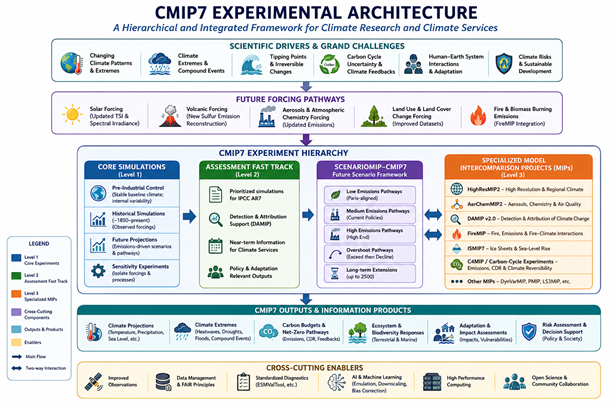
The experimental design of the Coupled Model Intercomparison Project Phase 7 (CMIP7) represents a major evolution from previous CMIP phases. Building on lessons learned from CMIP6, the new framework aims to provide a more flexible, policy-relevant, and scientifically robust architecture capable of addressing emerging climate challenges, including climate extremes, carbon-cycle feedbacks, tipping points, adaptation planning, and net-zero transitions. Unlike earlier phases that largely focused on concentration-driven simulations and fixed experimental structures, CMIP7 adopts a more dynamic framework centered on emissions-driven modeling, enhanced Earth system interactions, periodic updates of forcing datasets, and stronger integration between climate science and societal applications (Dunne et al., 2025).
The CMIP7 design combines a hierarchy of core experiments, specialized Model Intercomparison Projects (MIPs), observational benchmarking activities, and fast-track simulations intended to support the Seventh Assessment Report (AR7) of the Intergovernmental Panel on Climate Change (IPCC). Together, these components create a comprehensive framework for investigating historical climate change, future climate risks, mitigation pathways, adaptation challenges, and Earth system responses across multiple timescales.
5.1 Scenario Development
Scenario development forms the foundation of future climate projections in CMIP7 Climate Modeling. Previous CMIP phases relied heavily on Representative Concentration Pathways (RCPs) and later Shared Socioeconomic Pathways (SSPs) to describe possible climate futures. However, growing emphasis on mitigation policy, carbon dioxide removal, and net-zero targets has motivated the development of more policy-relevant scenario frameworks.
The ScenarioMIP-CMIP7 framework introduces a new generation of scenarios designed through extensive consultation with scientific communities, policymakers, and climate service users (Van Vuuren et al., 2026). The proposed scenarios span a broad range of climate futures, including:
- Low-emission pathways consistent with the Paris Agreement.
- Medium-emission pathways broadly aligned with current policy commitments.
- High-emission pathways designed to explore upper-end climate risks.
- Overshoot pathways that temporarily exceed warming targets before declining.
- Long-term extensions extending simulations to 2500 to investigate climate reversibility and long-term Earth system responses.
In parallel, researchers have proposed a transition toward Representative Emission Pathways (REPs), which directly characterize future emissions trajectories rather than atmospheric concentration outcomes (Meinshausen et al., 2024). These pathways are designed to better support mitigation planning, adaptation assessments, loss-and-damage studies, and global stocktake processes under the Paris Agreement.
A defining feature of CMIP7 scenarios is the growing emphasis on emissions-driven simulations. Rather than prescribing atmospheric greenhouse gas concentrations, many future experiments will directly prescribe anthropogenic emissions, allowing Earth System Models to simulate carbon-cycle feedbacks, land-use interactions, and carbon dioxide removal processes more realistically (Sanderson et al., 2024; Hajima et al., 2025).
5.2 Future Forcing Pathways
CMIP7 introduces major improvements in the treatment of climate forcings. Previous CMIP exercises revealed substantial uncertainties associated with aerosol forcing, volcanic eruptions, solar variability, land-use change, wildfire emissions, and atmospheric chemistry. Consequently, considerable effort has been devoted to developing updated forcing datasets for CMIP7.
Solar Forcing
New solar forcing datasets are being developed to incorporate updated Total and Spectral Solar Irradiance observations, improved energetic particle forcing, and revised reconstructions extending back to the preindustrial era (Funke et al., 2024). Future simulations may also include stochastic solar forcing ensembles to better characterize natural variability.
Volcanic Forcing
CMIP7 employs a substantially revised stratospheric aerosol forcing dataset based on improved volcanic sulfur emission inventories and emission-derived reconstructions. Compared with CMIP6, the new dataset better captures the influence of moderate volcanic eruptions and results in stronger historical aerosol forcing estimates (Aubry et al., 2026).
Aerosol and Atmospheric Chemistry Forcing
Updated anthropogenic aerosol datasets, improved representation of reactive gases, and enhanced treatment of atmospheric chemistry processes form another major innovation. AerChemMIP2 investigates aerosol-climate interactions, air-quality responses, hydrogen emissions, volatile organic compounds, wildfire smoke, and desert dust impacts under future climate scenarios (Fiedler et al., 2026).
Land Use and Fire Forcing
Land-use change and wildfire activity are increasingly recognized as important climate drivers. CMIP7 therefore expands land-use variables and integrates FireMIP experiments to improve understanding of fire-climate feedbacks, ecosystem responses, and carbon-cycle interactions (Li et al., 2026).
Together, these updated forcing pathways provide a more comprehensive representation of both natural and anthropogenic drivers of climate change.
5.3 Experiment Hierarchy
To balance scientific ambition with computational feasibility, CMIP7 adopts a hierarchical experimental structure. This hierarchy allows modeling groups with different computational resources to participate while ensuring that essential simulations are completed consistently across the modeling community.
The experimental framework consists of three broad levels:
Level 1: Core Experiments
These experiments form the minimum participation requirement for CMIP7 and provide the foundation for climate assessment activities. Core simulations include historical runs, pre-industrial control experiments, future scenario projections, and key emissions-driven simulations.
Level 2: Assessment Fast Track (AFT)
The Assessment Fast Track represents a major innovation in CMIP7. These prioritized simulations were selected based on their relevance for climate assessments, adaptation planning, detection and attribution studies, and policy applications. Fast-track experiments are intended to provide timely information for IPCC AR7 and other international climate assessments (Dunne et al., 2025).
Level 3: Community MIPs
A broad collection of specialized Model Intercomparison Projects (MIPs) investigates specific scientific questions related to Earth system processes, climate extremes, carbon cycling, atmospheric chemistry, cryosphere dynamics, and climate impacts. These projects extend the scientific scope of CMIP7 beyond the core experimental framework.
This hierarchical approach allows CMIP7 to maintain scientific diversity while prioritizing simulations with the greatest societal relevance.
5.4 Core Simulations
The core CMIP7 simulation suite forms the backbone of climate projection and assessment activities.
Pre-Industrial Control Simulations
Pre-industrial control runs provide stable baseline climate conditions against which future changes can be evaluated. These simulations are essential for quantifying internal climate variability, assessing model stability, and supporting detection and attribution studies.
Historical Simulations
Historical experiments simulate climate evolution from the mid-nineteenth century to the present day using observed greenhouse gas concentrations, aerosol emissions, volcanic eruptions, solar variability, land-use changes, and other climate forcings.
CMIP7 historical simulations benefit from:
- Improved forcing datasets.
- Enhanced aerosol reconstructions.
- Updated solar forcing.
- Better land-use representations.
- Improved atmospheric chemistry datasets.
These improvements aim to reduce biases identified in CMIP6 and strengthen model evaluation against observations (Aubry et al., 2026; Funke et al., 2024; Fiedler et al., 2025).
Future Projections
Future climate projections explore a range of emissions pathways and socioeconomic futures. A key innovation is the growing use of emissions-driven experiments that explicitly simulate carbon-cycle feedbacks and carbon removal processes (Sanderson et al., 2024; Van Vuuren et al., 2026).
Many scenario simulations will extend beyond 2100, with some extending to 2500 to investigate:
- Long-term climate stabilization.
- Climate reversibility.
- Sea-level rise commitments.
- Carbon-cycle evolution.
- Earth system tipping points.
Sensitivity Experiments
Sensitivity experiments isolate the effects of individual forcings and processes on climate change. These experiments provide crucial insights into uncertainty sources and climate feedback mechanisms.
Examples include:
- Greenhouse-gas-only experiments.
- Aerosol-only experiments.
- Natural-forcing-only experiments.
- Land-use-only experiments.
- Ozone-only experiments.
- Carbon-cycle feedback experiments.
- Carbon dioxide removal experiments.
Projects such as DAMIP v2.0 and flat10MIP are specifically designed to support these analyses and improve understanding of climate attribution, reversibility, and carbon-budget dynamics (Gillett et al., 2025; Sanderson et al., 2025).
5.5 Specialized Model Intercomparison Projects (MIPs)
Specialized MIPs remain one of the defining strengths of CMIP and continue to play a central role in CMIP7.
ScenarioMIP
ScenarioMIP provides future climate pathways representing different emissions trajectories, policy choices, and mitigation strategies (Van Vuuren et al., 2026).
HighResMIP2
HighResMIP2 investigates the role of higher spatial resolution in improving climate simulations, climate extremes, regional climate information, and Earth system process representation (Roberts et al., 2025).
AerChemMIP2
AerChemMIP2 focuses on atmospheric chemistry, aerosols, air quality, and climate forcing uncertainties (Fiedler et al., 2026).
DAMIP v2.0
DAMIP supports detection and attribution studies by quantifying the climate response to individual forcings such as greenhouse gases, aerosols, land-use change, and natural forcings (Gillett et al., 2025).
FireMIP
FireMIP examines wildfire dynamics, fire-climate interactions, ecosystem impacts, and fire-related carbon-cycle feedbacks (Li et al., 2026).
ISMIP7
The Ice Sheet Model Intercomparison Project supports improved understanding of ice-sheet dynamics, cryosphere feedbacks, and future sea-level rise projections (Lösing et al., 2026).
C4MIP and Carbon-Cycle Experiments
Carbon-cycle-focused activities investigate emissions-driven climate change, carbon budgets, carbon removal pathways, and climate reversibility, which have become central scientific priorities in CMIP7 (Sanderson et al., 2024; Sanderson et al., 2025).
5.6 Historical Simulations, Future Projections, and Sensitivity Experiments: An Integrated Framework
The strength of CMIP7 lies in its integrated experimental architecture. Historical simulations establish confidence in model performance by reproducing observed climate variability and change. Future projections explore alternative climate futures under different emissions pathways and policy choices. Sensitivity experiments isolate individual processes and forcing agents, helping identify uncertainty sources and quantify climate feedbacks.
Together, these complementary experiment types create a comprehensive framework capable of addressing CMIP7’s central scientific questions related to climate change patterns, extreme events, carbon-cycle dynamics, climate tipping points, adaptation challenges, and long-term Earth system risks. By combining improved forcing datasets, emissions-driven simulations, specialized MIPs, and fast-track assessment experiments, CMIP7 provides the most ambitious and policy-relevant climate modeling framework developed to date.
6. CMIP7 versus CMIP6: What Has Changed?
The transition from the Coupled Model Intercomparison Project Phase 6 (CMIP6) to CMIP7 represents more than a routine update of climate models and experimental protocols. While CMIP6 substantially advanced climate science through improved Earth System Models (ESMs), expanded scenario frameworks, and enhanced process representation, emerging scientific challenges and lessons learned from recent assessments have motivated a fundamental redesign of the next generation of climate modeling activities. CMIP7 aims to provide more policy-relevant climate information, improve the representation of Earth system feedbacks, strengthen support for adaptation planning, and better characterize uncertainty across multiple timescales (Dunne et al., 2025).
Several major differences distinguish CMIP7 from its predecessor, including the transition toward emissions-driven simulations, expanded Earth system complexity, higher-resolution modeling, improved forcing datasets, stronger integration with climate services, and growing incorporation of artificial intelligence and machine learning approaches. Table 1 summarizes the key differences between CMIP6 and CMIP7.
Table 1. Comparison of major features between CMIP6 and CMIP7
| Feature | CMIP6 | CMIP7 |
|---|---|---|
| Resolution | Typical atmospheric resolution of ~100–200 km with limited eddy-rich ocean simulations. High-resolution experiments largely restricted to HighResMIP1. | Greater emphasis on high-resolution and eddy-permitting simulations through HighResMIP2, improved regional climate representation, enhanced simulation of mesoscale processes, and stronger links to cloud-resolving models (Roberts et al., 2025; Zapponini et al., 2026). |
| Scenarios | Primarily based on Shared Socioeconomic Pathways (SSPs) and concentration-driven simulations. | Expanded ScenarioMIP framework with greater use of emissions-driven scenarios, overshoot pathways, long-term extensions to 2500, and emerging Representative Emission Pathways (REPs) aligned with policy and adaptation needs (Van Vuuren et al., 2026; Meinshausen et al., 2024). |
| Data Volume | Massive growth of climate archives, creating storage and accessibility challenges; variable requests often extensive and inconsistent. | Introduction of Baseline Climate Variables (ESM-BCVs), streamlined data requests, improved variable prioritization, and enhanced data management strategies to improve usability and reduce archive complexity (Juckes et al., 2025; Li et al., 2026). |
| Climate Extremes | Improved representation of some extremes but limited capability for compound events and regional-scale hazard assessment. | Explicit focus on heatwaves, droughts, floods, wildfire interactions, compound events, and climate risk assessment through enhanced diagnostics and higher-resolution simulations (Ruane et al., 2025; Dingley et al., 2026). |
| AI Integration | Limited role of artificial intelligence, primarily used externally for post-processing and statistical applications. | Growing integration of AI and machine learning for model emulation, downscaling, uncertainty analysis, benchmarking, digital twins, and climate service applications (Roberts et al., 2025; Sanderson et al., 2024). |
| Earth System Components | Strong Earth system representation including carbon cycle, atmospheric chemistry, and dynamic vegetation, but several interactions remained simplified. | Expanded treatment of carbon-cycle feedbacks, fire dynamics, freshwater systems, marine biogeochemistry, trophic interactions, cryosphere processes, and tipping-point indicators through dedicated Earth System Data Requests (McPartland et al., 2026; Li et al., 2026). |
| Computational Efficiency | Increasing model complexity often accompanied by high computational costs and limited ensemble sizes. | Greater use of experiment prioritization through the Assessment Fast Track, optimized variable requests, machine-learning-assisted workflows, and targeted simulations designed to maximize scientific return per computational cost (Dunne et al., 2025; Roberts et al., 2025). |
| Carbon-Cycle Representation | Predominantly concentration-driven simulations, limiting explicit carbon-cycle feedback assessment. | Major shift toward emissions-driven simulations capable of representing carbon sinks, carbon removal technologies, net-zero pathways, and climate reversibility (Sanderson et al., 2024; Hajima et al., 2025; Sanderson et al., 2025). |
| Forcing Datasets | Relied on CMIP6-era solar, volcanic, aerosol, and land-use forcing datasets. | Comprehensive updates to solar forcing, volcanic aerosols, anthropogenic aerosols, wildfire emissions, shipping emissions, and atmospheric chemistry forcings to improve historical and future climate simulations (Funke et al., 2024; Aubry et al., 2026; Fiedler et al., 2026). |
| Adaptation and Climate Services | Climate impacts and adaptation studies often conducted as secondary applications of model outputs. | Dedicated Impacts and Adaptation Data Request emphasizing user-driven outputs, climate services, adaptation planning, vulnerability assessment, and decision support (Ruane et al., 2025). |
| Detection and Attribution | DAMIP provided important attribution experiments but was not fully integrated into assessment priorities. | DAMIP v2.0 becomes a core component of the Assessment Fast Track, supporting attribution science, extreme-event analysis, and IPCC AR7 assessments (Gillett et al., 2025). |
| Fire and Air Quality | Fire and air-quality interactions received limited attention in core CMIP activities. | Dedicated FireMIP and AerChemMIP2 projects investigate wildfire-climate feedbacks, atmospheric chemistry, air quality, aerosol forcing, and related climate impacts (Li et al., 2026; Fiedler et al., 2026). |
6.1 From Climate Projection to Earth System Risk Assessment
Perhaps the most important distinction between CMIP6 and CMIP7 is a shift in scientific philosophy. CMIP6 primarily focused on improving climate projections and understanding physical climate processes under alternative socioeconomic pathways. In contrast, CMIP7 is increasingly designed to address broader Earth system risks, including climate tipping points, carbon-cycle feedbacks, biodiversity responses, wildfire dynamics, air quality, and adaptation challenges (Dunne et al., 2025; McPartland et al., 2026).
This transition reflects growing recognition that climate change cannot be understood solely through atmospheric temperature and precipitation projections. Instead, climate assessments increasingly require integrated information on ecosystem responses, water resources, food security, climate extremes, carbon budgets, and societal vulnerability. As a result, CMIP7 expands both the scope and complexity of climate modeling beyond traditional physical climate simulations.
6.2 The Shift Toward Emissions-Driven Climate Modeling
One of the most transformative innovations in CMIP7 is the move from concentration-driven to emissions-driven simulations. In CMIP6, atmospheric greenhouse-gas concentrations were generally prescribed, meaning that carbon-cycle feedbacks were only partially represented. This approach limited the ability of Earth System Models to evaluate net-zero pathways, carbon dioxide removal strategies, and long-term mitigation outcomes.
CMIP7 addresses this limitation by prioritizing emissions-driven experiments in which anthropogenic emissions are specified directly, allowing ESMs to simulate carbon uptake, carbon storage, land-use interactions, and climate-carbon feedbacks dynamically (Sanderson et al., 2024). This transition enables more realistic assessments of carbon budgets, climate reversibility, and the effectiveness of mitigation strategies. Experiments such as flat10MIP and ScenarioMIP-CMIP7 are specifically designed to support these objectives (Sanderson et al., 2025; Van Vuuren et al., 2026).
6.3 Toward More Actionable Climate Information
Another major evolution involves the increasing emphasis on climate services and adaptation planning. The Impacts and Adaptation Data Request reveals strong demand for high-resolution climate information that can support decision-making in agriculture, water management, infrastructure planning, public health, and disaster risk reduction (Ruane et al., 2025). Consequently, CMIP7 prioritizes variables and experiments that directly support impact assessments and climate adaptation strategies.
This user-centered approach represents a significant departure from earlier CMIP phases, where climate projections were often generated primarily for scientific analysis. In CMIP7 Climate Modeling, climate information is increasingly designed to support practical applications and policy decisions.
6.4 A More Flexible and Collaborative Framework
CMIP7 also introduces a more adaptive and collaborative organizational structure. Rather than operating through rigid phases separated by long intervals, CMIP7 emphasizes continuous development, periodic updates to forcing datasets, community-driven consultation processes, and ongoing support for specialized Model Intercomparison Projects (Dunne et al., 2025). Expanded participation from observational scientists, climate service providers, adaptation researchers, and policy stakeholders ensures that future climate simulations address a broader range of scientific and societal needs.
Overall, CMIP7 represents the most ambitious evolution of the CMIP framework to date. While CMIP6 focused primarily on improving climate projections and Earth system complexity, CMIP7 seeks to deliver a more integrated, emissions-driven, high-resolution, and policy-relevant understanding of climate change. By combining improved physical realism with enhanced societal relevance, CMIP7 is positioned to provide the scientific foundation for climate research, adaptation planning, and international climate assessments throughout the coming decade.
7. Research Themes Emerging from Current CMIP7 Literature
Analysis of the current CMIP7 literature reveals a rapidly evolving research landscape that extends well beyond traditional climate projection exercises. The approximately 35 publications reviewed for this study demonstrate that CMIP7 is increasingly focused on addressing complex Earth system interactions, climate risks, adaptation challenges, carbon-cycle feedbacks, and next-generation modeling technologies. Unlike previous CMIP phases, where research themes were often organized around individual climate system components, CMIP7 exhibits a more integrated and interdisciplinary structure that reflects the growing need for actionable climate information and Earth system risk assessment.
Based on thematic synthesis of the available literature, eight major research themes emerge: (1) Model Development and Evaluation, (2) Climate Sensitivity and Uncertainty, (3) Extreme Events, (4) Earth System Feedbacks, (5) Carbon Cycle and Net-Zero Pathways, (6) Regional Climate Projections, (7) AI and Next-Generation Modeling, and (8) Open Science and Data Infrastructure. These themes collectively define the scientific priorities and future direction of CMIP7.
7.1 Theme 1: Model Development and Evaluation
Model development and evaluation remain foundational components of CMIP7. Several studies emphasize the need to improve the representation of key physical, chemical, biological, and cryospheric processes while simultaneously strengthening model benchmarking and validation frameworks. The development of new model configurations such as AWI-CM3, GC5, HadGEM3, and UKESM2 reflects ongoing efforts to improve simulations of ocean circulation, sea ice dynamics, atmosphere–ocean coupling, and Earth system interactions (Blockley et al., 2024; Zapponini et al., 2026).
A major focus of recent literature involves improving model evaluation methodologies. Lauer et al. (2025) introduced enhanced benchmarking capabilities within ESMValTool, enabling systematic comparison of model outputs against observations and CMIP ensembles. Similarly, Beadling et al. (2026) proposed best practices for observational datasets used in climate model evaluation, emphasizing uncertainty characterization, metadata consistency, and robust benchmarking procedures. Reviews of terrestrial biogeochemical validation approaches also revealed substantial inconsistencies in CMIP6 assessments, leading to recommendations for standardized evaluation protocols in CMIP7 (Spafford and MacDougall, 2021).
Together, these studies indicate that model development in CMIP7 is increasingly accompanied by equally rigorous efforts to improve model evaluation, transparency, and reproducibility.
Read about: Monsoon Winds
7.2 Theme 2: Climate Sensitivity and Uncertainty
Understanding climate sensitivity and uncertainty remains one of the central scientific challenges motivating CMIP7. Following debates surrounding high Equilibrium Climate Sensitivity (ECS) values produced by several CMIP6 models, researchers have increasingly focused on improving methodologies for estimating climate sensitivity and identifying uncertainty sources.
Zehrung et al. (2025) demonstrated that ECS estimates can vary substantially depending on methodological choices used in the Gregory method, including anomaly calculations, radiative flux variables, and regression techniques. Their findings highlight the need for standardized approaches to climate sensitivity estimation. At the same time, Mankin et al. (2020) emphasized the importance of Initial Condition Large Ensembles (ICLEs) for separating internal climate variability from structural model uncertainty, particularly for regional adaptation planning.
Several studies also address uncertainty associated with forcing datasets. Updated solar forcing (Funke et al., 2024), aerosol forcing (Fiedler et al., 2025), volcanic forcing (Aubry et al., 2026), and sea surface temperature datasets (Fan et al., 2025) all seek to reduce uncertainties that propagate into climate projections. Collectively, this literature demonstrates that CMIP7 places unprecedented emphasis on understanding, quantifying, and reducing uncertainty across the climate modeling chain.
7.3 Theme 3: Extreme Events
The representation of climate extremes has emerged as one of the most prominent themes in CMIP7 research. Growing societal exposure to heatwaves, droughts, floods, wildfires, and compound hazards has intensified demand for improved simulations of extreme climate events.
The Impacts and Adaptation Data Request identifies high-resolution outputs and enhanced extreme-event representation as key priorities for climate service communities (Ruane et al., 2025). Similarly, the CMIP7 Atmosphere Data Request highlights temperature extremes, precipitation variability, atmospheric circulation changes, and extreme-event diagnostics as major scientific opportunities (Dingley et al., 2026).
Several specialized initiatives support this objective. HighResMIP2 seeks to improve simulation of tropical cyclones, extreme precipitation, and regional climate variability through enhanced spatial resolution (Roberts et al., 2025). FireMIP addresses wildfire dynamics and fire-climate interactions (Li et al., 2026), while AerChemMIP2 investigates atmospheric composition changes associated with extreme pollution and fire events (Fiedler et al., 2026). These efforts collectively indicate that CMIP7 aims to provide more realistic and actionable information on climate hazards and compound risks.
7.4 Theme 4: Earth System Feedbacks
A defining characteristic of CMIP7 is its increasing focus on Earth system feedbacks. Traditional climate modeling often emphasized atmosphere–ocean interactions, whereas CMIP7 expands consideration to include interactions among the atmosphere, ocean, cryosphere, biosphere, hydrosphere, and human systems.
The Earth System Data Request identifies numerous scientific opportunities centered on understanding exchanges of energy, water, carbon, nutrients, and biogeochemical fluxes across Earth system domains (McPartland et al., 2026). Research on boreal fire emissions demonstrates how changes in wildfire activity can alter cloud properties, Arctic warming, sea ice loss, and precipitation patterns (Blanchard-Wrigglesworth et al., 2025). Similarly, studies of ozone evolution reveal complex interactions between atmospheric chemistry and climate-driven circulation changes that may persist for centuries (Tkachenko and Rozanov, 2026).
The inclusion of tipping-point science within CMIP7’s core scientific questions further illustrates growing concern regarding nonlinear Earth system feedbacks and potentially irreversible changes (Dunne et al., 2025). These developments signal a shift toward a more integrated Earth system perspective in climate research.
7.5 Theme 5: Carbon Cycle and Net-Zero Pathways
Among all emerging themes, carbon-cycle science and net-zero pathways arguably represent the most transformative aspect of CMIP7. Several studies argue that concentration-driven simulations used in previous CMIP phases inadequately represent carbon-cycle feedbacks, carbon removal technologies, and mitigation strategies (Sanderson et al., 2024).
As a result, CMIP7 introduces a major shift toward emissions-driven simulations. ScenarioMIP-CMIP7, flat10MIP, and related experiments explicitly incorporate carbon emissions, carbon sinks, and carbon dioxide removal pathways within Earth System Models (Van Vuuren et al., 2026; Sanderson et al., 2025). These experiments are designed to improve understanding of transient climate responses, climate reversibility, net-zero transitions, and long-term carbon budgets.
Research evaluating differences between concentration-driven and emissions-driven simulations further supports this transition, demonstrating that emissions-driven experiments provide a more comprehensive representation of carbon-cycle uncertainty and climate feedbacks (Hajima et al., 2025). Consequently, carbon-cycle dynamics have become one of the central organizing themes of CMIP7.
7.6 Theme 6: Regional Climate Projections
The need for climate information at regional and local scales has become increasingly important as adaptation planning moves from global assessments toward practical implementation. Multiple CMIP7 studies emphasize improving the reliability and usability of regional climate projections.
HighResMIP2 plays a central role in this effort by promoting higher-resolution climate simulations capable of resolving regional atmospheric and oceanic processes (Roberts et al., 2025). Similarly, Zapponini et al. (2026) demonstrate that increased model resolution improves simulations of sea ice variability, ocean circulation, and climate dynamics in polar regions.
Research evaluating CMIP6 models in complex terrain regions highlights continuing challenges associated with topography, precipitation extremes, and drought representation (Shenkut et al., 2025). Goldenson et al. (2023) further propose process-oriented model selection strategies for regional downscaling applications, recognizing that different climate applications require different evaluation criteria. These developments indicate that regional climate prediction has become a core objective of CMIP7 rather than a secondary application of global climate simulations.
7.7 Theme 7: AI and Next-Generation Modeling
Artificial intelligence and machine learning are emerging as transformative technologies within the climate modeling community. Although AI-based approaches remain complementary to process-based Earth System Models, several CMIP7 studies highlight their growing importance.
HighResMIP2 identifies opportunities to use high-resolution climate simulations as training and validation datasets for machine-learning climate models and digital twin applications (Roberts et al., 2025). Similarly, discussions of emissions-driven climate modeling recognize machine learning as part of a broader climate modeling ecosystem that includes Earth System Models, simple climate models, and advanced computational frameworks (Sanderson et al., 2024).
Potential applications include model emulation, uncertainty quantification, parameter optimization, bias correction, downscaling, and rapid scenario exploration. As computational demands continue to increase, AI-assisted workflows may become increasingly important for enhancing efficiency and expanding climate modeling capabilities beyond CMIP7.
7.8 Theme 8: Open Science and Data Infrastructure
The final major theme emerging from CMIP7 literature concerns open science, data management, and research infrastructure. The enormous volume and complexity of CMIP6 archives revealed significant challenges associated with data accessibility, standardization, reproducibility, and long-term usability.
To address these issues, CMIP7 introduces several innovations. The Baseline Climate Variables (ESM-BCVs) initiative seeks to standardize core variable requests and improve consistency across modeling activities (Juckes et al., 2025). Data Request teams for atmosphere, land, Earth system science, and impacts and adaptation all emphasize reducing technical barriers and improving communication between model developers and data users (Li et al., 2026; Dingley et al., 2026; McPartland et al., 2026).
Open-science principles are further supported through enhanced benchmarking frameworks, improved observational datasets, FAIR data practices, ESGF infrastructure improvements, and stronger requirements for data citation and reproducibility (Stockhause and Lautenschlager, 2017; Beadling et al., 2026). These efforts reflect a broader recognition that future advances in climate science depend not only on improved models but also on accessible, transparent, and interoperable scientific infrastructure.
7.9 Synthesis of Emerging Research Directions
The thematic structure of current CMIP7 literature reveals a clear evolution in climate modeling priorities. While previous CMIP phases focused primarily on climate projection and model intercomparison, CMIP7 increasingly emphasizes Earth system risk assessment, climate adaptation, emissions-driven modeling, and decision-relevant climate information. The eight themes identified here are highly interconnected and collectively support CMIP7’s overarching goals of improving physical realism, reducing uncertainty, strengthening climate services, and advancing understanding of complex Earth system interactions.
As CMIP7 develops over the coming years, these research themes are expected to shape future climate assessments, inform mitigation and adaptation policies, and provide the scientific foundation for the IPCC Seventh Assessment Report and subsequent global climate initiatives.
8. CMIP7 Applications Across Disciplines
One of the defining strengths of the Coupled Model Intercomparison Project Phase 7 (CMIP7) is its broad applicability across multiple scientific disciplines and societal sectors. While earlier CMIP phases primarily supported climate science research and global climate assessments, CMIP7 is increasingly designed to generate climate information that is directly relevant to adaptation planning, risk assessment, resource management, and sustainable development. The expanded Earth System Data Request, Impacts and Adaptation Data Request, enhanced scenario framework, and high-resolution modeling initiatives collectively aim to provide climate information that can be translated into actionable knowledge across a wide range of disciplines (Ruane et al., 2025; McPartland et al., 2026).
The shift toward emissions-driven simulations, improved representation of climate extremes, expanded Earth system variables, and stronger links between climate science and decision-making significantly increase the usefulness of CMIP7 outputs for researchers, policymakers, and practitioners. Consequently, CMIP7 is expected to play a central role in advancing interdisciplinary climate research throughout the coming decade.
8.1 Climate Science
Climate science remains the primary domain supported by CMIP7, providing the foundation for understanding future climate change, Earth system responses, and climate-related risks.
Temperature Projections
Temperature projections continue to be among the most widely used outputs from climate models. CMIP7 introduces updated forcing datasets, emissions-driven simulations, and improved climate sensitivity diagnostics that are expected to reduce uncertainties in projected warming trajectories (Zehrung et al., 2025; Funke et al., 2024; Aubry et al., 2026). Long-term scenario extensions to 2500 further enable investigation of climate stabilization pathways, climate reversibility, and long-term warming commitments (Van Vuuren et al., 2026).
These temperature projections will remain essential for:
- Global warming assessments.
- Paris Agreement evaluations.
- Climate tipping-point research.
- Impact and vulnerability studies.
- Future climate adaptation planning.
Precipitation Projections
Accurate precipitation projections are critical because precipitation changes directly affect water availability, agriculture, ecosystems, and disaster risk. High-resolution climate simulations developed under HighResMIP2 are expected to improve representation of precipitation variability, convective systems, monsoon dynamics, and extreme rainfall events (Roberts et al., 2025).
Improved atmospheric physics, aerosol forcing datasets, and land-atmosphere interactions further enhance confidence in future precipitation projections (Dingley et al., 2026; Fiedler et al., 2026). These advances will support regional climate assessments and hydrological applications worldwide.
8.2 Agriculture
Agriculture is one of the sectors most vulnerable to climate variability and climate change. Consequently, agricultural applications represent a major focus of CMIP7-related climate services.
Crop Yield Assessment
Future crop productivity depends strongly on temperature, precipitation, soil moisture, atmospheric CO₂ concentrations, and extreme weather events. CMIP7’s improved representation of carbon-cycle feedbacks, climate extremes, and emissions-driven scenarios provides valuable information for crop simulation models and food security assessments (Sanderson et al., 2024; Ruane et al., 2025).
Enhanced projections of future climate conditions will support:
- Crop suitability analysis.
- Agricultural adaptation planning.
- Food security assessments.
- Climate-smart agriculture strategies.
- Sustainable land management.
Agricultural Drought
Agricultural drought results from complex interactions among precipitation deficits, evapotranspiration, soil moisture depletion, and vegetation stress. The expanded land and Earth system variables available through CMIP7 improve characterization of these processes and strengthen drought monitoring and prediction capabilities (Li et al., 2026; McPartland et al., 2026).
For drought-prone regions, CMIP7 outputs can support:
- Agricultural drought forecasting.
- Crop vulnerability mapping.
- Irrigation planning.
- Yield-loss assessment.
- Climate-resilient agricultural policies.
8.3 Water Resources
Water-resource management increasingly depends on reliable climate projections capable of describing future hydrological conditions under changing climate regimes.
Streamflow Projections
Projected changes in precipitation, snowmelt, glacier dynamics, and evapotranspiration strongly influence river discharge and streamflow variability. CMIP7’s improved representation of cryospheric processes, precipitation dynamics, and land-surface interactions provides enhanced inputs for hydrological models (Lösing et al., 2026; Li et al., 2026).
Streamflow projections derived from CMIP7 simulations will support:
- Reservoir operation planning.
- Water allocation strategies.
- Hydropower management.
- Flood forecasting.
- Drought preparedness.
Hydrological Applications
The expanded freshwater variables included within CMIP7’s Earth System Data Request provide opportunities to improve integrated hydrological assessments (McPartland et al., 2026). These datasets will help researchers evaluate future changes in:
- Surface runoff.
- Groundwater recharge.
- Water availability.
- Basin-scale hydrological responses.
- Water security under climate change.
Such information is increasingly important for climate adaptation and sustainable water-resource management.
8.4 Disaster Risk Reduction
One of the strongest motivations behind CMIP7 is the growing need for climate information that supports disaster risk reduction and climate resilience.
Flood Risk Assessment
Higher-resolution simulations developed through HighResMIP2 improve representation of extreme precipitation events, tropical cyclones, and hydrometeorological hazards (Roberts et al., 2025). Combined with improved precipitation projections and updated forcing datasets, these simulations provide valuable inputs for flood hazard assessments and infrastructure planning.
Drought Risk Assessment
Drought is among the most costly and widespread climate hazards globally. CMIP7’s improved treatment of land-atmosphere interactions, carbon-cycle feedbacks, vegetation dynamics, and climate variability strengthens future drought projections and risk assessments (Ruane et al., 2025; Li et al., 2026).
Heatwave Analysis
Heatwaves are becoming more frequent, intense, and prolonged under climate change. Enhanced climate sensitivity analysis, improved land-surface representation, and higher-resolution simulations are expected to improve projections of future heatwave characteristics and associated health risks (Zehrung et al., 2025; Roberts et al., 2025).
These applications position CMIP7 as a critical resource for climate adaptation and disaster preparedness initiatives.
8.5 Ecosystems
The growing integration of ecosystem processes within Earth System Models significantly expands the relevance of CMIP7 for ecological research and conservation planning.
Biodiversity Assessment
Climate change influences species distributions, habitat suitability, ecosystem functioning, and biodiversity conservation. CMIP7’s expanded Earth system variables, improved climate projections, and long-term scenario simulations provide critical inputs for biodiversity modeling and ecosystem vulnerability assessments (McPartland et al., 2026).
Researchers can use CMIP7 outputs to investigate:
- Species range shifts.
- Habitat fragmentation.
- Ecosystem resilience.
- Conservation planning.
- Climate adaptation strategies for biodiversity.
Forest Ecosystems
Forests play a central role in carbon sequestration, biodiversity conservation, and climate regulation. CMIP7’s improved representation of vegetation dynamics, wildfire processes, carbon cycling, and ecosystem feedbacks supports more realistic assessments of future forest responses to climate change (Li et al., 2026; Blanchard-Wrigglesworth et al., 2025).
Particularly important are new opportunities to evaluate:
- Wildfire risk.
- Forest carbon storage.
- Ecosystem resilience.
- Climate-induced forest transitions.
- Forest management strategies.
8.6 Urban Studies
Urban areas are increasingly vulnerable to climate-related hazards, including extreme heat, flooding, water scarcity, and infrastructure stress. Consequently, urban climate research has become an important application area for CMIP7.
Urban Heat Islands
Urban heat islands (UHIs) arise from complex interactions among land cover, built environments, anthropogenic heat emissions, and atmospheric processes. The higher spatial resolution of future climate simulations enables better representation of urban climate conditions and urban heat exposure (Roberts et al., 2025).
CMIP7 outputs can support:
- Urban heat-risk assessments.
- Climate-resilient urban planning.
- Green infrastructure design.
- Public health interventions.
- Sustainable city development.
As urban populations continue to grow, these applications will become increasingly important for climate adaptation planning.
8.7 Renewable Energy
Renewable energy systems are highly sensitive to climate variability and long-term climate change. CMIP7 projections therefore offer valuable information for energy-sector planning and sustainable energy transitions.
Solar Energy Resources
Solar power generation depends on solar radiation, cloud cover, atmospheric aerosols, and atmospheric circulation patterns. Improved forcing datasets and atmospheric process representation provide more accurate estimates of future solar energy potential (Funke et al., 2024; Fiedler et al., 2026).
CMIP7 simulations can support:
- Solar resource assessment.
- Energy infrastructure planning.
- Renewable energy investment decisions.
- Grid resilience analysis.
Wind Energy Resources
Wind energy production is influenced by atmospheric circulation patterns, pressure gradients, and regional climate variability. Improved atmospheric dynamics and high-resolution climate simulations enhance assessments of future wind-resource availability and variability (Dingley et al., 2026; Roberts et al., 2025).
These applications are particularly important as countries pursue decarbonization strategies and expand renewable energy portfolios.
8.8 Toward Integrated Climate Services
A common thread across all application areas is the growing role of climate services. Unlike previous CMIP phases, which primarily generated climate projections for scientific analysis, CMIP7 explicitly seeks to provide information that supports real-world decision-making. The Impacts and Adaptation Data Request reflects increasing demand for climate information tailored to agriculture, water resources, ecosystems, disaster management, public health, infrastructure planning, and sustainable development (Ruane et al., 2025).
Consequently, CMIP7 represents a major shift from climate modeling as a purely scientific exercise toward climate modeling as a decision-support framework. By combining improved Earth System Models, higher-resolution simulations, emissions-driven scenarios, and adaptation-oriented outputs, CMIP7 is positioned to become a foundational resource for interdisciplinary climate research and climate-resilient development throughout the twenty-first century.
9. Opportunities for Researchers
The transition from CMIP6 to CMIP7 presents unprecedented opportunities for researchers across multiple disciplines. The next generation of climate modeling is not only expanding the complexity of Earth System Models but is also transforming how climate information is generated, evaluated, integrated with observations, and translated into decision-support tools. New experimental frameworks, improved forcing datasets, emissions-driven simulations, enhanced observational integration, and advances in computational technologies create a rich environment for scientific innovation. As CMIP7 progresses, researchers from climate science, remote sensing, artificial intelligence, and impact assessment communities are uniquely positioned to contribute to and benefit from this evolving climate modeling ecosystem.
9.1 Opportunities for Climate Scientists
New Experiments and Scientific Questions
CMIP7 introduces one of the most ambitious experimental portfolios in the history of climate modeling. Beyond traditional historical and future scenario simulations, researchers now have access to a diverse suite of experiments investigating climate sensitivity, carbon-cycle feedbacks, climate reversibility, tipping points, wildfire dynamics, atmospheric chemistry, and Earth system interactions (Dunne et al., 2025).
New initiatives such as:
- ScenarioMIP-CMIP7,
- HighResMIP2,
- AerChemMIP2,
- FireMIP,
- DAMIP v2.0,
- flat10MIP,
provide opportunities to investigate emerging scientific questions that were either poorly addressed or completely absent in previous CMIP phases (Van Vuuren et al., 2026; Fiedler et al., 2026; Li et al., 2026; Sanderson et al., 2025).
Particularly promising research areas include:
- Climate tipping points.
- Carbon dioxide removal pathways.
- Climate reversibility.
- Fire–climate feedbacks.
- Air quality–climate interactions.
- Long-term Earth system responses.
- Climate risk assessment.
The extension of some simulations to the year 2500 further allows exploration of climate commitments and Earth system trajectories far beyond conventional planning horizons (Van Vuuren et al., 2026).
Multi-Model Evaluation and Benchmarking
The increasing diversity of CMIP7 models creates new opportunities for multi-model evaluation studies. Improved benchmarking tools such as ESMValTool, together with expanded observational datasets and standardized diagnostics, facilitate more rigorous model intercomparison than was possible during earlier CMIP phases (Lauer et al., 2025).
Researchers can explore:
- Model performance assessment.
- Structural uncertainty analysis.
- Ensemble weighting strategies.
- Climate sensitivity comparisons.
- Detection and attribution studies.
- Emergent constraints.
The growing availability of Initial Condition Large Ensembles (ICLEs) also enables improved separation of internal climate variability from model uncertainty, supporting more robust climate assessments and adaptation studies (Mankin et al., 2020).
For climate scientists, CMIP7 therefore provides an exceptional platform for advancing understanding of both climate processes and climate prediction uncertainty.
9.2 Opportunities for Remote Sensing Researchers
Validation Datasets for Earth System Models
Remote sensing observations remain one of the most important sources of information for evaluating climate models. The increasing complexity of CMIP7 Earth System Models creates substantial demand for high-quality observational datasets covering atmosphere, land, oceans, cryosphere, vegetation, and biogeochemical processes.
Satellite observations can support validation of:
- Surface temperature.
- Precipitation.
- Soil moisture.
- Vegetation dynamics.
- Snow cover.
- Sea ice extent.
- Aerosol distributions.
- Atmospheric composition.
- Ocean productivity.
Recent CMIP7 evaluation frameworks explicitly emphasize improved observational constraints and standardized benchmarking approaches, creating opportunities for stronger collaboration between climate modelers and Earth observation scientists (Beadling et al., 2026).
The expanded Earth System Data Request further increases demand for satellite-derived datasets capable of evaluating energy, carbon, water, and nutrient cycles (McPartland et al., 2026).
Earth Observation Integration
Beyond validation, Earth observation systems are increasingly becoming integral components of climate modeling workflows. Advances in remote sensing enable continuous monitoring of variables directly relevant to CMIP7 priorities, including:
- Wildfire activity.
- Land-use change.
- Carbon fluxes.
- Atmospheric aerosols.
- Greenhouse gas concentrations.
- Surface water dynamics.
- Cryosphere change.
These datasets provide valuable inputs for model initialization, forcing development, data assimilation, and process evaluation.
Future research opportunities include:
- Satellite-constrained climate simulations.
- Observation-driven model calibration.
- Multi-sensor Earth system monitoring.
- Climate data record development.
- Earth observation–model fusion frameworks.
For geospatial researchers, CMIP7 offers an important opportunity to strengthen the connection between Earth observation science and climate modeling.
9.3 Opportunities for AI Researchers
Hybrid Climate Models
Artificial intelligence and machine learning are rapidly emerging as transformative tools in climate science. Although process-based Earth System Models remain the cornerstone of climate research, AI methods increasingly complement traditional modeling approaches by improving efficiency, scalability, and predictive capability.
CMIP7 creates an ideal environment for developing hybrid climate models that combine:
- Physical climate laws.
- Earth system process representation.
- Machine learning algorithms.
- Data-driven emulators.
Such hybrid approaches can potentially improve simulation speed while preserving physical consistency (Sanderson et al., 2024).
Potential research directions include:
- Physics-informed machine learning.
- Neural climate emulators.
- Surrogate Earth System Models.
- Machine-learning-assisted parameterization.
- AI-based climate diagnostics.
These approaches may help address some of the computational challenges associated with next-generation climate simulations.
Digital Twins of the Earth System
One of the most exciting emerging research frontiers involves the development of digital twins of the Earth system. Digital twins integrate climate models, Earth observations, artificial intelligence, and high-performance computing into dynamic virtual representations of the Earth system.
HighResMIP2 explicitly identifies digital twins as an important future application of high-resolution climate simulations (Roberts et al., 2025).
Potential applications include:
- Real-time climate monitoring.
- Climate forecasting.
- Disaster early-warning systems.
- Urban climate management.
- Adaptation planning.
- Earth system risk assessment.
As digital twin technologies mature, AI researchers will play a central role in designing scalable frameworks capable of integrating climate simulations with continuously evolving observational data streams.
AI for Climate Services
Machine learning also provides opportunities to enhance climate services through:
- Statistical downscaling.
- Bias correction.
- Uncertainty quantification.
- Extreme-event prediction.
- Climate risk mapping.
- Decision-support systems.
As climate information becomes increasingly user-oriented, AI methods will become valuable tools for translating complex model outputs into actionable information.
9.4 Opportunities for Impact Modelers
Sectoral Climate Applications
CMIP7 significantly expands opportunities for researchers working in impact assessment and sector-specific climate applications. The Impacts and Adaptation Data Request was specifically developed to ensure that climate model outputs address the needs of end users and decision-makers (Ruane et al., 2025).
Researchers can use CMIP7 projections to investigate climate impacts across sectors including:
Agriculture
- Crop productivity.
- Agricultural drought.
- Irrigation demand.
- Food security.
- Climate-smart agriculture.
Water Resources
- Streamflow variability.
- Reservoir operations.
- Water scarcity.
- Hydrological extremes.
- Basin-scale adaptation.
Disaster Risk Reduction
- Flood hazards.
- Drought risk.
- Heatwave exposure.
- Wildfire vulnerability.
- Compound climate risks.
Ecosystems and Biodiversity
- Species distribution shifts.
- Habitat suitability.
- Forest resilience.
- Ecosystem services.
- Conservation planning.
Public Health
- Heat-related mortality.
- Air quality impacts.
- Climate-sensitive diseases.
- Urban climate vulnerability.
Energy Systems
- Solar energy potential.
- Wind energy resources.
- Energy demand forecasting.
- Grid resilience.
The expanded variable requests and improved climate services orientation of CMIP7 significantly improve the relevance of climate projections for these applications.
Adaptation and Risk Assessment
A major opportunity lies in integrating CMIP7 outputs into climate adaptation planning and risk assessment frameworks. The growing emphasis on climate extremes, adaptation-relevant variables, and long-term scenario analysis enables more comprehensive assessments of vulnerability, resilience, and adaptation effectiveness (Ruane et al., 2025).
Researchers can evaluate:
- Adaptation pathways.
- Climate resilience strategies.
- Nature-based solutions.
- Infrastructure vulnerability.
- Socioeconomic climate risks.
- Sustainable development planning.
Such studies will become increasingly important as governments and organizations seek evidence-based approaches to climate adaptation.
9.5 A New Era of Interdisciplinary Climate Research
Perhaps the greatest opportunity presented by CMIP7 is the emergence of truly interdisciplinary climate research. Climate scientists, remote sensing specialists, AI researchers, data scientists, ecologists, hydrologists, economists, and policy analysts are increasingly working within shared research frameworks supported by common climate datasets and Earth system simulations.
The integration of emissions-driven modeling, Earth observation systems, machine learning, climate services, and sector-specific applications creates opportunities for collaboration that were largely absent in earlier CMIP phases. As a result, CMIP7 is not simply a new generation of climate models; it is a platform for interdisciplinary innovation capable of addressing some of the most pressing scientific and societal challenges of the twenty-first century.
For researchers entering the field, CMIP7 offers unprecedented opportunities to contribute to climate science, sustainability research, adaptation planning, and Earth system understanding at a truly global scale.
10. Challenges and Limitations
Despite its ambitious vision and substantial methodological advances, CMIP7 faces several scientific, technical, data-related, and institutional challenges that may influence its implementation and long-term effectiveness. Many of these challenges emerged during CMIP6 and have become even more significant as climate models evolve toward higher resolution, greater Earth system complexity, and expanded societal applications. While CMIP7 introduces numerous innovations aimed at addressing previous limitations, important sources of uncertainty and operational constraints remain. Understanding these challenges is essential for interpreting CMIP7 outputs appropriately and identifying priorities for future climate modeling research.
10.1 Scientific Challenges
Structural Uncertainty
Structural uncertainty remains one of the most fundamental challenges in climate modeling. Even when climate models are forced with identical scenarios and boundary conditions, differences in model architecture, parameterizations, numerical schemes, and process representations can produce substantially different climate responses. These differences arise because Earth System Models represent highly complex physical, chemical, biological, and cryospheric processes using simplified mathematical formulations.
The CMIP6 experience demonstrated that model structural uncertainty continues to affect projections of climate sensitivity, precipitation patterns, cloud feedbacks, carbon-cycle dynamics, and regional climate change. One of the most widely discussed examples was the emergence of unusually high Equilibrium Climate Sensitivity (ECS) values in several CMIP6 models, raising questions regarding the representation of cloud feedbacks and radiative processes (Zehrung et al., 2025). Similar concerns extend to simulations of aerosol forcing, vegetation dynamics, wildfire processes, and ocean circulation, where different models often produce divergent responses despite using similar forcing datasets.
CMIP7 attempts to address these issues through enhanced benchmarking frameworks, improved observational constraints, and standardized diagnostics (Lauer et al., 2025; Beadling et al., 2026). However, structural uncertainty cannot be completely eliminated because it reflects fundamental differences in how models represent Earth system processes. Consequently, multi-model ensembles will remain essential for quantifying uncertainty and providing robust climate assessments.
Internal Climate Variability
In addition to structural uncertainty, climate projections are strongly influenced by internal climate variability. Natural fluctuations within the climate system can generate substantial variability across timescales ranging from seasons to centuries, independent of anthropogenic forcing. Examples include:
- El Niño–Southern Oscillation (ENSO),
- Atlantic Multidecadal Variability (AMV),
- Pacific Decadal Oscillation (PDO),
- Arctic Oscillation (AO),
- internal ocean-atmosphere interactions.
These naturally occurring fluctuations can significantly influence regional climate conditions and may temporarily amplify or suppress long-term climate trends.
Mankin et al. (2020) highlighted the importance of Initial Condition Large Ensembles (ICLEs) for separating internal variability from forced climate responses. Their work demonstrated that internal variability can substantially influence regional climate projections, particularly for droughts, precipitation extremes, and adaptation-relevant climate indicators. Although CMIP7 increasingly incorporates large ensemble approaches, fully characterizing internal variability remains a major scientific challenge, especially at regional scales where adaptation decisions are made.
Uncertainty in Earth System Feedbacks
CMIP7 places strong emphasis on Earth system feedbacks involving carbon cycles, vegetation dynamics, cryosphere processes, atmospheric chemistry, and wildfire interactions. However, many of these feedback mechanisms remain poorly constrained by observations.
For example:
- Carbon sink responses to future warming remain uncertain.
- Permafrost carbon release is incompletely understood.
- Wildfire–climate feedbacks are difficult to quantify.
- Ice-sheet instability thresholds remain uncertain.
- Climate tipping points are poorly constrained.
Several CMIP7 studies explicitly identify these uncertainties as key motivations for new experiments and Earth system data requests (McPartland et al., 2026; Dunne et al., 2025). Nevertheless, uncertainty surrounding nonlinear Earth system feedbacks will continue to challenge climate projections for decades to come.
10.2 Technical Challenges
Exascale Computing Requirements
One of the most significant technical challenges facing CMIP7 is the rapidly increasing computational demand of next-generation climate models. Over the past decade, Earth System Models have become substantially more complex, incorporating:
- Interactive carbon cycles,
- Dynamic vegetation,
- Atmospheric chemistry,
- Aerosol processes,
- Ice-sheet dynamics,
- Ocean biogeochemistry,
- Higher spatial resolution.
At the same time, growing demand for large ensembles, longer simulations, and high-frequency output further increases computational requirements.
HighResMIP2 highlights the scientific benefits of kilometer-scale and eddy-rich simulations, including improved representation of tropical cyclones, precipitation extremes, and regional climate variability (Roberts et al., 2025). However, these simulations require enormous computational resources and may only be feasible on emerging exascale supercomputing platforms.
Although advances in high-performance computing continue to improve model capabilities, the gap between scientific ambitions and available computational resources remains a significant constraint. As a result, modeling centers must continually balance resolution, complexity, ensemble size, and experiment diversity.
Computational Trade-Offs
Even with access to advanced computing systems, climate modelers face difficult decisions regarding resource allocation. Increasing model resolution often reduces the number of ensemble members that can be simulated. Similarly, expanding Earth system complexity may limit the feasibility of long-term simulations.
CMIP7 attempts to address these challenges through:
- Assessment Fast Track experiments,
- Prioritized data requests,
- Streamlined variable collections,
- Optimized experiment hierarchies (Dunne et al., 2025).
Nevertheless, computational trade-offs remain unavoidable and will continue influencing experimental design and scientific priorities.
10.3 Data Challenges
Big Climate Data
The volume of climate data generated by CMIP projects has grown exponentially. CMIP6 produced petabytes of climate model output distributed across thousands of variables, experiments, and ensemble members. This rapid growth created significant challenges for:
- Data storage,
- Data transfer,
- Archive management,
- Data accessibility,
- Long-term preservation,
- User analysis capabilities.
CMIP7 is expected to generate even larger datasets due to:
- Higher spatial resolution,
- Larger ensemble sizes,
- Additional Earth system variables,
- Extended simulation periods,
- Expanded diagnostics.
Without effective management strategies, the scientific value of these datasets may be limited by practical accessibility constraints.
Data Standardization and Reproducibility
Another important challenge concerns data consistency and reproducibility. Previous CMIP phases revealed difficulties associated with evolving datasets, metadata inconsistencies, data citation practices, and version control (Stockhause and Lautenschlager, 2017).
To address these issues, CMIP7 introduces initiatives such as:
- Baseline Climate Variables (ESM-BCVs),
- Standardized diagnostics,
- FAIR data principles,
- Enhanced ESGF infrastructure,
- Improved metadata frameworks (Juckes et al., 2025).
While these efforts represent substantial progress, ensuring consistent and reproducible use of increasingly complex climate datasets remains an ongoing challenge.
Observational Constraints
Many CMIP7 research priorities depend on observational datasets for model evaluation and benchmarking. However, observational records themselves contain uncertainties arising from:
- Instrument limitations,
- Spatial coverage gaps,
- Retrieval algorithms,
- Temporal discontinuities,
- Data-processing methods.
Beadling et al. (2026) emphasized that observational uncertainty must be explicitly considered when evaluating model performance. In some cases, disagreement among observational products may be comparable to differences among climate models themselves. Consequently, observational uncertainty remains an important limitation in model evaluation and validation.
10.4 Equity Challenges
Unequal Access to Computing Infrastructure
A major institutional challenge facing CMIP7 is ensuring equitable participation across the global climate research community. The increasing computational demands of climate modeling favor institutions with access to advanced supercomputing facilities, high-speed networks, and large data-storage systems.
Many research groups in developing countries face barriers related to:
- Limited computational infrastructure,
- Restricted access to large climate datasets,
- Insufficient funding,
- Limited technical support,
- Inadequate training opportunities.
As climate modeling becomes increasingly resource-intensive, there is a risk that scientific participation may become concentrated among a relatively small number of well-funded institutions.
Participation from Developing Countries
The need for broader participation is particularly important because many developing countries are among the most vulnerable to climate change impacts. Yet researchers from these regions often face challenges in accessing CMIP data, conducting high-resolution analyses, or contributing directly to model development activities.
The growing emphasis on climate services, adaptation planning, and regional climate information makes inclusive participation even more important. Climate information must reflect diverse environmental conditions, socioeconomic contexts, and stakeholder needs. Expanding access to data, computational resources, training programs, and collaborative networks therefore remains a critical priority for the CMIP7 community.
Bridging the Global Climate Knowledge Gap
CMIP7’s success will depend not only on scientific advances but also on its ability to support a globally inclusive climate research ecosystem. Efforts to improve open data access, standardized workflows, community-driven MIPs, and international collaboration represent important steps toward reducing barriers to participation. However, substantial disparities remain in research capacity between developed and developing countries.
Addressing these inequities will be essential for ensuring that future climate assessments benefit from diverse perspectives and effectively support adaptation and resilience efforts worldwide.
10.5 Looking Beyond CMIP7
The challenges facing CMIP7 highlight a broader reality: as climate models become increasingly sophisticated, the complexity of scientific, technical, and societal challenges also increases. Structural uncertainty, internal variability, computational limitations, data management issues, and inequitable access to resources cannot be completely eliminated. Instead, future progress will depend on continued advances in observations, high-performance computing, artificial intelligence, data infrastructure, and international collaboration.
Despite these challenges, CMIP7 represents a major step forward in climate science. By explicitly acknowledging and addressing many of the limitations encountered during CMIP6, the CMIP7 community is laying the groundwork for a more robust, transparent, inclusive, and policy-relevant climate modeling framework capable of supporting climate research and decision-making throughout the twenty-first century.
11. Future Directions
As climate science enters an era of increasing environmental complexity, societal vulnerability, and technological advancement, CMIP7 is widely viewed not as the final destination of climate modeling but as a bridge toward the next generation of Earth system prediction frameworks. The literature reviewed in this study reveals that the future of climate modeling will likely be characterized by tighter integration between observations, artificial intelligence, Earth system science, and societal decision-making. Several emerging concepts—including climate digital twins, AI-driven Earth system modeling, near-real-time climate prediction, and coupled human–natural system simulations—are already shaping discussions surrounding the long-term evolution of CMIP7 and the potential vision for CMIP8.
The transition toward these next-generation capabilities reflects a broader shift in climate science from retrospective understanding toward predictive, adaptive, and operational Earth system intelligence. As climate risks intensify and decision-making timelines shorten, future climate modeling systems will need to become faster, more integrated, and increasingly responsive to real-world challenges.
11.1 Climate Digital Twins
One of the most transformative concepts emerging from the CMIP7 literature is the development of climate digital twins. A digital twin can be defined as a dynamic virtual representation of the Earth system that continuously integrates observations, simulations, and predictive models to replicate real-world conditions in near real time.
Traditionally, climate models have operated as standalone simulation systems that produce projections for specific scenarios and time periods. Digital twins, by contrast, would create continuously evolving representations of the atmosphere, oceans, cryosphere, biosphere, and human systems using both observational data and advanced computational models.
Recent CMIP7 discussions, particularly within HighResMIP2, identify digital twins as a major future application of high-resolution climate simulations (Roberts et al., 2025). Such systems could enable:
- Continuous climate monitoring.
- Near-real-time hazard assessment.
- Adaptive climate forecasting.
- Virtual testing of mitigation strategies.
- Evaluation of adaptation measures.
- Scenario exploration for policymakers.
For example, digital twins could allow decision-makers to assess how different land-use policies, carbon removal strategies, or infrastructure investments influence future climate outcomes before implementing them in the real world.
The development of climate digital twins will likely require unprecedented integration among Earth observations, climate models, artificial intelligence, cloud computing, and high-performance computing infrastructure.
11.2 AI-Driven Earth System Modeling
Artificial intelligence is rapidly becoming one of the most important technological developments in climate science. While traditional Earth System Models remain essential for physically consistent climate simulations, AI methods offer opportunities to complement and enhance existing modeling frameworks.
Current CMIP7 literature already recognizes machine learning as a valuable tool for:
- Model emulation.
- Bias correction.
- Downscaling.
- Parameter optimization.
- Uncertainty quantification.
- Data assimilation.
Future AI-driven Earth system modeling may move beyond these supporting roles and become integrated directly into climate simulation frameworks (Sanderson et al., 2024; Roberts et al., 2025).
Several emerging research directions include:
Physics-Informed Machine Learning
Unlike purely data-driven approaches, physics-informed AI incorporates physical laws directly into machine-learning architectures. These methods can improve computational efficiency while maintaining physical realism.
Earth System Emulators
AI-based climate emulators can reproduce complex climate model behavior at a fraction of the computational cost. Such systems may allow rapid exploration of thousands of climate scenarios that would be impractical using conventional Earth System Models.
Hybrid Climate Models
Hybrid frameworks combine process-based climate models with machine-learning components. These systems may improve representation of processes that are difficult to model explicitly, such as cloud formation, vegetation dynamics, and sub-grid atmospheric processes.
Intelligent Climate Services
AI systems may also support automated climate-risk assessments, decision-support tools, and personalized climate services tailored to specific sectors and stakeholders.
As computational demands continue to increase, AI-assisted Earth system modeling is likely to become a central component of future climate research infrastructures.
11.3 Near-Real-Time Climate Prediction
Historically, climate models have primarily focused on long-term projections extending decades or centuries into the future. However, increasing societal demand for climate information is creating a need for more operational prediction systems capable of supporting decision-making on seasonal, annual, and decadal timescales.
The convergence of Earth observations, high-performance computing, and machine learning is creating opportunities for near-real-time climate prediction systems. Future climate modeling frameworks may continuously assimilate information from:
- Satellites.
- Ground observations.
- Ocean observing networks.
- Atmospheric monitoring systems.
- Carbon monitoring programs.
These systems could provide regularly updated climate outlooks capable of supporting:
- Drought early warning.
- Flood forecasting.
- Agricultural planning.
- Energy management.
- Water-resource allocation.
- Disaster preparedness.
The increasing availability of high-resolution simulations under CMIP7 provides an important foundation for such applications. By combining continuous observations with advanced Earth System Models, future climate prediction systems may increasingly blur the traditional distinction between weather forecasting and climate projection.
11.4 Coupled Human–Natural Systems
Another major future direction involves stronger integration of human systems within Earth system simulations. Previous generations of climate models largely treated human activities as external forcing factors represented through emissions scenarios and land-use assumptions. However, growing recognition of feedbacks between society and the environment has stimulated interest in coupled human–natural system modeling.
Future climate frameworks may explicitly represent interactions among:
- Population dynamics.
- Urbanization.
- Agricultural systems.
- Water management.
- Economic development.
- Energy transitions.
- Land-use decisions.
- Climate adaptation strategies.
Several CMIP7 initiatives already move in this direction. The Impacts and Adaptation Data Request emphasizes climate information designed to support societal decision-making, while emissions-driven simulations incorporate stronger links between human activities and climate outcomes (Ruane et al., 2025; Sanderson et al., 2024).
Coupled human–natural system models could help answer critical questions such as:
- How will adaptation measures influence future climate vulnerability?
- How will land-management practices affect carbon budgets?
- What are the long-term consequences of different mitigation pathways?
- How do socioeconomic decisions alter climate risk trajectories?
Such integrated frameworks are expected to become increasingly important as climate science evolves toward sustainability-oriented decision support.
11.5 Toward a CMIP8 Vision
Although CMIP7 is still in its early stages of implementation, many emerging developments already provide insight into what a future CMIP8 framework may look like. The progression from CMIP5 to CMIP6 and now CMIP7 demonstrates a clear trend toward greater Earth system complexity, higher resolution, improved observations, and stronger societal relevance.
Based on current research directions, several characteristics are likely to define a future CMIP8:
Fully Emissions-Driven Earth System Simulations
The transition toward emissions-driven modeling initiated in CMIP7 may become the standard approach in CMIP8, enabling more realistic representation of carbon-cycle feedbacks, mitigation strategies, and carbon dioxide removal technologies.
Kilometer-Scale Global Climate Models
Advances in exascale computing could allow routine global simulations at kilometer-scale resolution, dramatically improving representation of clouds, convection, precipitation, urban environments, and climate extremes.
Operational Climate Digital Twins
Climate digital twins may evolve from experimental concepts into operational Earth system platforms supporting climate monitoring, prediction, and policy evaluation.
AI-Native Climate Modeling
Machine learning may become deeply integrated into climate modeling workflows, enabling hybrid Earth System Models that combine physical realism with computational efficiency.
Integrated Human–Earth System Frameworks
Future climate assessments may move beyond physical climate projections to include coupled simulations of environmental, economic, social, and technological systems.
Continuous Climate Assessment
Rather than producing major climate assessments every five to seven years, future CMIP frameworks may support continuously updated climate information systems that evolve alongside observations and scientific understanding.
11.6 From CMIP7 to the Future of Earth System Intelligence
The future directions emerging from CMIP7 literature suggest a profound transformation in climate science. Climate models are evolving from tools designed primarily for scientific investigation into integrated Earth system intelligence platforms capable of supporting adaptation, mitigation, sustainability planning, and risk management.
Digital twins, artificial intelligence, near-real-time prediction systems, and coupled human–natural models collectively point toward a future in which climate information becomes more dynamic, actionable, and responsive to societal needs. While significant scientific, computational, and institutional challenges remain, CMIP7 provides a crucial stepping stone toward this vision.
Ultimately, the legacy of CMIP7 may extend beyond improved climate projections. It may mark the beginning of a new era in which Earth system modeling becomes an operational component of global decision-making, helping societies navigate the increasingly complex challenges of climate change throughout the twenty-first century.
12. Key Takeaways
- CMIP7 (Coupled Model Intercomparison Project Phase 7) represents the next generation of global climate modeling, designed to support future climate assessments, including the IPCC Seventh Assessment Report (AR7), while addressing emerging scientific and societal challenges.
- CMIP7 moves beyond traditional climate projection frameworks by emphasizing Earth system risk assessment, climate adaptation, mitigation planning, and decision-support applications rather than focusing solely on long-term climate change projections.
- A major innovation is the transition toward emissions-driven simulations, enabling Earth System Models to explicitly represent carbon-cycle feedbacks, carbon dioxide removal strategies, net-zero pathways, climate reversibility, and long-term carbon budget dynamics.
- Improved Earth System Models will provide more comprehensive representation of atmosphere, oceans, cryosphere, biosphere, carbon cycling, atmospheric chemistry, wildfire processes, freshwater systems, and ecosystem interactions, resulting in more realistic climate simulations.
- Higher-resolution climate simulations through initiatives such as HighResMIP2 are expected to improve projections of regional climate variability, heatwaves, droughts, floods, tropical cyclones, and extreme precipitation, thereby supporting climate adaptation and disaster risk reduction.
- CMIP7 introduces enhanced forcing datasets, including updated solar, volcanic, aerosol, atmospheric chemistry, land-use, and wildfire forcings, helping reduce uncertainties in historical climate simulations and future projections.
- Climate extremes, tipping points, and compound events have become central research priorities, reflecting growing concerns about climate risks, ecosystem vulnerability, and the increasing societal impacts of climate change.
- The project creates significant opportunities for researchers across disciplines, including climate scientists, remote sensing specialists, artificial intelligence researchers, hydrologists, ecologists, agricultural scientists, and climate-impact modelers through new experiments, datasets, and interdisciplinary applications.
- Artificial intelligence and machine learning are emerging as important complements to traditional climate models, supporting model emulation, downscaling, bias correction, uncertainty quantification, climate services, and future digital twin applications.
- The long-term vision of CMIP7 extends toward climate digital twins, near-real-time Earth system prediction, coupled human–natural system modeling, and AI-enhanced climate intelligence platforms, laying the foundation for the future evolution of climate modeling and a potential CMIP8 framework.
- Despite challenges related to structural uncertainty, computational requirements, big climate data management, and equitable participation, CMIP7 represents the most ambitious and policy-relevant climate modeling initiative to date, offering transformative opportunities for advancing climate science and supporting climate-resilient development worldwide.
- Ultimately, CMIP7 is expected to redefine how climate information is generated, interpreted, and applied, bridging the gap between climate science, Earth observation, artificial intelligence, and societal decision-making to address the complex challenges of the twenty-first century.
What is CMIP7?
CMIP7 (Coupled Model Intercomparison Project Phase 7) is the latest phase of the international climate-modeling initiative coordinated by the World Climate Research Programme (WCRP). It provides a standardized framework through which climate modeling centers around the world conduct coordinated experiments using Earth System Models (ESMs). The primary objective of CMIP7 is to improve understanding of climate change, Earth system feedbacks, climate risks, carbon-cycle dynamics, and adaptation challenges while providing scientific evidence for future climate assessments and policy decisions (Dunne et al., 2025).
Unlike previous phases, CMIP7 places greater emphasis on emissions-driven simulations, climate extremes, Earth system risks, climate services, and decision-relevant climate information.
When Will CMIP7 Data Become Available?
CMIP7 is currently transitioning from planning and experimental design into model implementation and simulation phases. Several forcing datasets, experimental protocols, and specialized Model Intercomparison Projects (MIPs) have already been published, while modeling centers are actively preparing CMIP7 simulations.
The first major datasets are expected to emerge through the Assessment Fast Track (AFT) experiments, which have been specifically designed to provide timely climate information for upcoming international climate assessments, including the IPCC Seventh Assessment Report (AR7) (Dunne et al., 2025). Additional datasets from ScenarioMIP, HighResMIP2, AerChemMIP2, FireMIP, and other CMIP7 activities will become available progressively throughout the late 2020s.
Because CMIP7 follows a more flexible and evolving framework than previous CMIP phases, new datasets, forcing updates, and experimental outputs may continue to be released over an extended period rather than through a single coordinated release.
How Is CMIP7 Different from CMIP6?
Although CMIP7 builds directly upon CMIP6, several important differences distinguish the two phases.
The most significant change is the shift toward emissions-driven climate simulations, allowing Earth System Models to explicitly simulate carbon-cycle feedbacks, carbon sinks, land-use interactions, and carbon dioxide removal pathways rather than relying primarily on prescribed atmospheric greenhouse-gas concentrations (Sanderson et al., 2024; Hajima et al., 2025).
Other major differences include:
Greater focus on climate extremes and compound events.
Improved representation of Earth system feedbacks.
Enhanced atmospheric chemistry and air-quality modeling.
Higher-resolution climate simulations through HighResMIP2.
Expanded Earth System Data Requests.
Stronger support for climate adaptation and climate services.
Increased use of machine learning and digital-twin concepts.
Improved forcing datasets for aerosols, volcanic eruptions, solar variability, and wildfire emissions.
Overall, CMIP7 represents a shift from traditional climate projection toward integrated Earth system risk assessment and decision-support science.
Will CMIP7 Be Used in Future IPCC Assessments?
Yes. One of the primary motivations behind CMIP7 is to support future international climate assessments, particularly the IPCC Seventh Assessment Report (AR7).
To facilitate this objective, CMIP7 includes an Assessment Fast Track (AFT) framework that prioritizes experiments and simulations most relevant to climate assessment needs (Dunne et al., 2025). These simulations will provide updated information on:
Future warming projections.
Climate sensitivity.
Extreme events.
Carbon budgets.
Climate mitigation pathways.
Adaptation challenges.
Earth system feedbacks.
Beyond AR7, CMIP7 outputs are also expected to support national climate assessments, adaptation planning, climate services, and international climate policy processes.
Can CMIP7 Improve Drought Projections?
Yes. Improving drought assessment and drought-risk prediction is one of the areas where CMIP7 is expected to provide substantial benefits.
Several innovations directly contribute to enhanced drought projections:
Higher Spatial Resolution
HighResMIP2 simulations provide improved representation of precipitation patterns, soil moisture variability, land–atmosphere interactions, and regional climate processes, all of which influence drought development (Roberts et al., 2025).
Improved Land-Surface Processes
Expanded Land and Land-Ice Data Requests include variables related to soil moisture, vegetation dynamics, evapotranspiration, freshwater systems, and ecosystem responses, enabling more realistic drought analysis (Li et al., 2026).
Emissions-Driven Climate Simulations
The transition toward emissions-driven modeling allows improved representation of carbon-cycle feedbacks and vegetation-climate interactions that influence drought severity and ecosystem resilience (Sanderson et al., 2024; Hajima et al., 2025).
Enhanced Climate Extremes Framework
CMIP7 explicitly prioritizes droughts, heatwaves, compound events, and climate-risk assessments through its Atmosphere and Impacts & Adaptation Data Requests (Ruane et al., 2025; Dingley et al., 2026).
Better Support for Drought Applications
The adaptation-focused philosophy of CMIP7 means that future climate datasets will be more useful for:
Agricultural drought assessment.
Hydrological drought monitoring.
Water-resource planning.
Drought early-warning systems.
Climate adaptation strategies.
For researchers working on agricultural drought, hydrological drought, and climate-risk assessment, CMIP7 is expected to provide more physically realistic, higher-resolution, and decision-relevant climate information than previous CMIP generations.
Why Should Researchers Pay Attention to CMIP7?
CMIP7 represents one of the most significant developments in climate science since the introduction of Earth System Models. It combines advances in climate modeling, Earth observation, atmospheric chemistry, carbon-cycle science, artificial intelligence, and climate services within a unified framework.
For researchers, CMIP7 offers opportunities to:
Investigate emerging climate risks.
Improve climate model evaluation.
Explore net-zero and carbon-removal pathways.
Develop AI-assisted climate applications.
Integrate Earth observations with climate simulations.
Advance climate adaptation and resilience research.
As the next decade of climate science unfolds, CMIP7 is expected to become the primary source of climate projections and Earth system information used across research, policy, and operational climate services worldwide.

2 thoughts on “CMIP7 Climate Modeling: The Complete Researcher’s Guide to the Next Generation of Climate Science”