
What Is Bibliometric Analysis?
today’s era of rapidly expanding scientific literature, keeping track of research developments across a discipline has become increasingly challenging. Thousands of articles are published every year, making it difficult for researchers to identify influential studies, emerging themes, leading contributors, and knowledge gaps. Bibliometric analysis has emerged as a powerful solution to this challenge. Bibliometric analysis has emerged as one of the most powerful methods for understanding scientific literature, identifying influential research, and mapping the evolution of knowledge across disciplines.
Bibliometric analysis is a quantitative research method used to evaluate and analyze scientific publications and their relationships. Rather than reviewing individual studies one by one, it examines large collections of scholarly documents using publication metadata such as authors, citations, keywords, affiliations, journals, and references. By transforming publication records into measurable data, bibliometric analysis helps researchers understand how a research field has evolved over time and where it is heading.
Unlike traditional literature reviews that rely primarily on qualitative interpretation, bibliometric analysis employs statistical and network-based techniques to uncover hidden patterns within scientific knowledge. It can reveal which authors, institutions, countries, and journals have contributed most significantly to a field, while also identifying influential publications, collaboration networks, and thematic research clusters.
One of the key strengths of bibliometric analysis is its ability to handle large volumes of scientific information. Modern databases such as Scopus and Web of Science contain millions of research records, and specialized tools like VOSviewer, Bibliometrix, Gephi, and CiteSpace enable researchers to process and visualize these datasets efficiently. As a result, bibliometric studies can provide a comprehensive overview of a research domain that would be difficult to achieve through manual review alone.
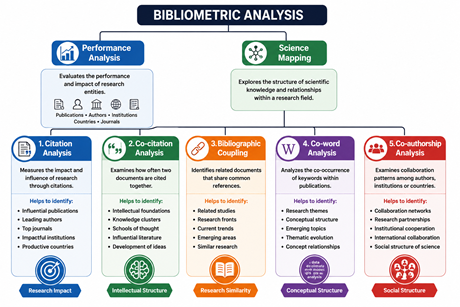
Bibliometric analysis is generally conducted for two main purposes. The first is performance analysis, which evaluates the productivity and impact of research contributors such as authors, institutions, countries, and journals. The second is science mapping, which explores the intellectual structure of a field by examining relationships among publications, citations, keywords, and researchers. Together, these approaches provide both a quantitative assessment of research performance and a deeper understanding of the knowledge structure underlying a scientific discipline.
Over the past decade, bibliometric analysis has become increasingly popular across diverse fields, including environmental science, medicine, engineering, business, social sciences, and geospatial research. Researchers use it to identify emerging trends, discover research gaps, understand collaboration patterns, and generate future research directions. Consequently, bibliometric analysis is now regarded as one of the most effective approaches for synthesizing large bodies of literature and mapping the evolution of scientific knowledge.
In simple terms, bibliometric analysis can be viewed as the science of studying science itself. By analyzing publication patterns and knowledge networks, it enables researchers to move beyond individual articles and gain a broader understanding of how a field develops, who drives its progress, and where future opportunities for research may lie.
“Bibliometric analysis is not merely about counting publications or citations; it is about understanding the patterns, relationships, and knowledge structures that drive scientific progress.”
Why Is Bibliometric Analysis Becoming So Popular?
The popularity of bibliometric analysis has grown dramatically over the past decade, largely due to the unprecedented expansion of scientific literature and the increasing need for evidence-based research synthesis. With thousands of articles being published every day across diverse disciplines, researchers face a significant challenge in identifying influential studies, emerging topics, and future research directions. Traditional review methods, while valuable, often struggle to manage such vast amounts of information efficiently. Bibliometric analysis addresses this challenge by providing a systematic, quantitative, and reproducible approach to exploring large bodies of literature.
One of the primary reasons for its growing adoption is the rapid increase in digital academic databases such as Scopus, Web of Science, Dimensions, and Google Scholar. These platforms provide access to extensive publication metadata, making it possible to analyze thousands of research records simultaneously. Combined with advances in computational tools and data visualization software, researchers can now generate comprehensive insights into a field within a relatively short period.
Another important factor is the increasing demand for objective and transparent literature assessments. Traditional narrative reviews often depend on the author’s interpretation and may be influenced by selection bias. Bibliometric analysis, in contrast, relies on measurable indicators such as publication counts, citation metrics, collaboration networks, and keyword occurrences. This data-driven approach enhances transparency and allows findings to be replicated and verified by other researchers.
The emergence of user-friendly bibliometric software has also contributed significantly to its popularity. Tools such as VOSviewer, Bibliometrix, CiteSpace, and Gephi enable researchers to perform sophisticated analyses and create visually appealing network maps without requiring advanced programming skills. These visualizations help simplify complex scientific relationships and make research findings easier to interpret and communicate.
Bibliometric analysis is particularly valuable because it serves multiple research purposes simultaneously. It can identify the most influential authors, institutions, countries, and journals within a field, while also revealing collaboration patterns, intellectual foundations, thematic clusters, and emerging research fronts. This comprehensive perspective helps researchers quickly understand the structure and evolution of a discipline, making it an effective starting point for new research projects.
Funding agencies, policymakers, universities, and research organizations are increasingly using bibliometric studies to evaluate scientific performance and guide strategic decision-making. By identifying leading research areas and influential contributors, bibliometric analysis supports research planning, funding allocation, institutional benchmarking, and policy development. Consequently, its relevance extends far beyond academic literature reviews.
The interdisciplinary nature of modern scientific research has further accelerated the adoption of bibliometric methods. Fields such as climate change, artificial intelligence, sustainability, public health, remote sensing, and environmental management often involve thousands of interconnected studies spanning multiple disciplines. Bibliometric analysis provides a powerful framework for mapping these complex knowledge networks and understanding how different research domains interact.
Perhaps most importantly, bibliometric analysis enables researchers to move from simply reviewing literature to understanding the broader dynamics of scientific knowledge production. It helps answer questions such as:
- Who are the leading researchers in a field?
- Which studies have had the greatest impact?
- What topics are gaining attention?
- How have research themes evolved over time?
- Where are the current knowledge gaps?
- What directions should future research take?
As scientific publication continues to grow at an unprecedented rate, bibliometric analysis is becoming an essential research tool rather than a specialized technique. Its ability to combine quantitative rigor, visual exploration, and strategic insight makes it one of the most powerful approaches for understanding and navigating the modern research landscape.
Bibliometric Analysis vs Systematic Review vs Meta-Analysis
As the volume of scientific literature continues to grow, researchers increasingly rely on evidence-synthesis methods to understand existing knowledge and identify future research directions. Among the most widely used approaches are bibliometric analysis, systematic reviews, and meta-analysis. Although these methods share the common goal of synthesizing research, they differ significantly in their objectives, methodology, data sources, and outcomes. Understanding these differences is essential for selecting the most appropriate approach for a research question.
Bibliometric Analysis
Bibliometric analysis is a quantitative method that examines the characteristics and relationships of scientific publications using publication metadata such as authors, citations, keywords, institutions, journals, and references. Rather than focusing on the findings of individual studies, bibliometric analysis investigates the structure and evolution of an entire research field.
The primary objective is to answer questions such as:
- Who are the most influential authors and institutions?
- Which countries contribute most to a research area?
- What are the major research themes?
- How have research trends evolved over time?
- What collaborations exist among researchers?
Bibliometric studies typically analyze hundreds or even thousands of publications and use techniques such as citation analysis, co-citation analysis, bibliographic coupling, co-word analysis, and co-authorship analysis. The outputs often include performance indicators, network maps, thematic clusters, and research trend visualizations.
Systematic Review
A systematic review is a structured and transparent method for identifying, selecting, evaluating, and synthesizing relevant studies related to a specific research question. Unlike traditional narrative reviews, systematic reviews follow predefined protocols designed to minimize bias and ensure reproducibility.
The goal of a systematic review is to critically assess existing evidence and provide a comprehensive understanding of what is currently known about a topic.
Researchers conducting systematic reviews typically:
- Develop a focused research question.
- Define inclusion and exclusion criteria.
- Perform comprehensive database searches.
- Screen and evaluate studies.
- Assess study quality.
- Synthesize findings qualitatively.
Systematic reviews emphasize the content and findings of individual studies rather than publication relationships. As a result, they usually involve a relatively smaller number of carefully selected studies compared with bibliometric analyses.
Meta-Analysis
Meta-analysis is a statistical extension of a systematic review that quantitatively combines the results of multiple empirical studies addressing the same research question. The objective is to calculate an overall effect size and provide a more precise estimate of a relationship or intervention outcome.
Meta-analysis is commonly used in fields such as medicine, psychology, public health, and environmental science where multiple studies report comparable statistical results.
A meta-analysis typically involves:
- Collecting studies through a systematic review process.
- Extracting numerical results.
- Standardizing effect sizes.
- Performing statistical integration.
- Evaluating heterogeneity among studies.
- Assessing publication bias.
The final output is usually a pooled statistical estimate supported by confidence intervals and significance testing.
Key Differences
The three approaches differ in both purpose and methodology:
| Aspect | Bibliometric Analysis | Systematic Review | Meta-Analysis |
|---|---|---|---|
| Primary Objective | Analyze research trends, impact, and knowledge structure | Synthesize existing evidence | Quantitatively combine study results |
| Data Source | Publication metadata | Full-text studies | Numerical results from studies |
| Focus | Publications and relationships | Research findings | Statistical effect sizes |
| Number of Studies | Hundreds to thousands | Usually tens to hundreds | Usually selected studies with comparable data |
| Methods | Citation and network analysis | Critical appraisal and qualitative synthesis | Statistical aggregation |
| Main Outputs | Research trends, networks, thematic maps | Evidence synthesis and knowledge gaps | Combined effect size and statistical conclusions |
| Best Used For | Mapping a research field | Answering a focused research question | Measuring the overall magnitude of an effect |
Which Method Should Researchers Choose?
The choice depends on the research objective.
If the goal is to understand the evolution of a research field, identify influential contributors, discover emerging themes, and map scientific knowledge, bibliometric analysis is the most suitable approach.
If the objective is to summarize and critically evaluate existing evidence on a specific topic, a systematic review is more appropriate.
If researchers want to statistically determine the overall effect of an intervention, treatment, or relationship across multiple studies, meta-analysis provides the strongest quantitative evidence.
In many modern studies, these approaches are increasingly used together. Researchers may begin with a bibliometric analysis to explore the landscape of a field, conduct a systematic review to assess the evidence in depth, and finally perform a meta-analysis when sufficient comparable quantitative data are available. Together, these methods provide complementary perspectives that strengthen research synthesis and support evidence-based decision-making.
The Two Pillars of Bibliometric Analysis
Bibliometric analysis is built upon two complementary approaches: performance analysis and science mapping. According to Donthu et al. (2021), these two approaches form the foundation of modern bibliometric research. While performance analysis focuses on evaluating the contribution and impact of research constituents, science mapping examines the relationships among those constituents to reveal the intellectual and social structure of a research field.
Together, these approaches provide a comprehensive understanding of scientific knowledge by answering two fundamental questions: Who contributes to a field and how influential are they? and How is knowledge within the field structured and connected?
Performance Analysis
Performance analysis focuses on assessing the productivity and impact of different research constituents. The objective is to evaluate the contribution of authors, institutions, countries, journals, and publications within a particular research domain.
This approach uses bibliographic information to identify the most influential contributors and to understand how research performance varies across different entities. Performance analysis helps researchers determine which authors publish the most, which institutions lead a field, which countries dominate research output, and which journals have the greatest scientific influence.
Common constituents evaluated through performance analysis include:
- Authors
- Institutions
- Countries
- Journals
- Articles
The outcomes of performance analysis are often presented through indicators such as publication productivity and citation impact. These indicators provide valuable insights into the development and maturity of a research field and help identify major contributors to scientific progress.
In essence, performance analysis answers the question:
“Who is contributing to the field and what impact are they making?”
Science Mapping
While performance analysis focuses on impact and productivity, science mapping focuses on relationships. Science mapping examines the connections among publications, authors, journals, institutions, and keywords to uncover the intellectual structure of a research field.
The primary purpose of science mapping is to visualize how knowledge develops, how research topics are connected, and how scientific communities interact. By exploring these relationships, researchers can identify major research themes, knowledge clusters, collaboration patterns, and emerging areas of investigation.
Science mapping provides a graphical representation of scientific knowledge and helps reveal structures that may not be immediately visible through traditional literature reviews. It allows researchers to understand how ideas evolve over time and how different research streams contribute to the development of a discipline.
According to Donthu et al. (2021), science mapping can be performed through several analytical techniques that examine relationships among research constituents. These techniques help researchers explore intellectual, conceptual, and social structures within a field.
In simple terms, science mapping answers the question:
“How is knowledge within the field organized and connected?”
Why Both Pillars Are Important
Performance analysis and science mapping serve different but complementary purposes. Performance analysis identifies the most influential contributors and evaluates research impact, whereas science mapping reveals how knowledge is structured and how different research elements interact.
Used together, these two pillars provide a holistic view of a research field. Performance analysis shows who drives scientific progress, while science mapping explains how that progress is interconnected and evolves over time. This combination is one of the main reasons bibliometric analysis has become a powerful approach for understanding the development, structure, and future direction of scientific research.
Key Bibliometric Techniques
One of the major strengths of bibliometric analysis is its ability to uncover different dimensions of scientific knowledge through a variety of analytical techniques. According to Donthu et al. (2021), these techniques form the foundation of science mapping and help researchers explore the intellectual, conceptual, and social structures of a research field. Each technique focuses on a specific type of relationship among publications, authors, references, or keywords, providing unique insights into how scientific knowledge is created and connected.
Citation Analysis
Citation analysis is one of the most fundamental bibliometric techniques. It examines the number of times a publication, author, journal, institution, or country has been cited by other publications. The underlying assumption is that highly cited works have exerted greater influence on the development of a research field.
Citation analysis is commonly used to identify:
- Influential publications
- Leading authors
- High-impact journals
- Prominent institutions
- Productive countries
By measuring scientific impact through citations, researchers can determine which contributions have played a significant role in shaping a discipline. Citation analysis is therefore closely associated with performance analysis because it focuses on evaluating research influence and productivity.
Co-citation Analysis
Co-citation analysis examines how often two documents, authors, or journals are cited together by subsequent publications. When two works are frequently cited together, it suggests that researchers perceive them as conceptually related.
The fundamental idea behind co-citation analysis is that the intellectual structure of a field can be revealed through patterns of joint citations. Over time, groups of frequently co-cited publications form clusters that represent major research themes or schools of thought.
Co-citation analysis is particularly useful for:
- Identifying intellectual foundations of a field
- Discovering influential knowledge clusters
- Understanding the development of research traditions
- Revealing relationships among foundational studies
Because co-citation relationships are created by later researchers, this technique reflects how scientific knowledge is interpreted and connected within the academic community.
Bibliographic Coupling
Bibliographic coupling focuses on the references cited by publications rather than the citations they receive. Two documents are considered bibliographically coupled when they cite one or more references in common.
The greater the number of shared references, the stronger the bibliographic coupling relationship between the documents. This indicates that the publications are likely addressing similar topics or drawing upon similar knowledge sources.
Bibliographic coupling is valuable for:
- Identifying current research fronts
- Discovering related publications
- Mapping contemporary research themes
- Exploring similarities among recent studies
Unlike co-citation analysis, which reflects historical intellectual influence, bibliographic coupling is particularly useful for examining present research activities because it is based on reference lists that already exist at the time of publication.
Co-word Analysis
Co-word analysis investigates the relationships among keywords appearing within publications. The technique assumes that keywords reflect the main concepts addressed in a study and that frequently co-occurring keywords indicate conceptual relationships.
By examining patterns of keyword co-occurrence, researchers can identify major themes, emerging topics, and conceptual structures within a research field.
Co-word analysis helps researchers:
- Discover dominant research themes
- Identify emerging research trends
- Explore conceptual relationships
- Understand thematic evolution
Because keywords directly represent research content, co-word analysis is widely used to map the conceptual structure of a scientific discipline and visualize thematic clusters.
Co-authorship Analysis
Co-authorship analysis examines collaboration patterns among researchers, institutions, or countries. The technique is based on the assumption that co-authored publications represent collaborative relationships among research contributors.
Through co-authorship networks, researchers can investigate how scientific collaboration occurs and identify influential research communities within a field.
Co-authorship analysis is commonly used to:
- Explore collaboration networks
- Identify research partnerships
- Examine institutional cooperation
- Assess international collaboration
- Reveal social structures of science
The resulting networks provide valuable insights into how researchers interact, share knowledge, and contribute collectively to scientific advancement.
Understanding the Different Perspectives
Each bibliometric technique examines scientific knowledge from a different perspective:
| Technique | Focus | Main Purpose |
|---|---|---|
| Citation Analysis | Citations received | Measure scientific impact |
| Co-citation Analysis | Shared citations | Reveal intellectual structure |
| Bibliographic Coupling | Shared references | Identify related research |
| Co-word Analysis | Keyword co-occurrence | Explore conceptual structure |
| Co-authorship Analysis | Research collaboration | Examine social structure |
Together, these techniques provide a comprehensive understanding of a research field. Citation analysis reveals influence, co-citation analysis uncovers intellectual foundations, bibliographic coupling identifies current research connections, co-word analysis maps concepts, and co-authorship analysis highlights collaboration networks. Collectively, they form the core analytical toolkit of modern bibliometric research and enable researchers to visualize and interpret the complex structure of scientific knowledge.
Network Analysis and Visualization
One of the distinguishing features of bibliometric analysis is its ability to transform large collections of scientific publications into visual knowledge structures. According to Donthu et al. (2021), network analysis and visualization play a central role in science mapping because they help researchers understand the relationships among various research constituents in a clear and intuitive manner.
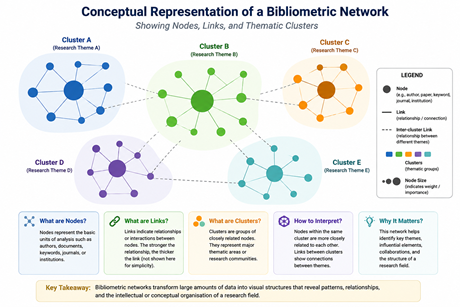
A network consists of nodes and links. Nodes represent research constituents such as authors, publications, journals, institutions, countries, or keywords, while links represent relationships among them. Depending on the type of bibliometric technique employed, these relationships may represent citations, co-citations, shared references, keyword co-occurrences, or collaborative partnerships.
Network analysis enables researchers to move beyond individual publications and examine the broader structure of scientific knowledge. By analyzing the connections among research constituents, it becomes possible to identify influential actors, major research themes, collaboration patterns, and intellectual foundations within a field.
Understanding Bibliometric Networks
In bibliometric studies, different techniques generate different types of networks:
- Citation analysis produces citation networks.
- Co-citation analysis generates co-citation networks.
- Bibliographic coupling creates coupling networks.
- Co-word analysis develops keyword networks.
- Co-authorship analysis produces collaboration networks.
Each network provides a different perspective on a research field and helps answer specific research questions regarding influence, intellectual structure, conceptual development, or social interactions.
For example, a co-authorship network reveals how researchers collaborate, whereas a co-word network illustrates how concepts and topics are related within the literature.
Network Visualization
While numerical indicators provide valuable information, visual representations often make complex relationships easier to interpret. Network visualization transforms bibliometric data into graphical maps where nodes and links visually represent scientific relationships.
In a typical network map:
- Larger nodes usually indicate greater importance or influence.
- Stronger links represent stronger relationships.
- Closely connected nodes tend to form clusters.
- Different clusters often represent distinct research themes or communities.
These visualizations allow researchers to quickly identify dominant areas of research, influential contributors, and relationships that may be difficult to detect through traditional literature reviews.
Identifying Clusters and Research Structures
One of the most important advantages of network visualization is its ability to reveal clusters. Clusters are groups of closely related nodes that emerge because of strong relationships among publications, authors, or keywords.
These clusters help researchers identify:
- Major research themes.
- Intellectual schools of thought.
- Collaboration communities.
- Emerging research areas.
- Conceptual structures within a field.
By examining cluster formation, researchers can better understand how knowledge is organized and how different research topics are interconnected.
The Role of Visualization in Science Mapping
Donthu et al. (2021) emphasize that visualization is particularly valuable because it simplifies the interpretation of complex bibliometric relationships. Large datasets containing hundreds or thousands of publications can be difficult to analyze through tables alone. Visual maps provide an efficient way to explore scientific knowledge structures and communicate findings to a broader audience.
As a result, network visualization has become one of the most widely used components of bibliometric research. It helps researchers transform large amounts of publication data into meaningful representations of scientific development, enabling a deeper understanding of how research fields evolve over time.
Why Network Analysis Matters
Network analysis and visualization provide the foundation for modern science mapping. They allow researchers to identify not only who contributes to a field but also how researchers, publications, concepts, and institutions are connected. By revealing the intellectual, conceptual, and social structures of scientific knowledge, network analysis helps researchers gain a comprehensive understanding of the evolution and organization of a research domain.
In essence, network analysis transforms bibliometric data into visual knowledge maps, making it possible to explore the hidden structures that shape scientific research and knowledge development.
Common Tools Used in Bibliometric Studies
As bibliometric analysis has grown in popularity, specialized software tools have been developed to help researchers manage, analyze, and visualize large volumes of bibliographic data. These tools simplify the implementation of performance analysis and science mapping techniques, allowing researchers to explore complex relationships among publications, authors, institutions, journals, and keywords.
According to Donthu et al. (2021), bibliometric studies increasingly rely on dedicated software applications capable of processing large datasets obtained from scientific databases such as Scopus and Web of Science. These tools support various bibliometric techniques including citation analysis, co-citation analysis, bibliographic coupling, co-word analysis, and co-authorship analysis.
Bibliometrix
Bibliometrix is an open-source package developed within the R environment for comprehensive bibliometric analysis. It provides researchers with a wide range of analytical functions for data importing, performance analysis, science mapping, and visualization.
One of its key advantages is the ability to conduct complete bibliometric workflows within a single analytical environment. Researchers can perform data cleaning, descriptive analysis, network construction, and visualization using standardized procedures.
VOSviewer
VOSviewer is one of the most widely used software tools for bibliometric visualization. It is specifically designed for constructing and visualizing bibliometric networks based on citations, co-citations, bibliographic coupling, keyword co-occurrence, and co-authorship relationships.
A major strength of VOSviewer is its ability to generate intuitive network maps that help researchers identify clusters, relationships, and research structures within large datasets. These visualizations make it easier to interpret complex bibliometric patterns and communicate findings effectively.
Choosing the Right Tool
The choice of software depends on the objectives of the study and the type of analysis being performed. Some researchers use a single tool throughout the entire workflow, while others combine multiple tools to take advantage of different analytical and visualization capabilities.
Regardless of the software selected, the ultimate goal remains the same: to transform bibliographic data into meaningful insights about research performance, knowledge structures, and the evolution of scientific fields.
As emphasized by Donthu et al. (2021), software tools are not a substitute for sound research design. Effective bibliometric studies depend on appropriate research questions, high-quality data, and careful interpretation of results. The software simply provides the means to implement and visualize the analytical techniques that underpin bibliometric research.
Step-by-Step Workflow for Conducting a Bibliometric Analysis
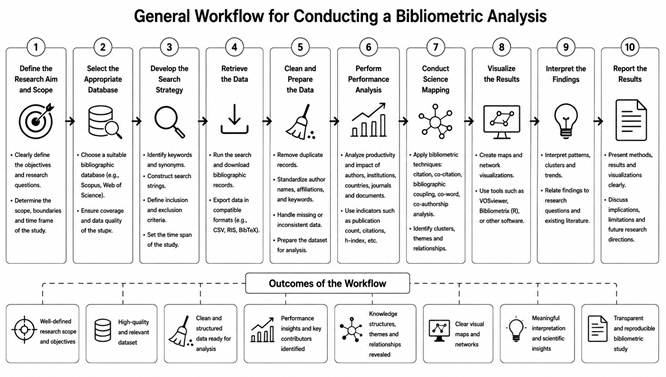
Conducting a bibliometric analysis involves more than simply collecting publications and generating visualizations. According to Donthu et al. (2021), a successful bibliometric study requires a systematic and well-structured workflow that ensures the reliability, transparency, and reproducibility of results. The process generally begins with defining the research objective and ends with interpreting and reporting the findings.
The authors propose a structured approach that guides researchers from data collection to knowledge interpretation.
Step 1: Define the Research Aim and Scope
The first step is to clearly establish the purpose of the bibliometric study. Researchers must determine what they want to investigate and why the analysis is being conducted.
Typical objectives may include:
- Evaluating the development of a research field.
- Identifying influential authors and publications.
- Exploring collaboration patterns.
- Mapping knowledge structures.
- Discovering emerging research themes.
A clearly defined objective helps determine the appropriate data source, search strategy, analytical techniques, and interpretation framework.
Step 2: Select the Appropriate Database
Once the research objective is established, the next step is selecting a suitable bibliographic database. The quality of a bibliometric study depends heavily on the quality and coverage of the underlying data.
Researchers must choose databases that provide reliable bibliographic information, including:
- Authors
- Titles
- Abstracts
- Keywords
- Affiliations
- References
- Citation information
The selected database should adequately represent the research field being investigated and provide sufficient metadata for subsequent analyses.
Read more: CMIP7 Climate Modeling
Step 3: Develop the Search Strategy
After selecting a database, researchers must design a search strategy that accurately captures the relevant literature.
This step involves:
- Identifying appropriate keywords.
- Defining search strings.
- Establishing inclusion criteria.
- Establishing exclusion criteria.
- Determining the study period.
The search strategy should be transparent and reproducible so that other researchers can understand how the dataset was generated.
A well-designed search strategy is critical because it directly influences the completeness and quality of the bibliometric dataset.
Step 4: Retrieve and Clean the Data
The retrieved dataset often requires preparation before analysis. Bibliographic records may contain inconsistencies such as:
- Duplicate records.
- Variations in author names.
- Differences in institutional names.
- Missing information.
- Formatting inconsistencies.
Data cleaning is therefore an essential step that improves accuracy and ensures meaningful results. Careful preprocessing helps reduce errors that could affect network structures and performance indicators.
Step 5: Perform Performance Analysis
Once the dataset has been prepared, researchers can begin the analytical phase. Performance analysis is typically conducted first because it provides an overview of research productivity and impact.
This stage focuses on evaluating:
- Authors
- Institutions
- Countries
- Journals
- Publications
The objective is to identify the most influential contributors and understand the overall development of the research field.
Performance analysis answers questions such as:
- Who are the leading contributors?
- Which publications are most influential?
- Which countries dominate research output?
- What journals have the greatest impact?
Step 6: Conduct Science Mapping
The next stage involves science mapping, which explores relationships among research constituents.
Science mapping techniques may include:
- Citation analysis
- Co-citation analysis
- Bibliographic coupling
- Co-word analysis
- Co-authorship analysis
These techniques help reveal:
- Intellectual structures
- Conceptual structures
- Social structures
- Research clusters
- Collaboration networks
Science mapping provides a deeper understanding of how knowledge is organized and how a research field evolves over time.
Step 7: Visualize the Results
Visualization plays a crucial role in bibliometric analysis because it transforms complex relationships into interpretable knowledge maps.
Network visualizations can help researchers identify:
- Influential nodes
- Strong relationships
- Thematic clusters
- Collaboration groups
- Emerging research areas
Visual representations often make patterns easier to understand than numerical tables alone and improve communication of research findings.
Step 8: Interpret the Findings
Generating maps and indicators is only part of the process. The most important step is interpreting what the results actually mean.
Researchers must carefully analyze:
- Performance indicators.
- Network structures.
- Cluster formations.
- Knowledge relationships.
- Research trends.
Interpretation should always be linked back to the original research objectives and the broader context of the field under investigation.
Step 9: Report the Results Transparently
The final step is reporting the methodology and findings in a clear and transparent manner.
Researchers should document:
- Database selection.
- Search strategy.
- Inclusion and exclusion criteria.
- Data-cleaning procedures.
- Analytical methods.
- Visualization approaches.
Transparent reporting improves reproducibility and allows other researchers to evaluate, replicate, or extend the study.
Bringing It All Together
The workflow proposed by Donthu et al. (2021) emphasizes that bibliometric analysis is not merely a software-driven exercise but a structured research process. Each step—from defining objectives and collecting data to mapping knowledge structures and interpreting results—contributes to the overall quality of the study.
When carefully implemented, this workflow enables researchers to transform large collections of scientific publications into meaningful insights about research performance, intellectual development, conceptual evolution, and future research opportunities.
Common Mistakes Researchers Make in Bibliometric Studies
Although bibliometric analysis has become an increasingly popular research method, its effectiveness depends heavily on the quality of the research design and the careful interpretation of results. Donthu et al. (2021) emphasize that bibliometric studies should not be viewed as purely software-driven exercises. Rather, they require thoughtful planning, rigorous data preparation, and appropriate analytical choices. Several common mistakes can compromise the reliability and validity of bibliometric findings.
Poorly Defined Research Objectives
One of the most common mistakes is beginning a bibliometric study without a clearly defined research objective. Researchers sometimes collect large datasets and perform numerous analyses without establishing specific questions that the study aims to answer.
A well-designed bibliometric study should start with clear objectives that guide:
- Database selection
- Search strategy development
- Analytical method selection
- Interpretation of findings
Without a clear purpose, the resulting analyses may become descriptive rather than meaningful.
Inadequate Search Strategy
The quality of a bibliometric study largely depends on the literature retrieved during the search process. An incomplete or poorly designed search strategy may exclude important publications, leading to biased or misleading conclusions.
Common problems include:
- Using overly narrow keywords.
- Using overly broad search terms.
- Ignoring relevant synonyms.
- Applying inconsistent inclusion criteria.
- Failing to document search procedures.
Because the dataset forms the foundation of all subsequent analyses, careful search design is essential.
Using Inappropriate Databases
Another frequent issue is selecting a database that does not adequately represent the research field being investigated. Different databases vary in their coverage, indexing practices, and citation information.
Researchers should ensure that the selected database provides sufficient coverage of the literature relevant to their research objectives. Failure to do so can result in incomplete datasets and distorted interpretations of research performance and knowledge structures.
Neglecting Data Cleaning
Bibliometric datasets often contain inconsistencies that can significantly affect analytical results. Variations in author names, institutional affiliations, and publication records may fragment networks and distort performance indicators.
Examples include:
- Multiple spellings of the same author.
- Different formats for institutional names.
- Duplicate records.
- Missing metadata.
Ignoring these issues can produce misleading network structures and inaccurate conclusions. Data cleaning is therefore a critical step that should never be overlooked.
Overreliance on Citation Counts
Citation-based indicators are widely used in bibliometric studies, but they should not be interpreted as the sole measure of research quality or impact. High citation counts may reflect visibility and influence, but they do not necessarily indicate scientific quality.
Donthu et al. (2021) highlight the importance of using bibliometric indicators carefully and interpreting them within the broader context of the research field. Citation metrics should be viewed as indicators of influence rather than absolute measures of excellence.
Misinterpreting Network Visualizations
Network maps are powerful tools for understanding scientific relationships, but they can also be misunderstood if interpreted superficially. Researchers sometimes focus solely on visual appearance without examining the underlying relationships and analytical context.
For example:
- Large nodes do not automatically imply scientific superiority.
- Clusters require careful interpretation.
- Network structures should be linked to substantive research themes.
- Visual patterns should be supported by analytical evidence.
Effective interpretation requires both methodological understanding and subject-matter expertise.
Focusing on Software Rather Than Methodology
The growing availability of bibliometric software has made analysis more accessible, but it has also created a misconception that software alone can produce meaningful research outcomes.
Tools such as Bibliometrix and VOSviewer can generate networks and indicators efficiently; however, they do not replace sound research design. Researchers must still make informed decisions regarding:
- Research questions.
- Data collection.
- Analytical techniques.
- Interpretation of results.
The quality of a bibliometric study ultimately depends on the researcher’s methodological choices rather than the software used.
Reporting Results Without Transparency
Transparency is a fundamental requirement for reproducible research. Bibliometric studies should clearly document:
- Data sources.
- Search queries.
- Inclusion and exclusion criteria.
- Data-cleaning procedures.
- Analytical methods.
Insufficient methodological reporting makes it difficult for other researchers to evaluate, replicate, or extend the study.
Treating Bibliometric Analysis as a Substitute for Literature Review
A final misconception is assuming that bibliometric analysis can completely replace traditional literature reviews. While bibliometric methods are highly effective for identifying patterns, trends, and structures within large datasets, they do not provide the detailed contextual understanding obtained through reading and critically evaluating individual studies.
Donthu et al. (2021) emphasize that bibliometric analysis should complement, rather than replace, traditional scholarly inquiry. The most meaningful insights often emerge when quantitative bibliometric findings are combined with qualitative interpretation.
Key Takeaway
Most problems in bibliometric studies arise not from the analytical techniques themselves but from weaknesses in research design, data preparation, and interpretation. By carefully defining objectives, constructing robust datasets, cleaning data thoroughly, selecting appropriate methods, and reporting procedures transparently, researchers can ensure that bibliometric analysis produces reliable and meaningful insights into the structure and evolution of scientific knowledge.
| Common Mistake | Potential Consequence |
|---|---|
| Unclear research objectives | Unfocused analysis and weak conclusions |
| Poor search strategy | Incomplete or biased dataset |
| Inappropriate database selection | Limited literature coverage |
| Lack of data cleaning | Distorted networks and indicators |
| Overreliance on citation counts | Misleading impact assessment |
| Misinterpretation of visualizations | Incorrect conclusions about research structures |
| Excessive focus on software | Weak methodological foundation |
| Poor reporting transparency | Reduced reproducibility |
| Ignoring qualitative interpretation | Superficial understanding of the field |
Advantages and Limitations of Bibliometric Analysis
Bibliometric analysis has emerged as one of the most widely used approaches for synthesizing scientific literature and understanding the development of research fields. As highlighted by Donthu et al. (2021), its growing popularity stems from its ability to analyze large volumes of scientific publications in a systematic, objective, and reproducible manner. However, like any research method, bibliometric analysis possesses both strengths and limitations that researchers should carefully consider when designing studies and interpreting results.
Advantages of Bibliometric Analysis
Ability to Analyze Large Volumes of Literature
One of the greatest advantages of bibliometric analysis is its capacity to process and analyze large datasets containing hundreds or even thousands of publications. Traditional literature reviews often become difficult to manage as the volume of research increases, whereas bibliometric methods allow researchers to systematically examine extensive bodies of literature.
This capability is particularly valuable in rapidly growing research fields where keeping track of scientific developments can be challenging.
Objective and Quantitative Assessment
Bibliometric analysis relies on publication metadata and quantitative indicators rather than subjective interpretation alone. By using measurable information such as citations, publication counts, keywords, and collaboration links, researchers can evaluate scientific activity in a more systematic and transparent manner.
This quantitative approach helps reduce potential biases that may arise in purely narrative reviews.
Identification of Influential Contributors
Bibliometric techniques enable researchers to identify influential:
- Authors
- Institutions
- Countries
- Journals
- Publications
Such insights help reveal who contributes most significantly to a field and how scientific influence is distributed across the research community.
Understanding Knowledge Structures
Through science mapping techniques, bibliometric analysis can uncover the intellectual, conceptual, and social structures of a research domain. Researchers can identify:
- Major research themes
- Knowledge clusters
- Collaboration networks
- Research fronts
- Emerging topics
These insights are often difficult to obtain through conventional literature reviews alone.
Visualization of Scientific Knowledge
A unique strength of bibliometric analysis is its ability to transform complex publication data into visual knowledge maps. Network visualizations allow researchers to explore relationships among publications, authors, and concepts in an intuitive manner.
Visualization enhances interpretation and helps communicate research findings effectively.
Support for Strategic Research Decisions
Bibliometric studies can assist researchers, institutions, and policymakers in understanding research trends and identifying future directions. By highlighting influential topics and emerging areas, bibliometric analysis provides valuable information for research planning and decision-making.
Limitations of Bibliometric Analysis
Dependence on Database Quality
The quality of a bibliometric study depends heavily on the quality and coverage of the underlying database. If important publications are missing from the selected database, the resulting analysis may not accurately represent the research field.
Database coverage therefore plays a crucial role in determining the reliability of findings.
Sensitivity to Search Strategy
Bibliometric results are strongly influenced by the search strategy used to retrieve publications. Poor keyword selection or inappropriate inclusion criteria can lead to incomplete datasets and potentially biased conclusions.
Because the dataset forms the foundation of the analysis, careful search design is essential.
Citation-Based Limitations
Many bibliometric indicators rely on citation data. Although citations provide useful information about influence and visibility, they do not necessarily reflect the quality or significance of a publication.
Citation counts should therefore be interpreted cautiously and within the broader context of the research field.
Data Quality Issues
Bibliometric datasets often contain inconsistencies that can affect analytical results. Problems such as:
- Author name variations
- Institutional name inconsistencies
- Duplicate records
- Missing information
can distort networks and performance indicators if not properly addressed during data cleaning.
Limited Contextual Understanding
While bibliometric analysis is highly effective for identifying patterns and relationships, it does not provide detailed insight into the content, methodology, or scientific quality of individual studies.
For example, a bibliometric map may reveal that two publications are strongly connected, but it cannot fully explain the scientific reasons behind that relationship without further qualitative investigation.
Interpretation Challenges
Network maps and bibliometric indicators require careful interpretation. Visual patterns and numerical measures may appear straightforward, but meaningful conclusions depend on understanding both the analytical techniques and the research context.
Without proper interpretation, researchers may oversimplify complex scientific relationships.
Balancing Strengths and Limitations
Donthu et al. (2021) emphasize that bibliometric analysis should not be viewed as a standalone substitute for traditional scholarly inquiry. Instead, it should be regarded as a complementary method that provides a broad overview of scientific knowledge while supporting deeper investigation through qualitative assessment.
When combined with careful research design, transparent methodology, and thoughtful interpretation, bibliometric analysis offers a powerful framework for exploring the evolution, structure, and impact of scientific research. At the same time, researchers must remain aware of its limitations and avoid treating bibliometric indicators as definitive measures of scientific quality or importance.
Key Takeaway
Bibliometric analysis is a powerful method for exploring large bodies of scientific literature, identifying influential contributors, and mapping knowledge structures. However, its effectiveness depends on high-quality data, robust search strategies, and careful interpretation. Understanding both its strengths and limitations enables researchers to use bibliometric methods more effectively and responsibly.
| Advantages | Limitations |
|---|---|
| Analyzes large volumes of literature | Dependent on database coverage |
| Objective and quantitative approach | Sensitive to search strategy |
| Identifies influential contributors | Citation metrics have limitations |
| Reveals knowledge structures | Data-quality issues may affect results |
| Produces intuitive visualizations | Limited contextual understanding |
| Supports research planning | Requires careful interpretation |
| Enhances transparency and reproducibility | Cannot replace detailed literature evaluation |
Final Thoughts
In an era characterized by an unprecedented growth of scientific literature, researchers face the challenge of not only keeping pace with new knowledge but also understanding how research fields evolve over time. Bibliometric analysis has emerged as a powerful solution to this challenge by providing systematic, quantitative, and reproducible methods for exploring scientific publications and their relationships.
As discussed throughout this article, bibliometric analysis extends beyond simple publication counting. Through performance analysis, researchers can evaluate the productivity and impact of authors, institutions, countries, journals, and publications. Through science mapping, they can uncover the intellectual, conceptual, and social structures that shape a research field. Together, these approaches provide a comprehensive understanding of how scientific knowledge is produced, connected, and developed.
The increasing availability of large bibliographic databases and specialized analytical tools has further strengthened the role of bibliometric analysis in modern research. By combining quantitative indicators with network visualization techniques, researchers can identify influential contributors, discover emerging research themes, explore collaboration patterns, and reveal hidden knowledge structures that may not be apparent through traditional literature reviews.
However, bibliometric analysis should not be viewed as a purely technical or software-driven exercise. The quality of a bibliometric study ultimately depends on well-defined research objectives, robust data collection strategies, careful data preparation, appropriate analytical methods, and thoughtful interpretation of results. Bibliometric indicators and visualizations provide valuable insights, but they must always be interpreted within the broader context of the research field.
As emphasized by Donthu et al. (2021), bibliometric analysis serves as a complementary approach to traditional literature reviews rather than a replacement for them. While it excels at revealing patterns, trends, and relationships within large bodies of literature, meaningful scientific understanding still requires critical evaluation and domain expertise.
For researchers, especially those entering a new field, bibliometric analysis offers an effective pathway for understanding the research landscape, identifying influential studies, recognizing emerging opportunities, and developing informed research agendas. As scientific knowledge continues to expand, bibliometric methods will play an increasingly important role in helping scholars navigate complex research environments and make sense of the ever-growing volume of academic literature.
Ultimately, bibliometric analysis can be viewed as a tool for understanding the structure and evolution of science itself. By transforming publication data into meaningful insights, it enables researchers to move beyond individual studies and gain a broader perspective on how knowledge develops, connects, and advances over time.
Source: Donthu, N., Kumar, S., Mukherjee, D., Pandey, N., & Lim, W. M. (2021). How to conduct a bibliometric analysis: An overview and guidelines. Journal of Business Research, 133, 285–296. https://doi.org/10.1016/j.jbusres.2021.04.070

One thought on “How to Conduct a Bibliometric Analysis: A Practical Guide for PhD Scholars and Researchers”