
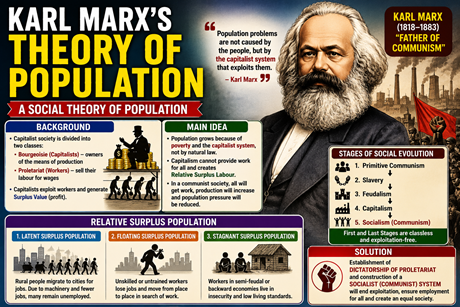
Karl Marx’s Theory of Population (Social Theory of Population)
Introduction
Karl Marx (1818–1883), widely known as the “Father of Communism,” was a German philosopher, economist, sociologist, and political thinker. In contrast to Thomas Robert Malthus, who regarded population growth as the primary cause of poverty and resource scarcity, Marx argued that social and economic inequalities created by the capitalist system were the real causes of poverty, unemployment, and social distress.
Marx’s population theory is often referred to as the Social Theory of Population because it emphasizes social, economic, and political factors rather than biological or natural laws. His approach is also known as Historical Determinism, as it explains population issues within the broader context of historical and economic development.
Background of Marx’s Population Theory
Karl Marx was a strong critic of capitalism. According to him, capitalist society is divided into two major classes:
- The Capitalist or Bourgeois Class – the wealthy owners who control the means of production, including land, factories, machinery, and capital.
- The Proletariat or Working Class – the labourers who possess no means of production and are compelled to sell their labour in exchange for wages.
Marx argued that capitalists continuously exploit workers in order to maximize profits. He described this profit as Surplus Value, which represents the difference between the value created by workers and the wages paid to them.
The working class, on the other hand, remains economically dependent and often lives under poor social and economic conditions. This exploitation forms the foundation of Marx’s analysis of population problems.
Main Proposition of Marx’s Population Theory
According to Marx, population growth is not the fundamental cause of poverty, unemployment, or social distress. Rather, these problems arise from the unequal distribution of wealth and resources within a capitalist economy.
Marx argued that poor families often have more children because they view them as potential contributors to household income and future economic security. Therefore, population growth is a consequence of poverty rather than its cause.
He further maintained that capitalism creates unemployment by generating a condition known as Relative Surplus Labour, where the supply of labour exceeds the available employment opportunities. Consequently, unemployment and poverty are products of the capitalist system rather than excessive population growth.
Unlike Malthus, Marx rejected the idea that population growth follows any universal natural law. He viewed population change as a social and economic phenomenon shaped by the prevailing mode of production.
Marx believed that under a Communist System, resources and employment opportunities could be distributed more equitably, allowing society to utilize its labour force effectively. As a result, poverty, unemployment, and population pressure would gradually diminish.
Relative Surplus Population
One of Marx’s most important contributions to population theory is the concept of Relative Surplus Population. According to him, capitalism creates different forms of surplus labour for the benefit of the capitalist class.
i) Latent Surplus Population
Latent surplus population is commonly found during the early stages of capitalist development. Large numbers of people migrate from rural areas to urban industrial centres in search of employment. However, due to technological advancement and mechanization, industries require fewer workers than expected. As a result, many workers remain unemployed or underemployed, forming a latent surplus population.
ii) Floating Surplus Population
In capitalist economies, workers who lack the skills necessary to operate modern machinery are often dismissed from their jobs. These displaced workers continuously move from one place to another in search of employment opportunities. Marx referred to this group as the Floating Surplus Population.
iii) Stagnant Surplus Population
Stagnant surplus population is commonly found in societies where capitalist and semi-feudal economic systems coexist. Workers in such societies are forced to accept irregular employment, low wages, and poor working conditions. They possess little economic security and limited bargaining power. Marx described this group as the Stagnant Surplus Population.
Karl Marx’s Stages of Social Evolution
Marx believed that society evolves through a series of historical stages driven by changes in productive forces and production relations. He identified five major stages of social development:
- Primitive Communism
- Slavery
- Feudalism
- Capitalism
- Socialism
According to Marx, social transformation occurs through the dialectical interaction between productive forces and social relations. The first stage (Primitive Communism) and the final stage (Socialism/Communism) are classless and exploitation-free societies. The intermediate stages are characterized by class divisions and exploitation arising from economic inequality.
Solution Proposed by Marx
Marx argued that the only effective solution to the problems created by capitalism was the establishment of the Dictatorship of the Proletariat. Under this system, political and economic power would be transferred from the capitalist class to the working class.
According to Marx, the overthrow of capitalism would create a new economic foundation based on collective ownership of resources and social equality. He believed that a socialist system would eliminate exploitation, reduce unemployment, improve living standards, and enable the productive utilization of the labour force.
Thus, unlike Malthus, who advocated population control as a solution to poverty, Marx regarded social and economic transformation as the key to resolving population-related problems.
Conclusion
Karl Marx’s Theory of Population presents a fundamentally different perspective from the Malthusian view of population growth. While Malthus considered excessive population growth to be the primary cause of poverty, unemployment, and resource scarcity, Marx argued that these problems arise from the inequalities and exploitative nature of the capitalist economic system. According to Marx, unemployment and poverty are not the consequences of overpopulation but rather the result of the creation of a relative surplus population through capitalist production and the unequal distribution of wealth and resources.
Marx emphasized that social and economic structures play a decisive role in shaping population dynamics. His concepts of surplus value, class conflict, and relative surplus labour highlight how economic systems influence employment opportunities and living standards. He further argued that a socialist society, based on collective ownership and equitable distribution of resources, could effectively utilize the labour force and reduce social inequalities.
In the modern world, Marx’s theory continues to hold relevance in discussions of economic inequality, labour exploitation, unemployment, income disparity, and social justice. Although many of his predictions regarding the inevitable collapse of capitalism have not been fully realized, his analysis of class relations and economic inequality remains influential in sociology, economics, human geography, and development studies. The growing concerns over wealth concentration, precarious employment, automation, and labour market insecurity in the twenty-first century have renewed interest in Marx’s ideas, making his population theory an important framework for understanding the relationship between population, labour, and economic systems in contemporary society.

One thought on “Karl Marx’s Theory of Population: Social Theory, Relative Surplus Population and Marxian Perspective”